
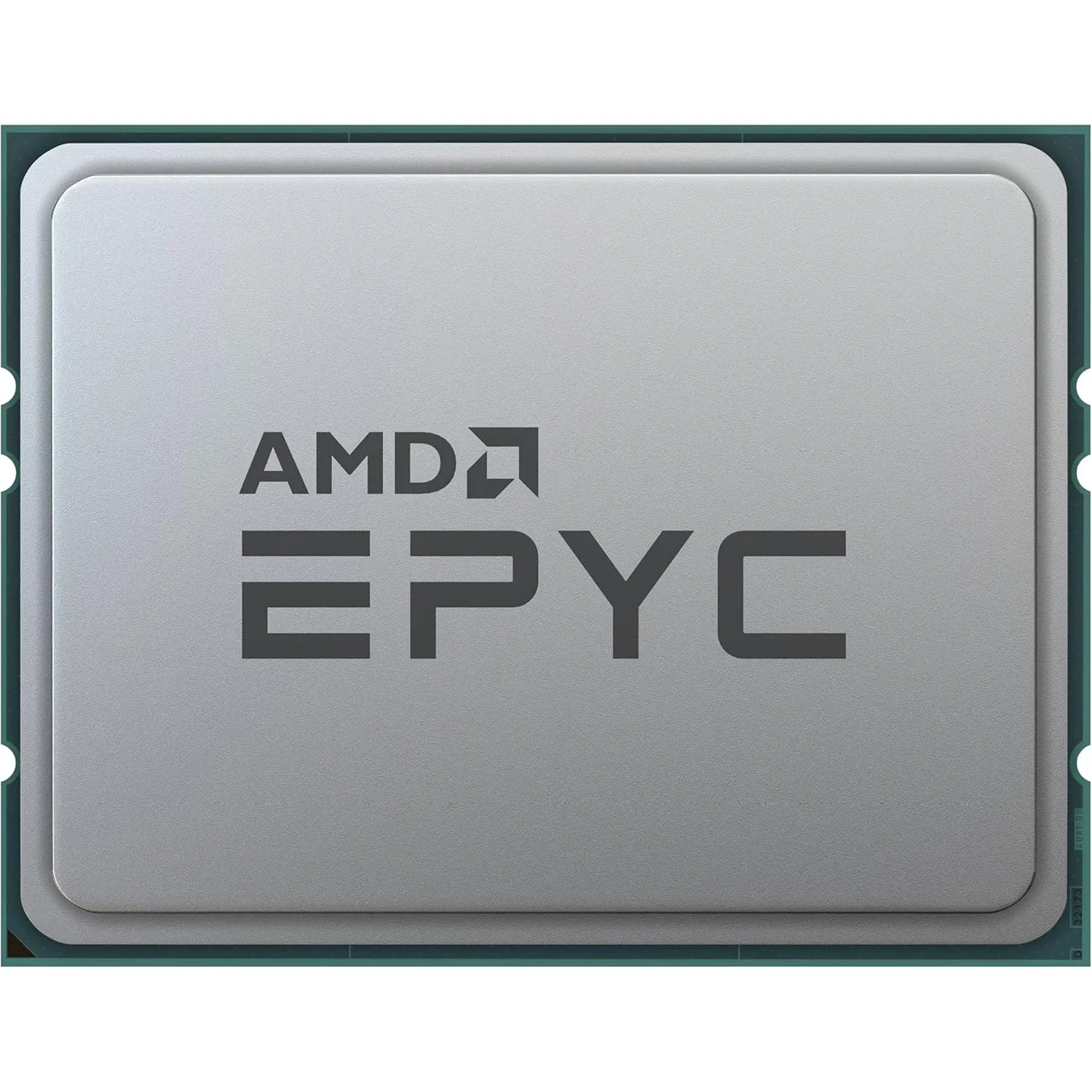
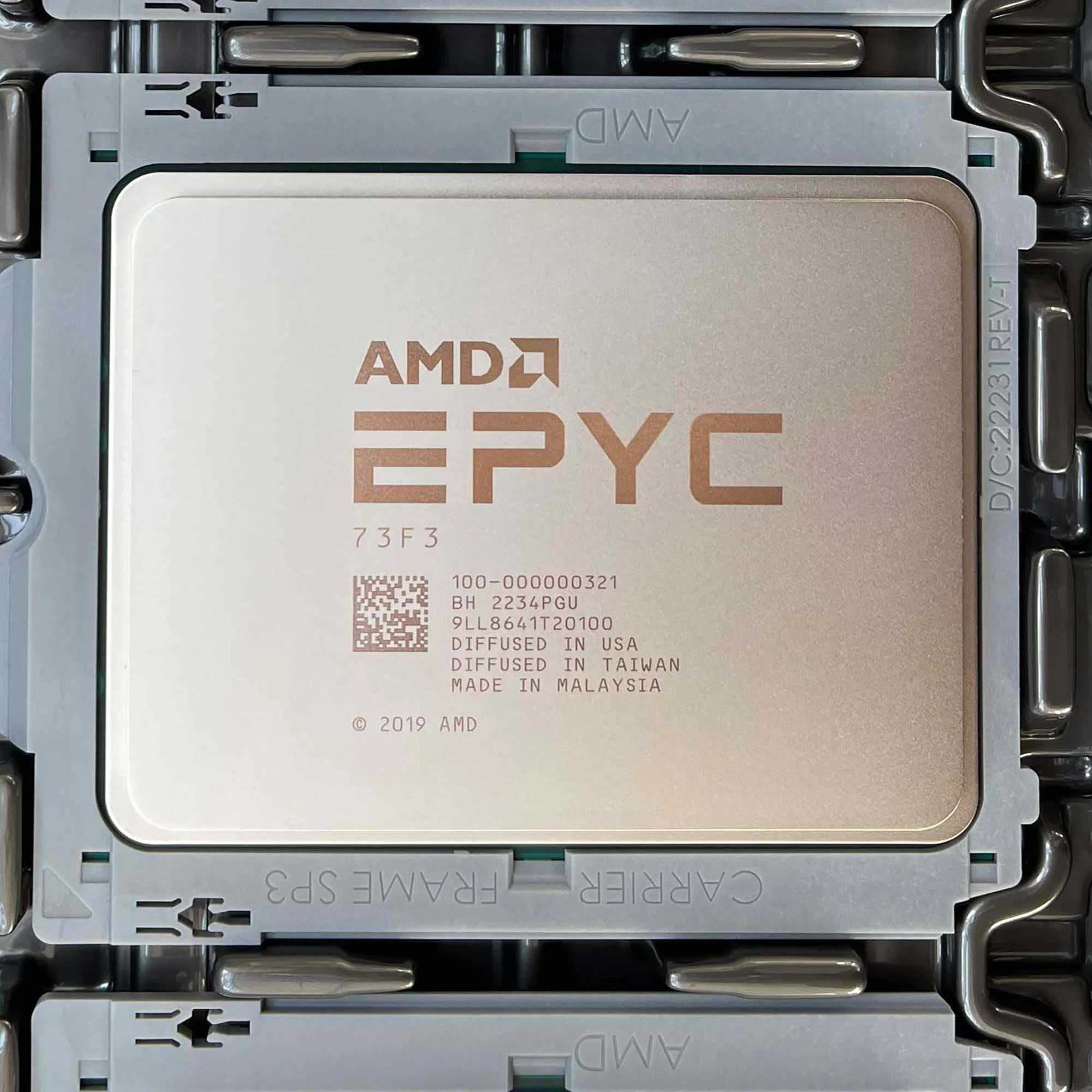
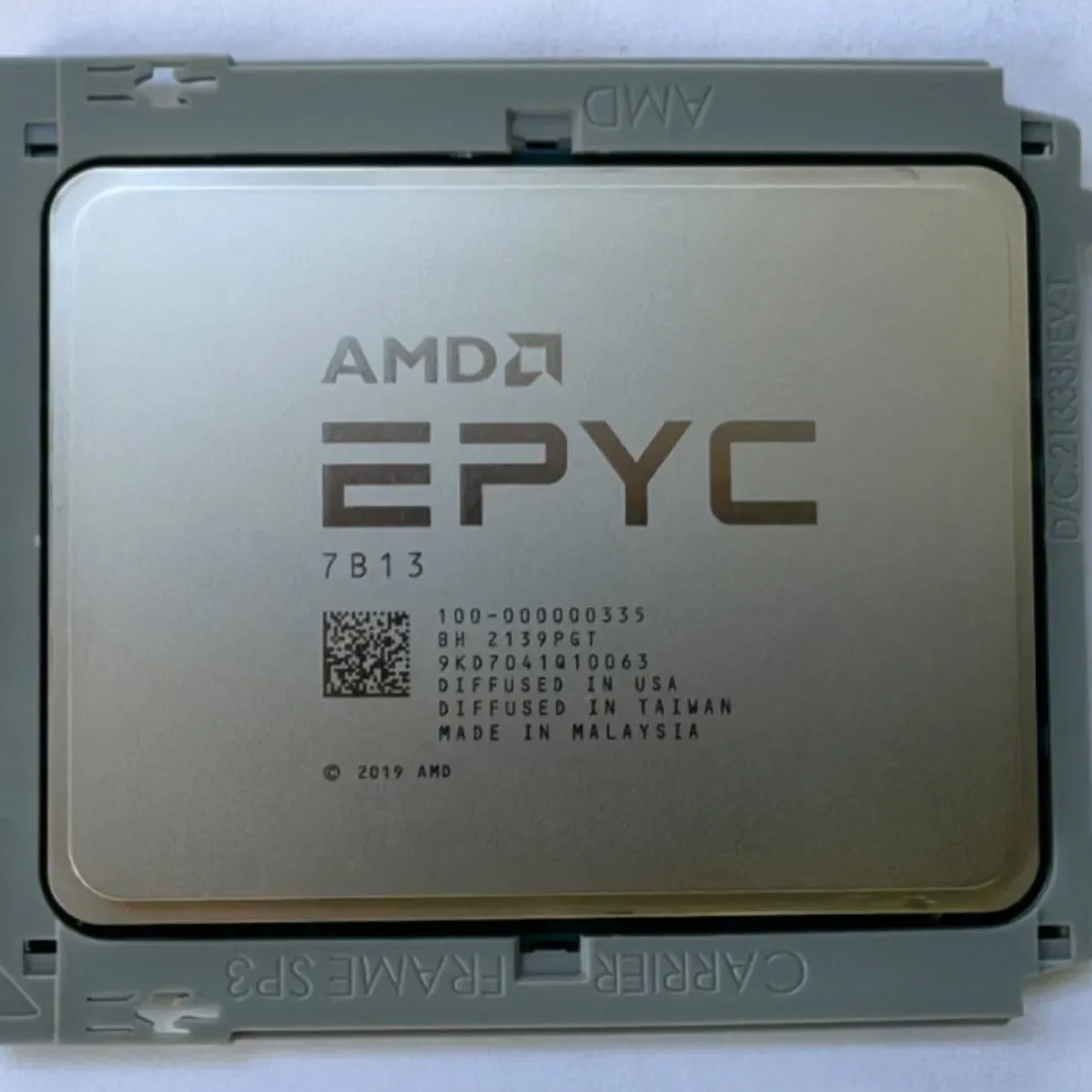
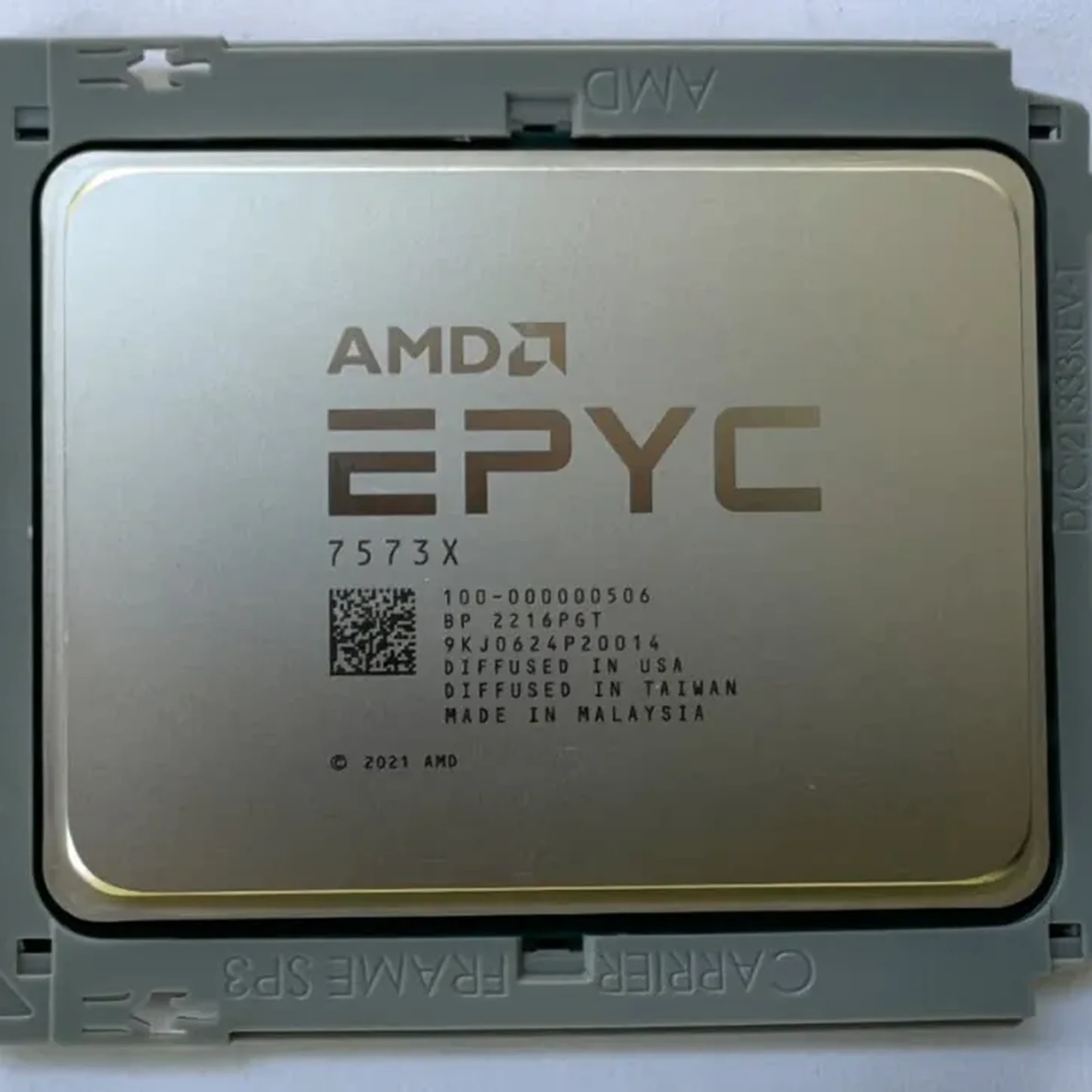
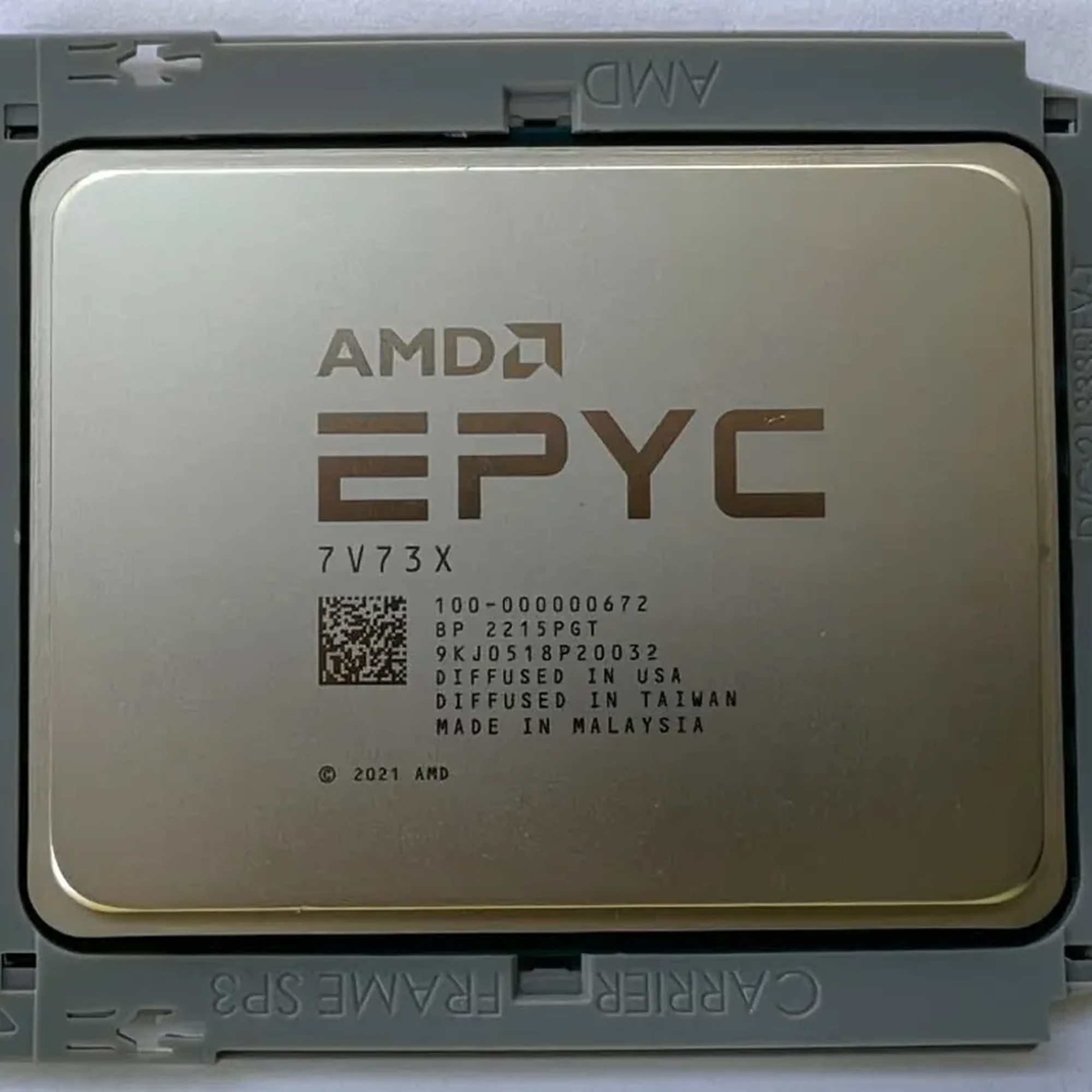
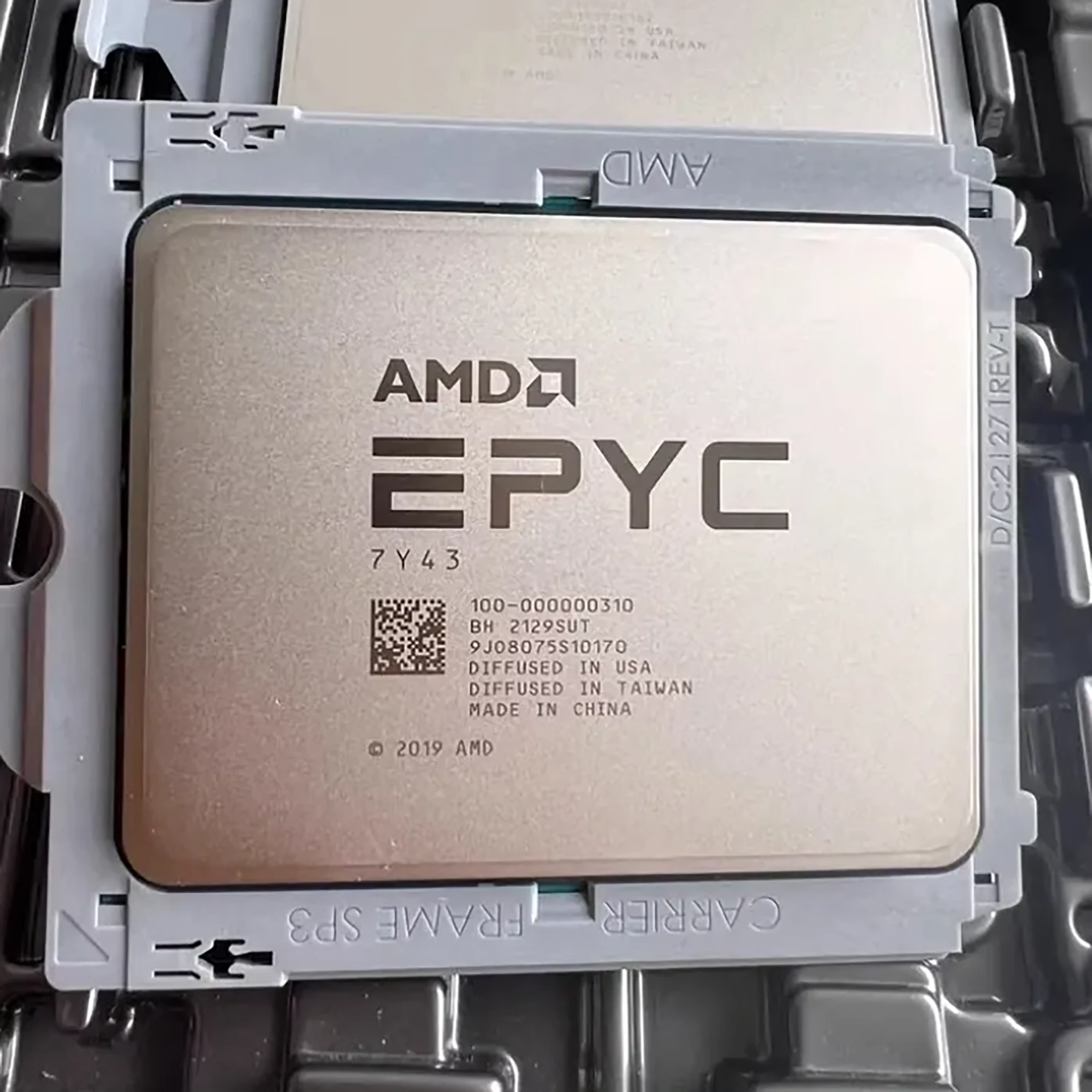
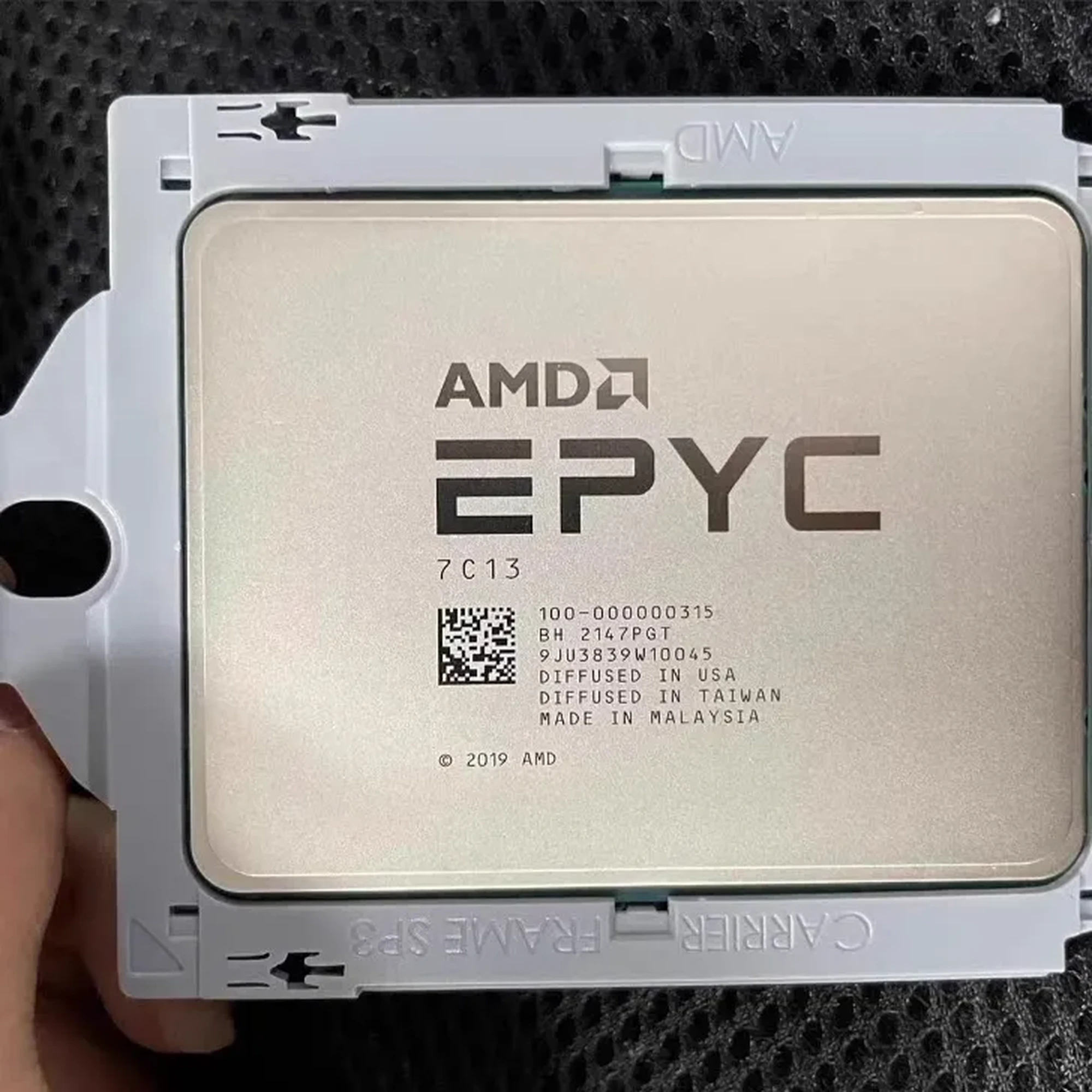

AMD EPYC 73F3 Server Processor | 16 Cores, 32 Threads, 7nm Zen 3, 4.0GHz Max Boost, 256MB L3 Cache, 240W TDP – High-Performance for HPC & Enterprise Workloads
| Specification | Details |
|---|---|
| Processor Model | AMD EPYC 73F3 |
| Series | AMD EPYC 7003 (Milan) Series |
| Microarchitecture | Zen 3 |
| Manufacturing Process | 7nm+ |
| Cores | 16 Physical Cores |
| Threads | 32 Threads (SMT Supported) |
| Base Clock Speed | 3.5GHz |
| Max Boost Clock Speed | 4.0GHz |
| L1 Cache | 1MB (Total) |
| L2 Cache | 8MB (Total) |
| L3 Cache | 256MB (Total) |
| TDP (Thermal Design Power) | 240W |
| Configurable TDP (cTDP) | 225-240W |
| Memory Support | 8-Channel DDR4-3200 MT/s |
| Max Memory Capacity | 4TB per Socket |
| Memory Bandwidth | 204.8 GB/s per Socket |
| PCIe Version | PCIe 4.0 |
| PCIe Lanes | 128 Lanes per Socket |
| Socket Type | SP3 |
| Socket Configuration | 1P (Single-Socket) / 2P (Dual-Socket) Supported |
| Launch Date | March 15, 2021 |
| Launch Price (1KU) | $3521 USD |
| Product ID (Tray) | 100-000000321 |
| Supported Technologies | AMD Infinity Guard, AMD Infinity Architecture, AMD Sensemi, SMT, ECC Memory Support |
| Workload Affinity | EDA, High-Speed Data Management (NR|RDBMS), Per Core CAE|CFD|FEA |
| Geekbench 6 Single-Core Score | 1051 |
| Geekbench 6 Multi-Core Score | 5712 |
In the competitive landscape of enterprise server processors, the AMD EPYC 73F3 stands out as a high-performance, purpose-built solution designed to meet the demands of latency-sensitive and cache-dependent workloads. Launched on March 15, 2021, as part of AMD’s EPYC 7003 (Milan) series, the EPYC 73F3 leverages the power of the 7nm Zen 3 microarchitecture to deliver exceptional single-threaded and multi-threaded performance, making it a top choice for data centers, high-performance computing (HPC) environments, financial modeling, and enterprise-grade applications that require a balance of speed, cache, and reliability.
Key Architecture & Core Performance
At the heart of the AMD EPYC 73F3 is the Zen 3 microarchitecture, a significant upgrade over its Zen 2 predecessor, which introduced a unified 8-core CCX (Core Complex) design. This architectural enhancement eliminates the need for cross-CCX data access, reducing latency and improving cache efficiency—critical factors for workloads that rely heavily on fast data retrieval. The EPYC 73F3 features 16 physical cores and 32 threads, thanks to AMD’s Simultaneous Multithreading (SMT) technology, which allows each core to handle two threads simultaneously, maximizing throughput for multi-threaded applications.
With a base clock speed of 3.5GHz and a maximum boost clock of 4.0GHz, the EPYC 73F3 delivers consistent high performance across both single-threaded and multi-threaded tasks. The 4.0GHz max boost is particularly valuable for latency-sensitive workloads, such as electronic design automation (EDA), computational fluid dynamics (CFD), finite element analysis (FEA), and high-speed data management (NR|RDBMS), where even small improvements in clock speed can translate to significant gains in productivity and efficiency. According to Geekbench 6 benchmarks, the EPYC 73F3 achieves a single-core score of 1051 and a multi-core score of 5712, placing it among the top-performing 16-core server processors in its class.
Cache & Memory Performance
One of the most distinguishing features of the AMD EPYC 73F3 is its substantial cache configuration, which sets it apart from many competitors in its segment. The processor boasts 1MB of L1 cache, 8MB of L2 cache, and an impressive 256MB of L3 cache—double the L3 cache of its close relative, the AMD EPYC 7343. This large L3 cache is a game-changer for cache-sensitive applications, as it provides a larger pool of high-speed memory for frequently accessed data, reducing the need to access slower system memory and minimizing latency. For databases, HPC workloads, and EDA tools, which rely on fast data access to process large datasets, the 256MB L3 cache ensures that critical data remains readily available, significantly improving overall performance.
In terms of memory support, the EPYC 73F3 features 8-channel DDR4 memory support, with a maximum memory speed of 3200 MT/s. This high memory bandwidth—up to 204.8 GB/s per socket—ensures that the processor can efficiently handle large volumes of data, making it ideal for memory-intensive tasks like data analytics, virtualization, and large-scale database operations. The processor also supports up to 4TB of memory per socket, providing ample capacity for enterprise applications that require significant memory resources. Additionally, the EPYC 73F3 supports ECC memory, which is essential for server environments where data integrity is critical, as it detects and corrects memory errors to prevent system crashes and data corruption.
Power Efficiency & Thermal Management
The AMD EPYC 73F3 has a Thermal Design Power (TDP) of 240W, with a configurable TDP (cTDP) range of 225-240W, allowing data center administrators to balance performance and power consumption based on their specific needs. While its TDP is higher than the 190W TDP of the EPYC 7343, the EPYC 73F3’s higher clock speeds and larger cache justify the increased power draw for workloads that prioritize peak performance over energy efficiency. AMD’s Sensemi technology further enhances power efficiency by dynamically adjusting clock speeds and voltage based on workload demand, ensuring that the processor only uses the power necessary to complete the task at hand.
Thermal management is a critical consideration for server processors, and the EPYC 73F3 is designed to operate reliably even in dense data center environments. The processor uses AMD’s advanced thermal solution, which works in tandem with server cooling systems to maintain optimal operating temperatures. This ensures consistent performance under heavy loads and extends the lifespan of the processor, reducing downtime and maintenance costs for data center operators.
Connectivity & Expansion
The AMD EPYC 73F3 supports PCIe 4.0 technology, offering 128 PCIe 4.0 lanes per socket. PCIe 4.0 provides double the bandwidth of PCIe 3.0, delivering faster data transfer speeds between the processor and peripheral devices such as storage controllers, network adapters, and GPUs. This high-speed connectivity is essential for modern data centers, where fast access to storage and networking resources is critical for supporting high-performance workloads. The 128 PCIe 4.0 lanes also provide ample expansion capacity, allowing data center administrators to configure the server with a wide range of peripherals to meet their specific application needs.
The processor is compatible with the SP3 socket and supports both 1P (single-socket) and 2P (dual-socket) configurations, providing flexibility for data center scaling. In dual-socket configurations, the EPYC 73F3 can leverage AMD’s Infinity Fabric technology to connect two processors, enabling seamless communication and shared memory access, which is ideal for large-scale HPC clusters and enterprise applications that require additional processing power.
Supported Technologies & Workload Affinity
The AMD EPYC 73F3 comes equipped with a range of advanced technologies designed to enhance performance, security, and manageability. AMD Infinity Guard, a suite of security features, provides hardware-level protection against common cyber threats, including memory tampering and data encryption, ensuring that sensitive enterprise data remains secure. AMD Infinity Architecture, meanwhile, enables high-speed communication between processor cores, cache, and memory, further reducing latency and improving overall system performance.
The processor is optimized for specific workloads, including EDA, high-speed data management (NR|RDBMS), and per-core CAE|CFD|FEA applications, making it a versatile choice for a wide range of enterprise use cases. For financial institutions, the EPYC 73F3’s high clock speeds and large cache make it ideal for financial modeling and risk analysis, where fast processing of complex algorithms is essential. For gaming servers, the processor’s multi-threaded performance ensures smooth gameplay for multiple users simultaneously, while its low latency delivers a responsive gaming experience.
Pricing & Value Proposition
At launch, the AMD EPYC 73F3 had a manufacturer’s suggested retail price (MSRP) of $3521 for a single unit (1KU pricing), positioning it as a premium option for high-performance server environments. While its price point is higher than some general-purpose server processors, the EPYC 73F3’s exceptional performance, large cache, and high clock speeds make it a cost-effective choice for workloads that require peak performance. For organizations that rely on latency-sensitive and cache-dependent applications, the EPYC 73F3 delivers a significant return on investment by reducing processing time, improving productivity, and minimizing downtime.
When compared to similar processors in its class, such as the Intel Xeon E5-2643 v4, the EPYC 73F3 offers superior multi-threaded performance, with a Geekbench multi-core score of 5712 compared to the Xeon E5-2643 v4’s score of 5773 (a negligible difference), while offering a higher base clock speed and larger cache. This makes the EPYC 73F3 a more attractive option for organizations looking to upgrade their server infrastructure to handle modern enterprise workloads.
Real-World Applications & Use Cases
The AMD EPYC 73F3 is well-suited for a wide range of enterprise and data center applications, thanks to its high performance, large cache, and flexible configuration options. Some of the most common use cases include:
- High-Performance Computing (HPC): The EPYC 73F3’s high clock speeds, large cache, and multi-threaded performance make it ideal for HPC workloads such as CFD, FEA, and scientific computing, where fast processing of complex simulations is critical.
- Databases & Data Management: The 256MB L3 cache and high memory bandwidth of the EPYC 73F3 ensure fast data access for databases, making it suitable for high-speed data management (NR|RDBMS) and data analytics applications.
- Electronic Design Automation (EDA): EDA tools require high single-threaded performance and fast cache access to process complex circuit designs, making the EPYC 73F3 an excellent choice for semiconductor and electronics design companies.
- Financial Modeling & Risk Analysis: Financial institutions rely on fast processing of complex algorithms for risk analysis, portfolio management, and trading platforms, which the EPYC 73F3 delivers with its high clock speeds and multi-threaded performance.
- Gaming Servers: The EPYC 73F3’s 16 cores and 32 threads provide ample processing power for gaming servers, supporting multiple concurrent users while maintaining low latency for a responsive gaming experience.
- Virtualization & Cloud Computing: While the EPYC 73F3 is optimized for high-performance workloads, its multi-threaded performance and large memory support also make it suitable for virtualization and cloud computing environments, where multiple virtual machines (VMs) can run simultaneously without sacrificing performance.
Conclusion
The AMD EPYC 73F3 Server Processor is a high-performance, feature-rich solution designed to meet the demands of modern enterprise and data center workloads. Built on the 7nm Zen 3 microarchitecture, it offers 16 cores, 32 threads, a 3.5GHz base clock, 4.0GHz max boost, and an impressive 256MB L3 cache, making it ideal for latency-sensitive and cache-dependent applications. With support for 8-channel DDR4 memory, 128 PCIe 4.0 lanes, and AMD’s advanced security and connectivity technologies, the EPYC 73F3 provides the flexibility, reliability, and performance needed to power today’s most demanding server environments.
Whether you’re running HPC simulations, managing large databases, designing complex electronics, or powering enterprise applications, the AMD EPYC 73F3 delivers the performance and value needed to stay competitive in today’s fast-paced digital landscape. Its compatibility with 1P and 2P configurations, configurable TDP, and support for advanced technologies make it a versatile choice for data centers of all sizes, while its robust security features ensure that your sensitive data remains protected at all times.
Recommended Motherboards for AMD EPYC 7002/7003 SP3 Processors
| Model | Brand | CPU Configuration | Memory Slots | Max Memory | LAN | PCIe Expansion | Storage | Form Factor | BMC |
|---|---|---|---|---|---|---|---|---|---|
| MZ72-HB2 | GIGABYTE | Dual SP3 | 16×DDR4 | 2TB | 2×10G + 1×Mgmt LAN | 5×PCIe 4.0 x16/x8 | 5×SlimSAS, 1×M.2 | E-ATX | AST2600 |
| MZ32-AR0 | GIGABYTE | Single SP3 | 16×DDR4 | 2TB | 2×1G (Intel I350) | 7×PCIe 4.0/3.0 x16/x8 | 6×SlimSAS, 2×M.2 | E-ATX | AST2600 |
| MZ71-CE1 | GIGABYTE | Dual SP3 | 16×DDR4 | 2TB | 2×1G (BCM5720) + Mgmt LAN | 5×PCIe 4.0 x16/x8 | 3×SlimSAS, 4×SATA | E-ATX | AST2600 |
| ROMED8-2T/BCM | ASRock Rack | Single SP3 | 8×DDR4 | 256GB | 2×10G (Intel X550) + IPMI | 7×PCIe 4.0 x16 | 10×SATA, 2×M.2 | ATX | AST2500 |
| ROMED4ID-2T | ASRock Rack | Single SP3 | 4×DDR4 | 256GB | 2×10G (Intel X550) + IPMI | 1×PCIe 4.0 x16 | 16×SATA, 1×M.2 | Mini-ITX | AST2500 |
| ROME2D16-2T | ASRock Rack | Dual SP3 | 16×DDR4 | 4TB | 2×10G (Intel X550) + IPMI | 5×PCIe 4.0 x16 + 1×x8 | 2×SlimSAS, 2×OcuLink, 2×M.2 | EEB | AST2600 |
| ROME2D32GM-2T | ASRock Rack | Dual SP3 | 32×DDR4 | 8TB | 2×10G + IPMI | 6×PCIe 4.0 x16 | 19×SlimSAS, 1×M.2 | EEB | AST2600 |
| H12SSL-NT | Supermicro | Single SP3 | 8×DDR4 | 2TB | 2×10G (BCM57416) + IPMI | 5×PCIe 4.0 x16/x8 | 2×SlimSAS (SATA/NVMe) | ATX | AST2500 |
| H12SSL-i | Supermicro | Single SP3 | 8×DDR4 | 2TB | 2×1G (BCM5720) | 5×PCIe 4.0 x16, 2×x8 | 8×SATA, 2×M.2 | ATX | AST2500 |
| H12DSi-N6 | Supermicro | Dual SP3 | 16×DDR4 | 4TB | 2×1G + IPMI | 3×PCIe 4.0 x16, 3×x8 | 10×SATA, 1×M.2 | E-ATX | AST2600 |
AMD EPYC 7003 Series Processors Specifications
| Name | # of CPU Cores | # of Threads | Max. Boost Clock | Base Clock | L3 Cache | Default TDP |
| AMD EPYC™ 7203P | 8 | 16 | Up to 3.4 GHz | 2.8 GHz | 64 MB | 120W |
| AMD EPYC™ 7203 | 8 | 16 | Up to 3.4 GHz | 2.8 GHz | 64 MB | 120W |
| AMD EPYC™ 72F3 | 8 | 16 | Up to 4.1 GHz | 3.7 GHz | 256 MB | 180W |
| AMD EPYC™ 7303P | 16 | 32 | Up to 3.4 GHz | 2.4 GHz | 64 MB | 130W |
| AMD EPYC™ 7303 | 16 | 32 | Up to 3.4 GHz | 2.4 GHz | 64 MB | 130W |
| AMD EPYC™ 73F3 | 16 | 32 | Up to 4 GHz | 3.5 GHz | 256 MB | 240W |
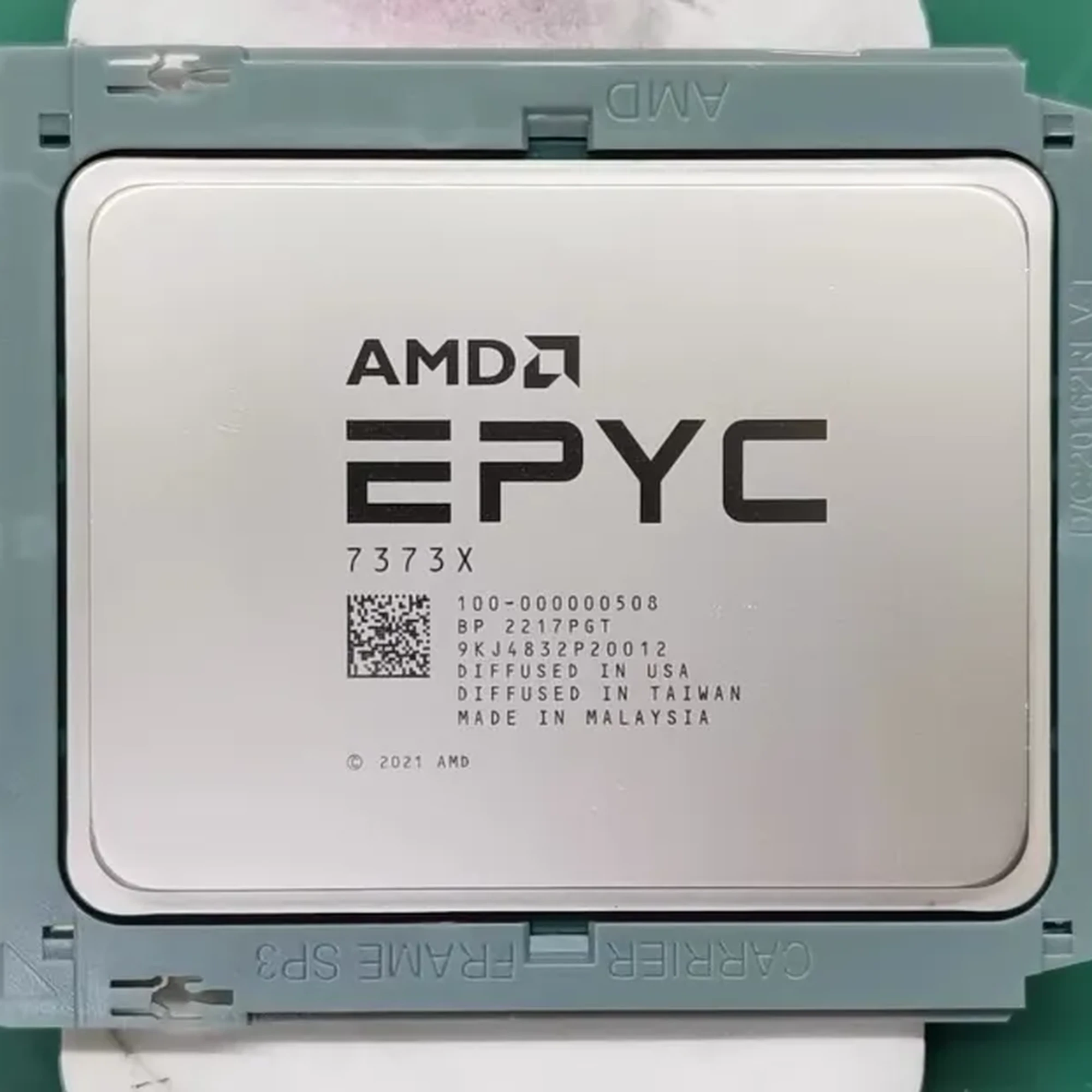
| AMD EPYC™ 7373X | 16 | 32 | Up to 3.8 GHz | 3.05 GHz | 768 MB | 240W |
| AMD EPYC™ 7343 | 16 | 32 | Up to 3.9 GHz | 3.2 GHz | 128 MB | 190W |
| AMD EPYC™ 7313P | 16 | 32 | Up to 3.7 GHz | 3 GHz | 128 MB | 155W |
| AMD EPYC™ 7313 | 16 | 32 | Up to 3.7 GHz | 3 GHz | 128 MB | 155W |
| AMD EPYC™ 74F3 | 24 | 48 | Up to 4 GHz | 3.2 GHz | 256 MB | 240W |
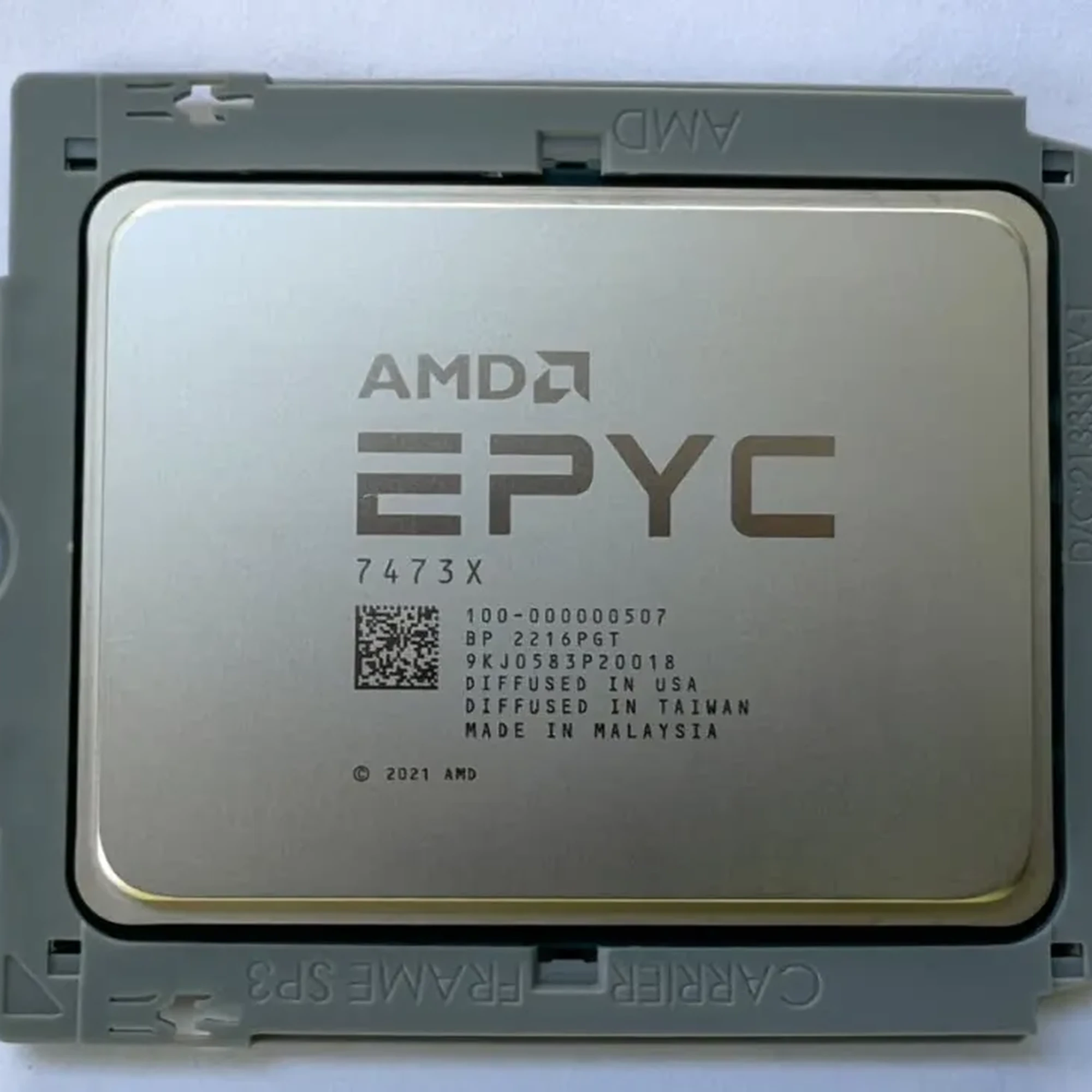
| AMD EPYC™ 7473X | 24 | 48 | Up to 3.7 GHz | 2.8 GHz | 768 MB | 240W |
| AMD EPYC™ 7443P | 24 | 48 | Up to 4 GHz | 2.85 GHz | 128 MB | 200W |
| AMD EPYC™ 7443 | 24 | 48 | Up to 4 GHz | 2.85 GHz | 128 MB | 200W |
| AMD EPYC™ 7413 | 24 | 48 | Up to 3.6 GHz | 2.65 GHz | 128 MB | 180W |
| AMD EPYC™ 7453 | 28 | 56 | Up to 3.45 GHz | 2.75 GHz | 64 MB | 225W |
| AMD EPYC™ 75F3 | 32 | 64 | Up to 4 GHz | 2.95 GHz | 256 MB | 280W |
| AMD EPYC™ 7573X | 32 | 64 | Up to 3.6 GHz | 2.8 GHz | 768 MB | 280W |
| AMD EPYC™ 7543P | 32 | 64 | Up to 3.7 GHz | 2.8 GHz | 256 MB | 225W |
| AMD EPYC™ 7543 | 32 | 64 | Up to 3.7 GHz | 2.8 GHz | 256 MB | 225W |
| AMD EPYC™ 7513 | 32 | 64 | Up to 3.65 GHz | 2.6 GHz | 128 MB | 200W |
| AMD EPYC™ 7643P | 48 | 96 | Up to 3.6 GHz | 2.3 GHz | 256 MB | 225W |
| AMD EPYC™ 7643 | 48 | 96 | Up to 3.6 GHz | 2.3 GHz | 256 MB | 225W |
| AMD EPYC™ 7663 | 56 | 112 | Up to 3.5 GHz | 2 GHz | 256 MB | 240W |
| AMD EPYC™ 7663P | 56 | 112 | Up to 3.5 GHz | 2 GHz | 256 MB | 240W |
| AMD EPYC™ 7773X | 64 | 128 | Up to 3.5 GHz | 2.2 GHz | 768 MB | 280W |
| AMD EPYC™ 7763 | 64 | 128 | Up to 3.5 GHz | 2.45 GHz | 256 MB | 280W |
| AMD EPYC™ 7713P | 64 | 128 | Up to 3.67 GHz | 2 GHz | 256 MB | 225W |
| AMD EPYC™ 7713 | 64 | 128 | Up to 3.67 GHz | 2 GHz | 256 MB | 225W |
| Weight | 1 kg |
|---|---|
| Dimensions | 20 × 20 × 10 cm |
| CPU Series | EPYC 7003 Series |
| CPU Cores | 16 |
| Threads | 32 |
| Max. Boost Clock | 4 GHz |
| Base Clock | 3.5 GHz |
| L2 Cache | 8 MB |
| L3 Cache | 256 MB |
| Default TDP | 240W |
| CPU Socket | SP3 |
| Products Status | USED |
| Warranty(Year) | 1-Year Limited |


Reviews
There are no reviews yet.