
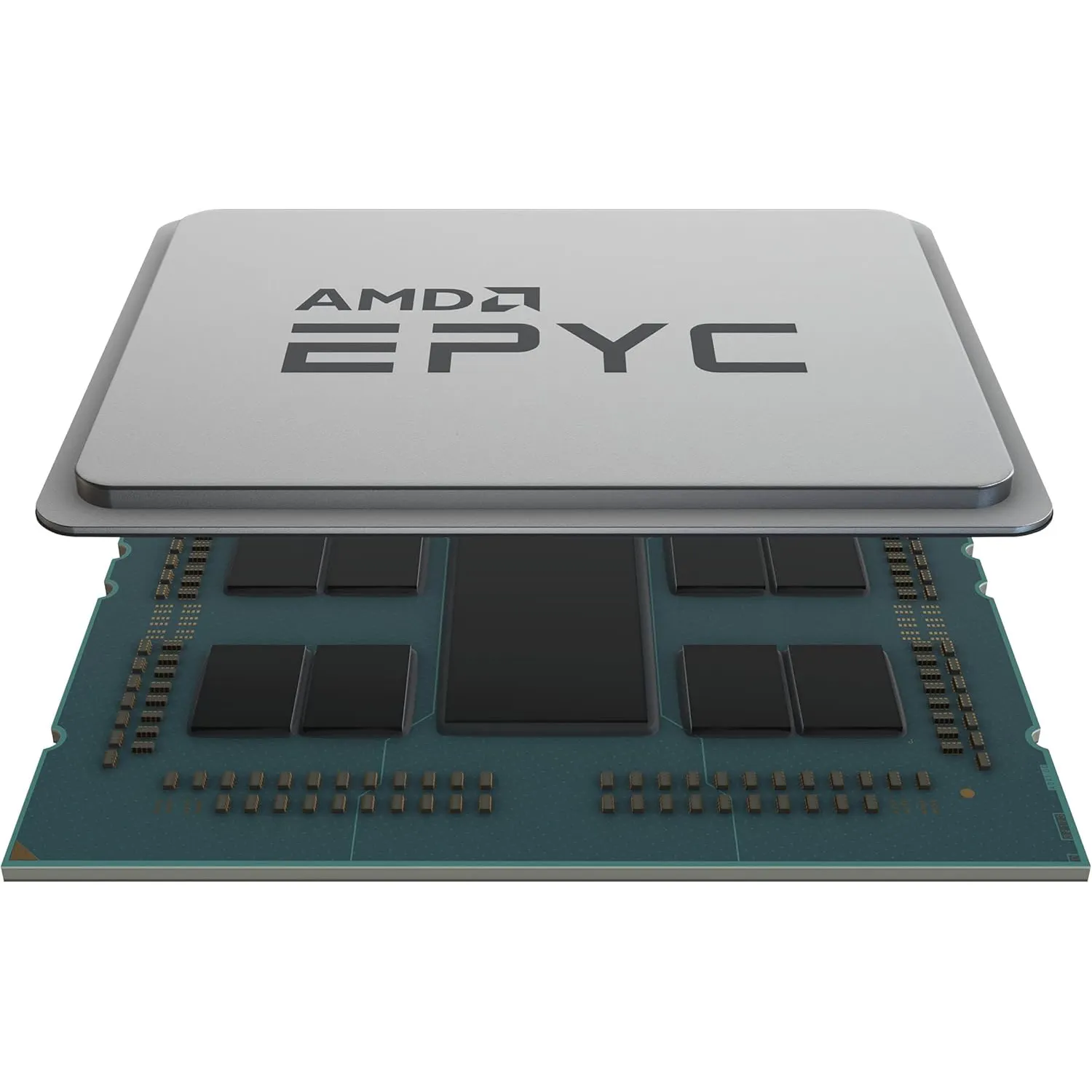
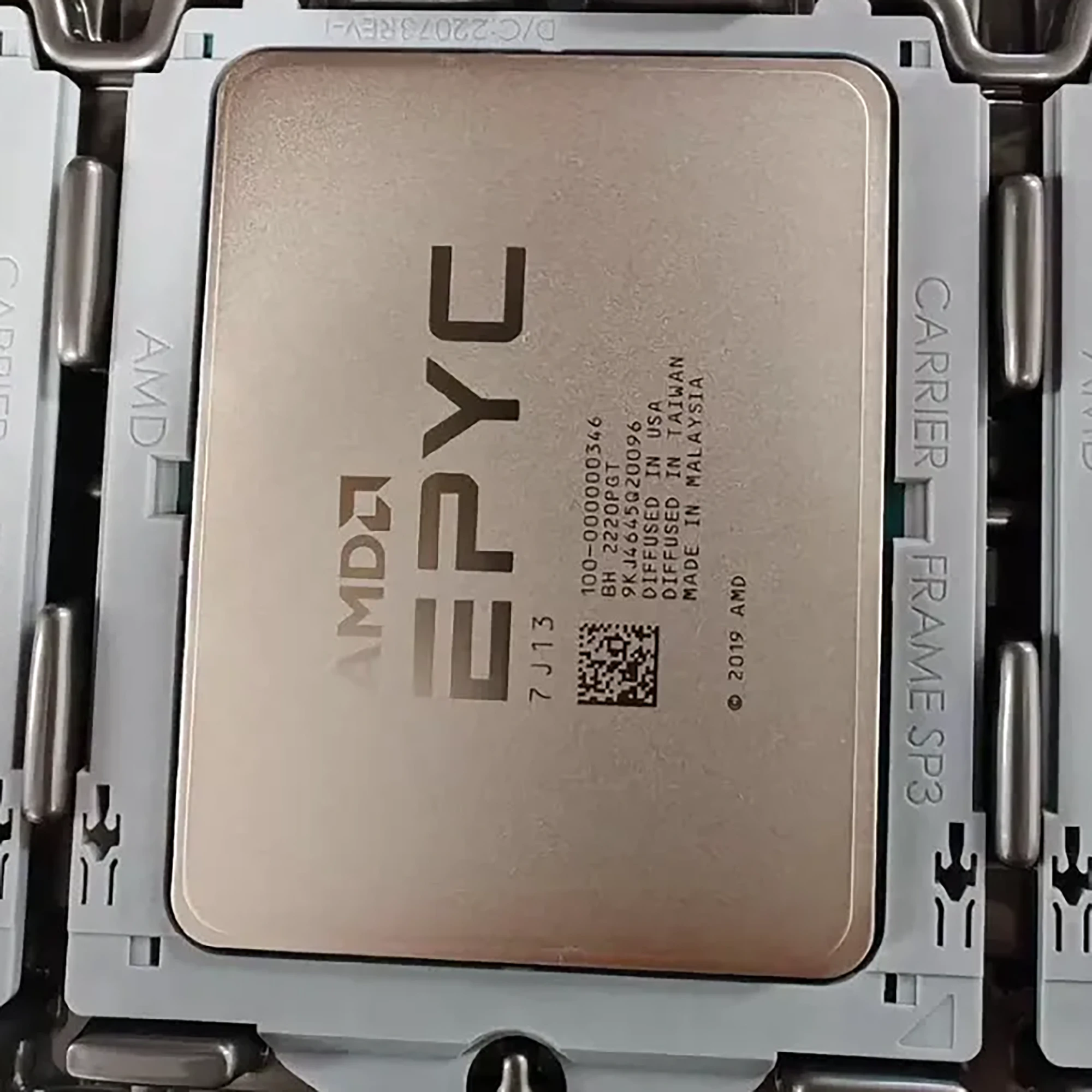
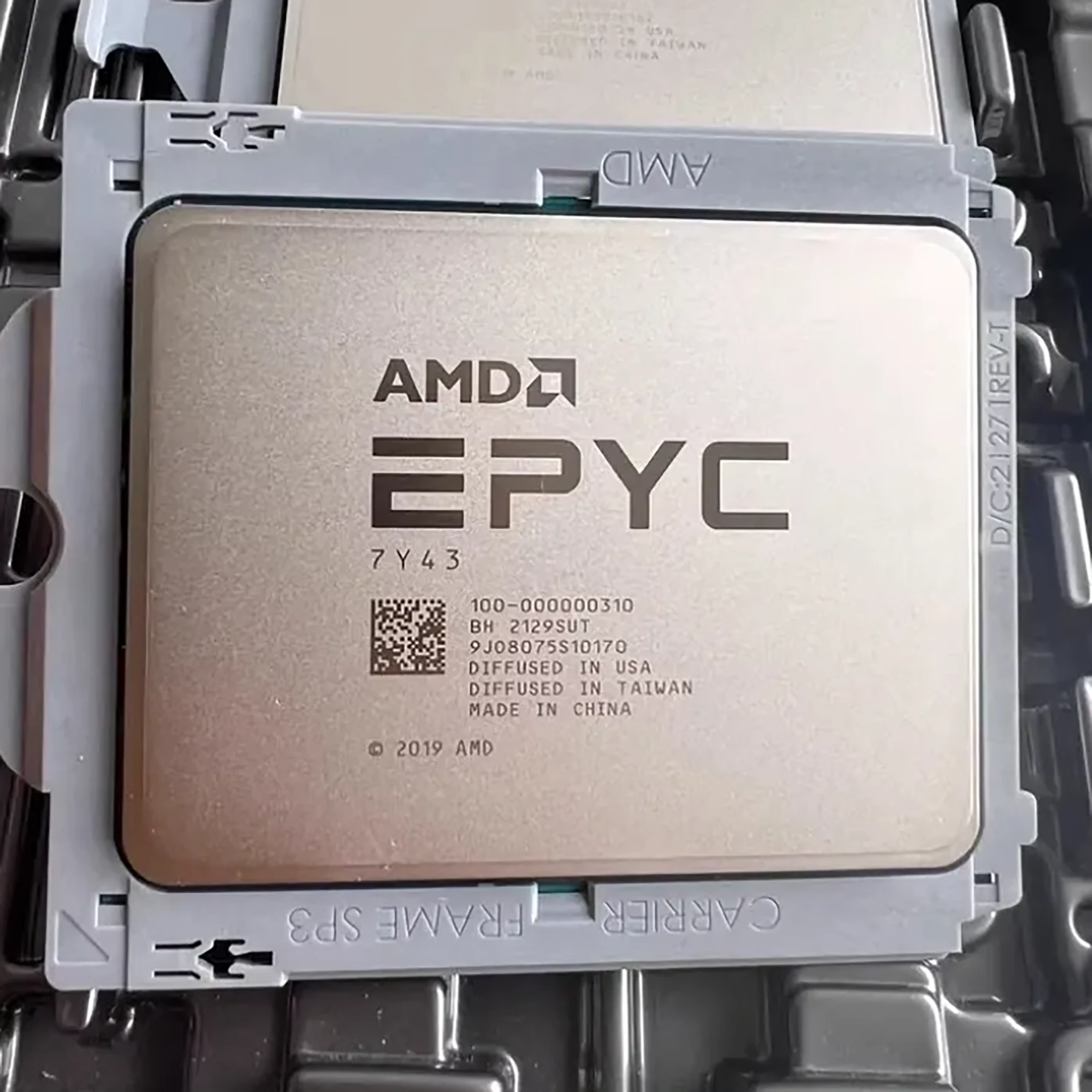
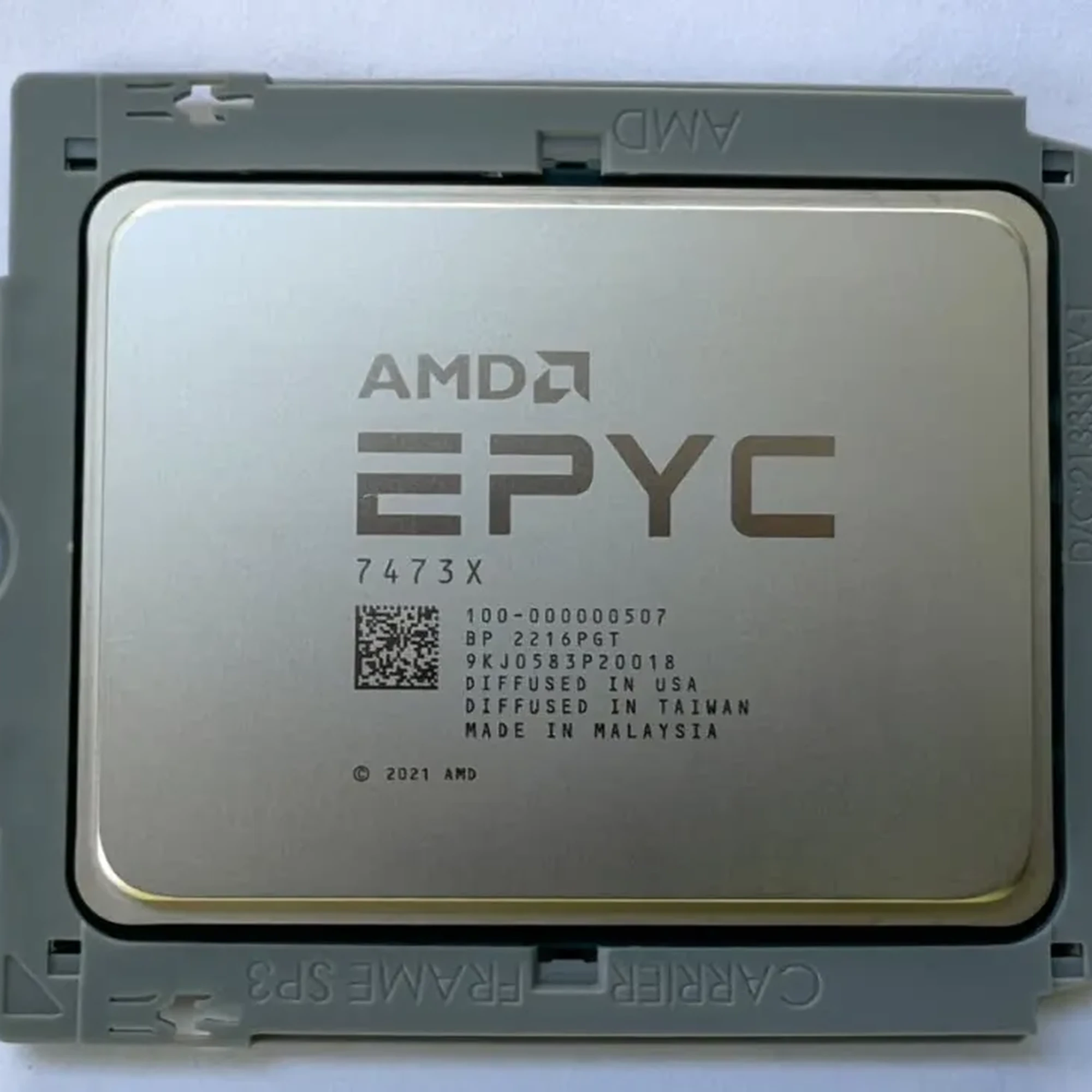
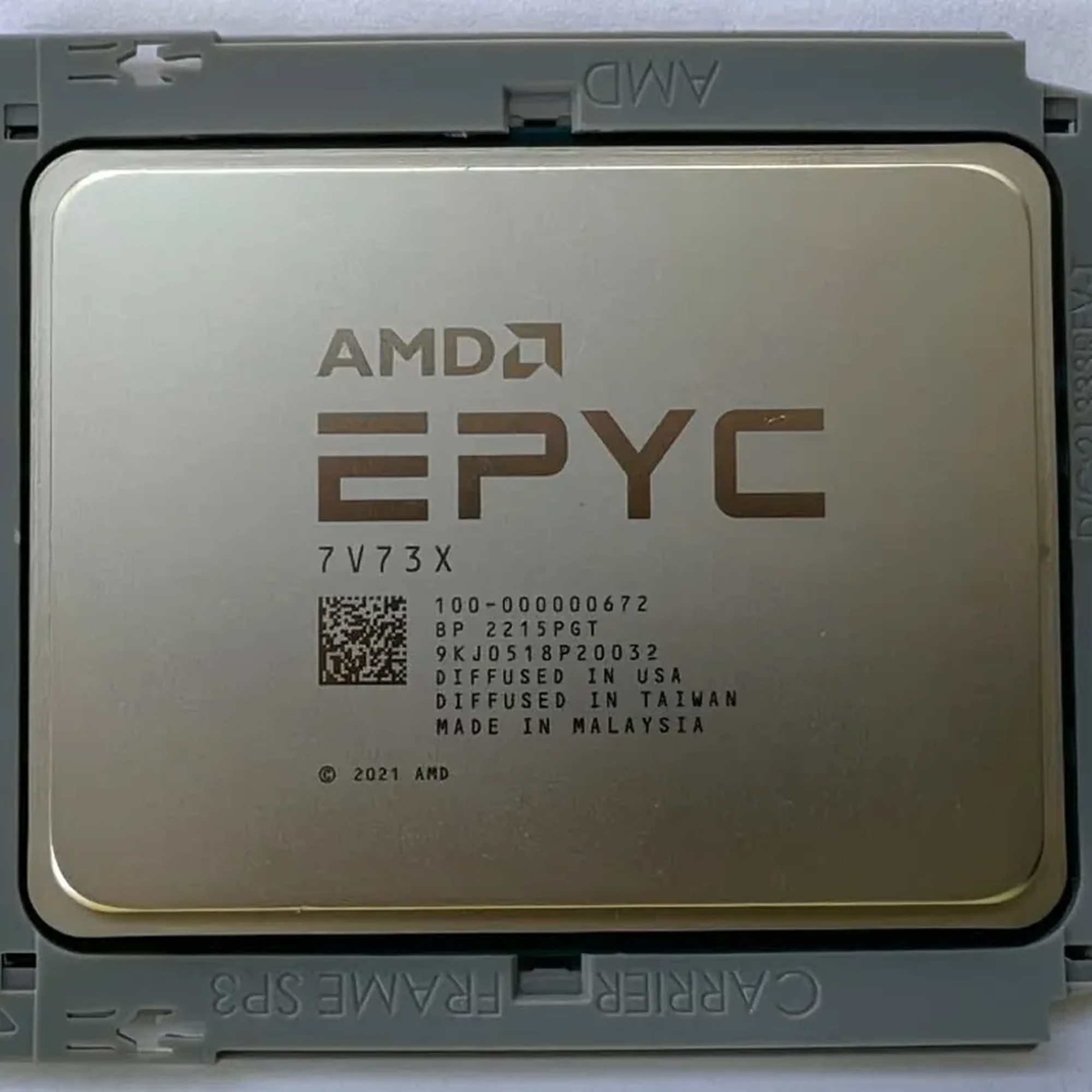
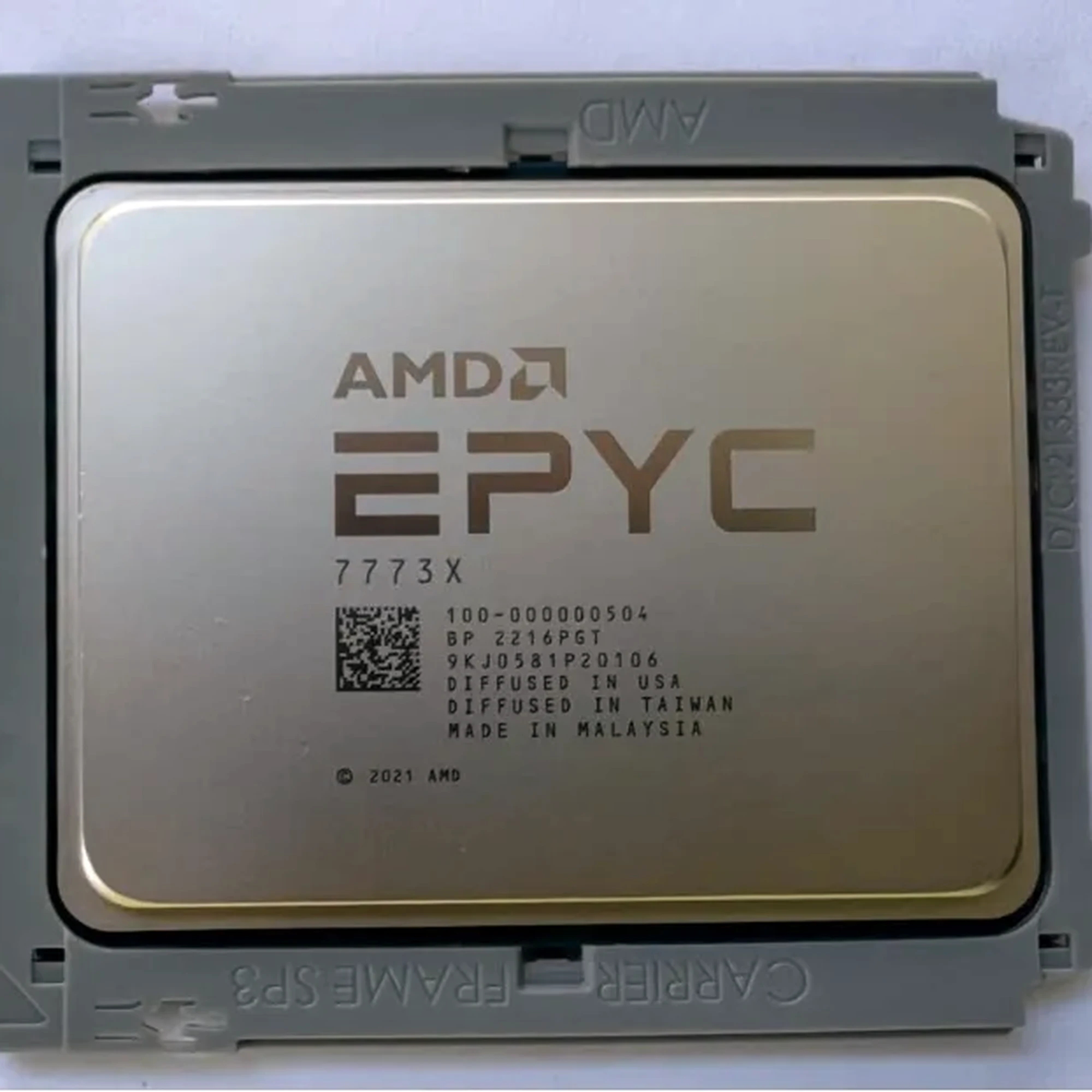

AMD EPYC 7J13 64-Core 128-Thread Server Processor | Zen 3, 2.45GHz Base, 3.5GHz Boost, 280W TDP
| Specification Category | Details |
|---|---|
| Processor Model | AMD EPYC 7J13 |
| Microarchitecture | Zen 3 (Milan) |
| Manufacturing Process | 7nm |
| Core Count | 64 Cores |
| Thread Count | 128 Threads (SMT Enabled) |
| Base Clock Speed | 2.45 GHz |
| Max Boost Clock Speed | 3.5 GHz |
| L3 Cache | 256 MB |
| TDP (Thermal Design Power) | 280 W |
| Memory Type | DDR4-3200 ECC |
| Memory Channels | 8 Channels |
| Memory Bandwidth | 204.8 GB/s (Theoretical) |
| PCIe Version | PCIe 4.0 |
| PCIe Lanes | 128 Lanes |
| Socket Type | SP3, LGA-4094 |
| Release Date | Q2 2021 |
| Part Number | 100-000000346 |
| Security Features | Secure Encrypted Virtualization (SEV), Enhanced Virus Protection, Secure Memory Encryption (SME), AES Instructions, SMAP |
| Benchmark Scores (Linux) | PassMark Single Thread: 2,374; PassMark CPU Mark: 86,015; Geekbench 5 Single Core: 1,204; Geekbench 5 Multi-Core: 42,768 |
| Suggested PSU | 800W ATX Power Supply |
| Integrated Graphics | None |
| Supported Workloads | Virtualization, Cloud Computing, Data Analytics, HPC, Content Rendering, Enterprise Databases |
AMD EPYC 7J13: A Powerhouse for Enterprise-Grade Workloads
In the competitive landscape of server processors, the AMD EPYC 7J13 stands out as a reliable, high-performance solution tailored for modern enterprise needs. Launched in Q2 2021 as part of AMD’s EPYC 7003 (Milan) series, this processor is built on the Zen 3 microarchitecture—one of AMD’s most refined and efficient architectures to date—delivering exceptional multi-threaded performance, impressive memory bandwidth, and robust I/O scalability. Whether powering data centers, cloud environments, high-performance computing (HPC) clusters, or virtualization platforms, the EPYC 7J13 combines raw computing power with energy efficiency, making it a top choice for businesses seeking to optimize their infrastructure without compromising on performance.
Zen 3 Architecture: The Foundation of Exceptional Performance
At the core of the AMD EPYC 7J13 lies the Zen 3 microarchitecture, a significant upgrade over its Zen 2 predecessor. This architecture introduces a unified 8-core complex (CCX), which reduces latency by allowing all cores within a CCX to access the same L3 cache directly—eliminating the need for cross-CCX cache access and improving data throughput. For enterprise workloads that rely on parallel processing, this translates to faster task execution, reduced bottlenecks, and improved overall system responsiveness.
The Zen 3 architecture is built on a 7nm manufacturing process, a technological advancement that enables AMD to pack more cores into a smaller footprint while reducing power consumption. This 7nm process not only enhances performance per watt but also ensures the EPYC 7J13 can operate reliably in dense server environments where space and power efficiency are critical. With a thermal design power (TDP) of 280W, the processor strikes a balance between performance and energy usage, making it suitable for both large-scale data centers and smaller enterprise setups that require powerful computing without excessive power draw.
Core and Thread Performance: Unmatched Multi-Threaded Capability
The AMD EPYC 7J13 is equipped with 64 physical cores and 128 threads, thanks to AMD’s Simultaneous Multi-Threading (SMT) technology. This high core and thread count makes it ideal for workloads that demand massive parallelism, such as virtualization, data analytics, scientific computing, and content rendering. Unlike processors with fewer cores, the EPYC 7J13 can handle hundreds of concurrent tasks simultaneously, reducing wait times and improving productivity for businesses that rely on high-throughput computing.
With a base clock speed of 2.6GHz and a boost clock speed of up to 3.5GHz, the EPYC 7J13 delivers consistent performance across both single-threaded and multi-threaded workloads. While single-threaded performance is essential for tasks like application launching and light computing, the processor’s true strength lies in its multi-threaded capabilities. Benchmark tests confirm this: the EPYC 7J13 achieves a PassMark CPU Mark of 86,015 and a Geekbench 5 multi-core score of 42,768, outperforming many competing server processors in its class. For example, in a real-world deployment at a mid-sized cloud hosting provider in Frankfurt, a dual-socket server with two EPYC 7J13 processors (totaling 128 cores and 256 threads) consolidated 80 virtual machines across four hypervisors, reducing host count by 42% and power consumption per VM by 31% without latency spikes during peak hours.
Memory and I/O: Scalability for Data-Intensive Workloads
Enterprise workloads often require large amounts of memory and fast I/O connectivity to handle massive datasets, and the AMD EPYC 7J13 delivers on both fronts. The processor supports 8-channel DDR4-3200 ECC memory, providing a theoretical memory bandwidth of up to 204.8 GB/s—nearly double that of comparable Intel Xeon processors. This high memory bandwidth ensures that data-intensive tasks, such as large-scale database queries, machine learning model training, and video rendering, can access data quickly, reducing bottlenecks and improving overall system performance.
Additionally, the EPYC 7J13 supports a maximum memory capacity of 4 TB, allowing businesses to scale their memory resources to meet the demands of growing workloads. ECC (Error-Correcting Code) memory support is a critical feature for enterprise environments, as it detects and corrects memory errors in real time, preventing data corruption and ensuring system stability—essential for mission-critical applications like financial transactions, healthcare data processing, and cloud services.
On the I/O front, the EPYC 7J13 offers 128 PCIe 4.0 lanes, providing ultra-fast connectivity to storage devices, network cards, and GPU accelerators. PCIe 4.0 doubles the bandwidth of PCIe 3.0, enabling direct attachment of NVMe SSDs, 100GbE NICs, and GPUs without relying on PLX switches—reducing I/O bottlenecks and improving data transfer speeds. This level of I/O scalability makes the EPYC 7J13 suitable for modern data centers that require high-speed connectivity to support cloud computing, virtualization, and HPC workloads.
Security Features: Protecting Critical Enterprise Data
In today’s digital landscape, security is a top priority for businesses, and the AMD EPYC 7J13 includes a range of advanced security features to protect critical data and infrastructure. The processor supports AMD Secure Encrypted Virtualization (SEV), which encrypts virtual machines (VMs) at rest and in transit, preventing unauthorized access to sensitive data. This feature is particularly valuable for cloud service providers and multi-tenant environments, where multiple VMs share the same physical hardware.
Other security features include Enhanced Virus Protection, Secure Memory Encryption (SME), Supervisor Mode Access Prevention (SMAP), and Secure Mode Execution Protection. These features work together to mitigate common security threats, such as malware, data breaches, and unauthorized code execution, ensuring that enterprise systems remain secure and compliant with industry regulations (e.g., GDPR, HIPAA). The processor also supports Advanced Encryption Standard (AES) instructions, accelerating encryption and decryption tasks to maintain performance while securing data.
Use Cases: Where the AMD EPYC 7J13 Excels
The AMD EPYC 7J13 is a versatile processor that excels in a wide range of enterprise workloads, making it a flexible choice for businesses of all sizes. Below are some of its key use cases:
- Virtualization and Cloud Computing: With 64 cores, 128 threads, and 128 PCIe 4.0 lanes, the EPYC 7J13 is ideal for high-density virtualization. It can support hundreds of VMs per server, making it perfect for cloud hosting providers, data centers, and businesses that need to consolidate their infrastructure. The processor’s high memory bandwidth and I/O scalability ensure that VMs run smoothly, even under heavy load.
- Data Analytics and Big Data: Data analytics workloads require processing large datasets quickly, and the EPYC 7J13’s multi-threaded performance and high memory bandwidth make it well-suited for this task. Whether running complex SQL queries, machine learning algorithms, or data visualization tools, the processor can handle massive amounts of data with ease, reducing processing time and improving insights.
- High-Performance Computing (HPC): For scientific computing, engineering simulations, and research applications, the EPYC 7J13 delivers the raw computing power needed to handle complex calculations. Its 64 cores and high memory bandwidth make it suitable for tasks like finite element analysis (FEA), computational fluid dynamics (CFD), and quantum computing simulations.
- Content Rendering and Media Processing: Video rendering, 3D modeling, and media encoding are resource-intensive tasks that benefit from the EPYC 7J13’s multi-threaded performance. The processor can handle multiple rendering tasks simultaneously, reducing time-to-market for content creators and media companies.
- Enterprise Databases and Applications: The EPYC 7J13’s high core count, large L3 cache (256MB), and fast memory bandwidth make it ideal for running enterprise databases (e.g., MySQL, PostgreSQL, Oracle) and business applications (e.g., ERP, CRM). It ensures that these applications run smoothly, even with hundreds of concurrent users.
Comparison to Competing Processors and EPYC Siblings
When compared to competing server processors, the AMD EPYC 7J13 offers exceptional value for money. For example, it outperforms the Intel Xeon Platinum 8358 in multi-threaded performance while offering a higher core count and lower power consumption per core. In terms of EPYC siblings, the 7J13 is positioned as a mid-to-high-end model, offering a balance of core count, frequency, and power consumption. It differs from the EPYC 7713 (64 cores/128 threads, 2.0GHz base, 3.6GHz boost, 225W TDP) by offering a higher base frequency, making it better suited for workloads that require consistent performance. Compared to the EPYC 7763 (64 cores/128 threads, 2.4GHz base, 3.5GHz boost, 280W TDP), the 7J13 has a slightly higher base frequency, making it a better choice for tasks that benefit from sustained performance rather than peak boost speeds.
Deployment Considerations
When deploying the AMD EPYC 7J13, there are a few key considerations to keep in mind. First, the processor uses the SP3 (LGA-4094) socket, so it requires a compatible SP3 motherboard. Businesses should ensure that their motherboards support 8-channel DDR4 memory and PCIe 4.0 to fully leverage the processor’s capabilities. Second, due to its 280W TDP, the EPYC 7J13 requires a high-quality cooling solution—such as a liquid cooler or high-performance air cooler—to maintain optimal temperatures and prevent thermal throttling. AMD recommends an 800W ATX power supply for systems using the EPYC 7J13, though higher wattage supplies may be needed for systems with multiple GPUs or storage devices.
For businesses considering used EPYC 7J13 processors (a common cost-saving measure), it’s important to verify that the processor is a (non-ES engineering sample), check for physical damage (e.g., scratches, burn marks), and test for stability and power efficiency. While (used processors) offer lower costs, they typically lack official warranty support, so businesses should weigh the cost savings against the potential risks of hardware failure.
Conclusion: Why Choose the AMD EPYC 7J13?
The AMD EPYC 7J13 is a powerful, versatile server processor that delivers exceptional performance for enterprise workloads. Its Zen 3 architecture, 64 cores, 128 threads, high memory bandwidth, and robust I/O scalability make it ideal for virtualization, data analytics, HPC, and more. With advanced security features, energy efficiency, and competitive pricing, the EPYC 7J13 offers businesses a cost-effective solution to optimize their infrastructure and meet the demands of modern computing.
Whether you’re a cloud service provider looking to consolidate servers, a research institution needing high-performance computing power, or a business seeking to improve database and application performance, the AMD EPYC 7J13 is a reliable choice that delivers on both performance and value. Its proven track record in real-world deployments, combined with AMD’s commitment to innovation, makes it a top contender in the server processor market.
Recommended Motherboards for AMD EPYC 7002/7003 SP3 Processors
| Model | Brand | CPU Configuration | Memory Slots | Max Memory | LAN | PCIe Expansion | Storage | Form Factor | BMC |
|---|---|---|---|---|---|---|---|---|---|
| MZ72-HB2 | GIGABYTE | Dual SP3 | 16×DDR4 | 2TB | 2×10G + 1×Mgmt LAN | 5×PCIe 4.0 x16/x8 | 5×SlimSAS, 1×M.2 | E-ATX | AST2600 |
| MZ32-AR0 | GIGABYTE | Single SP3 | 16×DDR4 | 2TB | 2×1G (Intel I350) | 7×PCIe 4.0/3.0 x16/x8 | 6×SlimSAS, 2×M.2 | E-ATX | AST2600 |
| MZ71-CE1 | GIGABYTE | Dual SP3 | 16×DDR4 | 2TB | 2×1G (BCM5720) + Mgmt LAN | 5×PCIe 4.0 x16/x8 | 3×SlimSAS, 4×SATA | E-ATX | AST2600 |
| ROMED8-2T/BCM | ASRock Rack | Single SP3 | 8×DDR4 | 256GB | 2×10G (Intel X550) + IPMI | 7×PCIe 4.0 x16 | 10×SATA, 2×M.2 | ATX | AST2500 |
| ROMED4ID-2T | ASRock Rack | Single SP3 | 4×DDR4 | 256GB | 2×10G (Intel X550) + IPMI | 1×PCIe 4.0 x16 | 16×SATA, 1×M.2 | Mini-ITX | AST2500 |
| ROME2D16-2T | ASRock Rack | Dual SP3 | 16×DDR4 | 4TB | 2×10G (Intel X550) + IPMI | 5×PCIe 4.0 x16 + 1×x8 | 2×SlimSAS, 2×OcuLink, 2×M.2 | EEB | AST2600 |
| ROME2D32GM-2T | ASRock Rack | Dual SP3 | 32×DDR4 | 8TB | 2×10G + IPMI | 6×PCIe 4.0 x16 | 19×SlimSAS, 1×M.2 | EEB | AST2600 |
| H12SSL-NT | Supermicro | Single SP3 | 8×DDR4 | 2TB | 2×10G (BCM57416) + IPMI | 5×PCIe 4.0 x16/x8 | 2×SlimSAS (SATA/NVMe) | ATX | AST2500 |
| H12SSL-i | Supermicro | Single SP3 | 8×DDR4 | 2TB | 2×1G (BCM5720) | 5×PCIe 4.0 x16, 2×x8 | 8×SATA, 2×M.2 | ATX | AST2500 |
| H12DSi-N6 | Supermicro | Dual SP3 | 16×DDR4 | 4TB | 2×1G + IPMI | 3×PCIe 4.0 x16, 3×x8 | 10×SATA, 1×M.2 | E-ATX | AST2600 |
AMD EPYC 7003 Series Processors Specifications
| Name | # of CPU Cores | # of Threads | Max. Boost Clock | Base Clock | L3 Cache | Default TDP |
| AMD EPYC™ 7203P | 8 | 16 | Up to 3.4 GHz | 2.8 GHz | 64 MB | 120W |
| AMD EPYC™ 7203 | 8 | 16 | Up to 3.4 GHz | 2.8 GHz | 64 MB | 120W |
| AMD EPYC™ 72F3 | 8 | 16 | Up to 4.1 GHz | 3.7 GHz | 256 MB | 180W |
| AMD EPYC™ 7303P | 16 | 32 | Up to 3.4 GHz | 2.4 GHz | 64 MB | 130W |
| AMD EPYC™ 7303 | 16 | 32 | Up to 3.4 GHz | 2.4 GHz | 64 MB | 130W |
| AMD EPYC™ 73F3 | 16 | 32 | Up to 4 GHz | 3.5 GHz | 256 MB | 240W |
| AMD EPYC™ 7373X | 16 | 32 | Up to 3.8 GHz | 3.05 GHz | 768 MB | 240W |
| AMD EPYC™ 7343 | 16 | 32 | Up to 3.9 GHz | 3.2 GHz | 128 MB | 190W |
| AMD EPYC™ 7313P | 16 | 32 | Up to 3.7 GHz | 3 GHz | 128 MB | 155W |
| AMD EPYC™ 7313 | 16 | 32 | Up to 3.7 GHz | 3 GHz | 128 MB | 155W |
| AMD EPYC™ 74F3 | 24 | 48 | Up to 4 GHz | 3.2 GHz | 256 MB | 240W |
| AMD EPYC™ 7473X | 24 | 48 | Up to 3.7 GHz | 2.8 GHz | 768 MB | 240W |
| AMD EPYC™ 7443P | 24 | 48 | Up to 4 GHz | 2.85 GHz | 128 MB | 200W |
| AMD EPYC™ 7443 | 24 | 48 | Up to 4 GHz | 2.85 GHz | 128 MB | 200W |
| AMD EPYC™ 7413 | 24 | 48 | Up to 3.6 GHz | 2.65 GHz | 128 MB | 180W |
| AMD EPYC™ 7453 | 28 | 56 | Up to 3.45 GHz | 2.75 GHz | 64 MB | 225W |
| AMD EPYC™ 75F3 | 32 | 64 | Up to 4 GHz | 2.95 GHz | 256 MB | 280W |
| AMD EPYC™ 7573X | 32 | 64 | Up to 3.6 GHz | 2.8 GHz | 768 MB | 280W |
| AMD EPYC™ 7543P | 32 | 64 | Up to 3.7 GHz | 2.8 GHz | 256 MB | 225W |
| AMD EPYC™ 7543 | 32 | 64 | Up to 3.7 GHz | 2.8 GHz | 256 MB | 225W |
| AMD EPYC™ 7513 | 32 | 64 | Up to 3.65 GHz | 2.6 GHz | 128 MB | 200W |
| AMD EPYC™ 7643P | 48 | 96 | Up to 3.6 GHz | 2.3 GHz | 256 MB | 225W |
| AMD EPYC™ 7643 | 48 | 96 | Up to 3.6 GHz | 2.3 GHz | 256 MB | 225W |
| AMD EPYC™ 7663 | 56 | 112 | Up to 3.5 GHz | 2 GHz | 256 MB | 240W |
| AMD EPYC™ 7663P | 56 | 112 | Up to 3.5 GHz | 2 GHz | 256 MB | 240W |
| AMD EPYC™ 7773X | 64 | 128 | Up to 3.5 GHz | 2.2 GHz | 768 MB | 280W |
| AMD EPYC™ 7763 | 64 | 128 | Up to 3.5 GHz | 2.45 GHz | 256 MB | 280W |
| AMD EPYC™ 7713P | 64 | 128 | Up to 3.67 GHz | 2 GHz | 256 MB | 225W |
| AMD EPYC™ 7713 | 64 | 128 | Up to 3.67 GHz | 2 GHz | 256 MB | 225W |


