
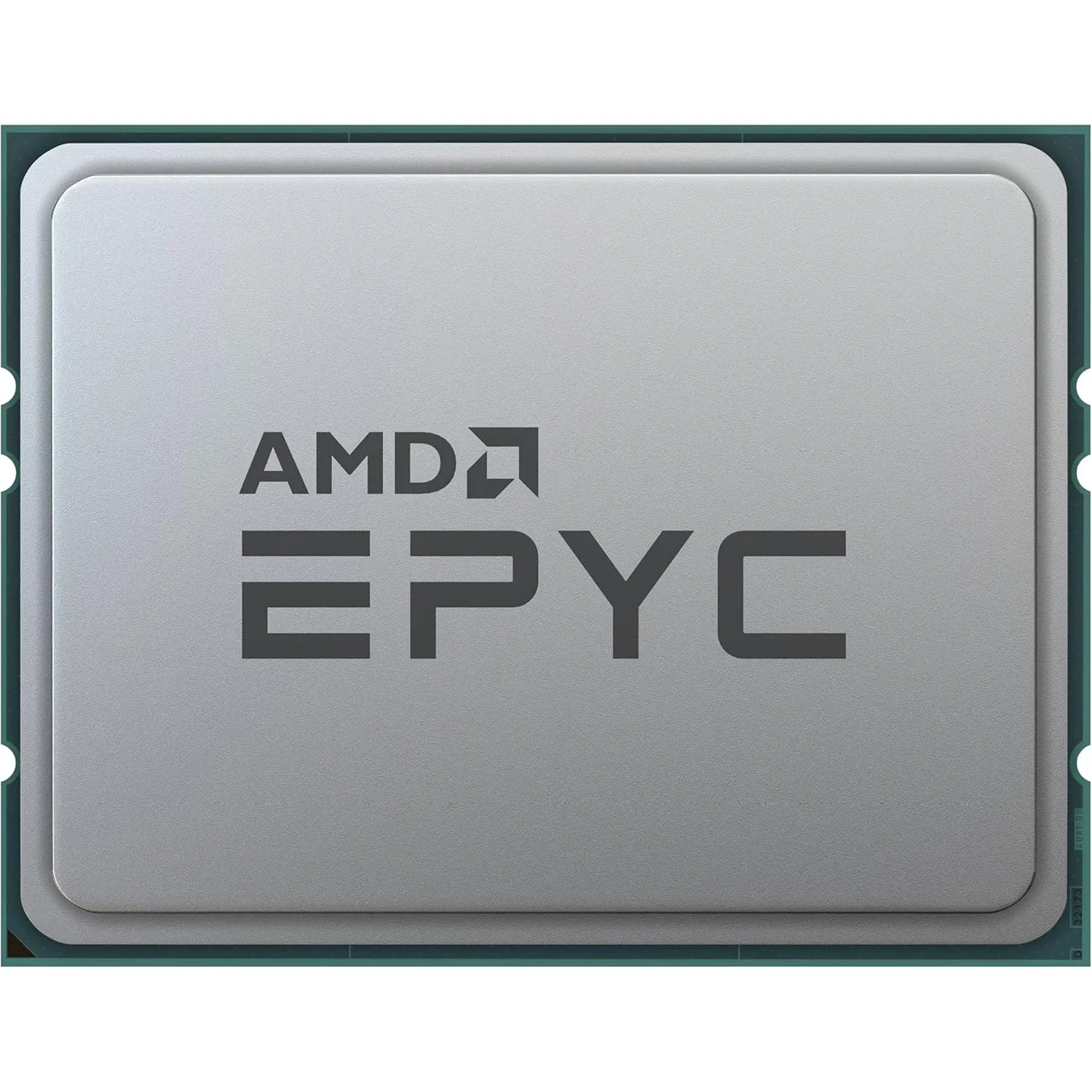
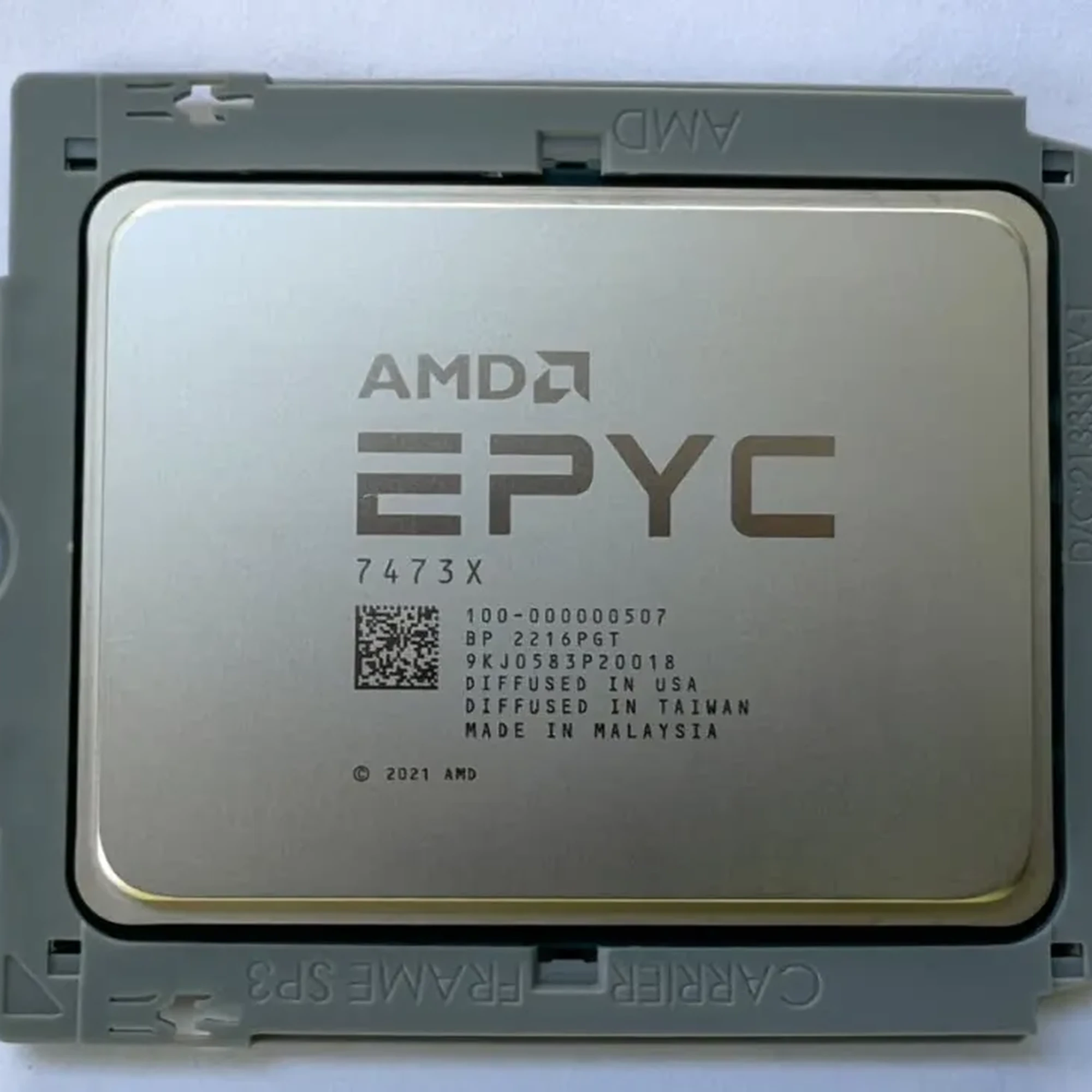
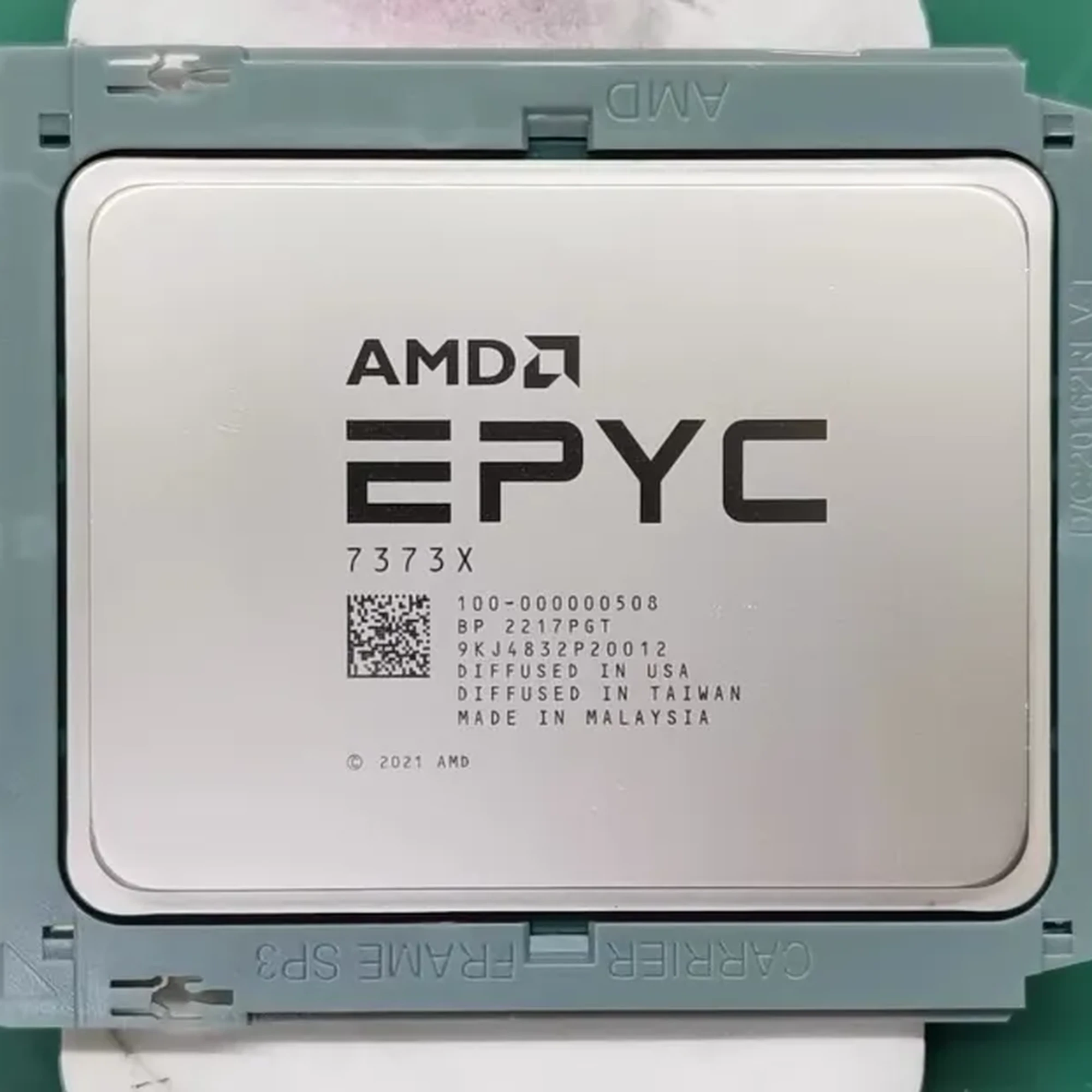
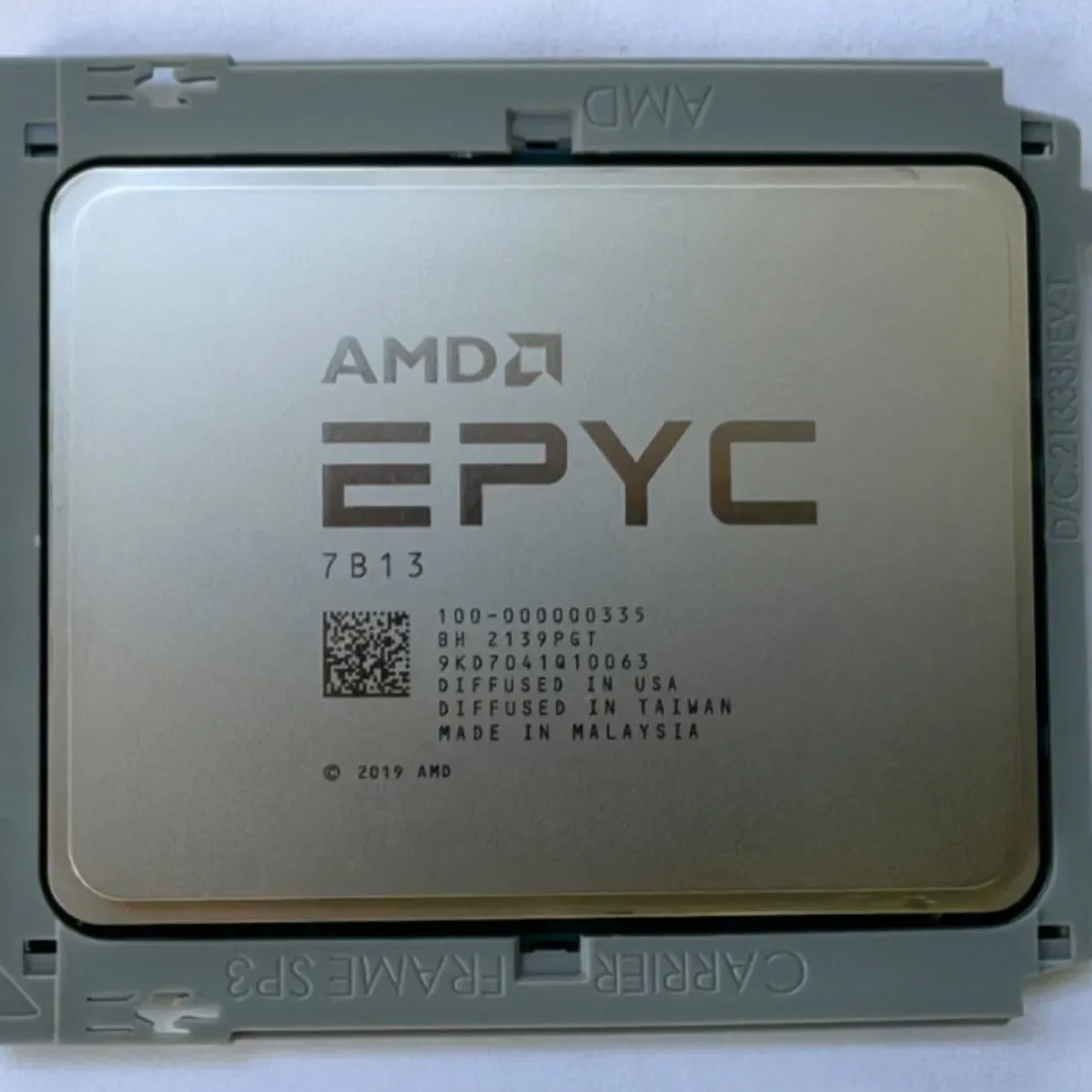
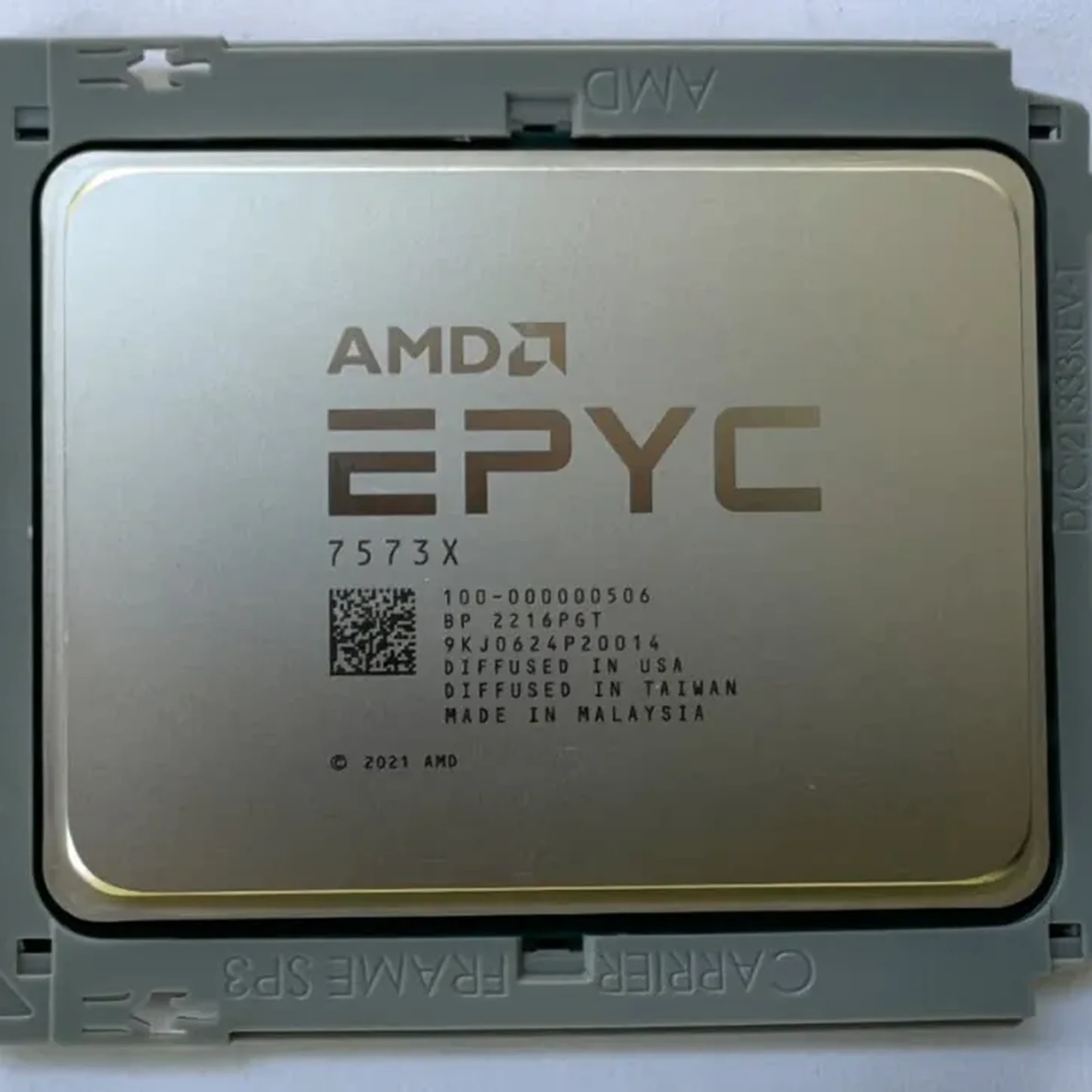
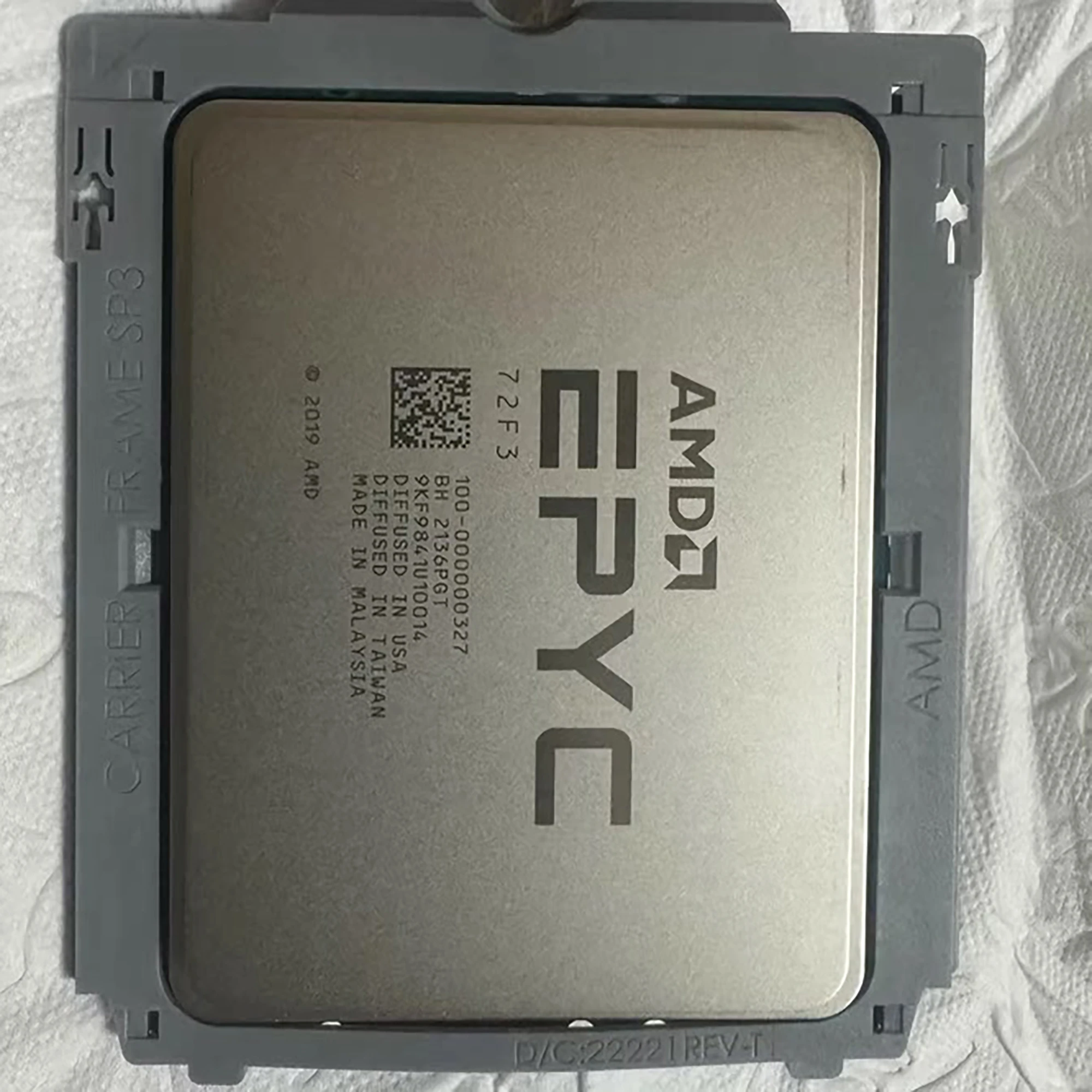

AMD EPYC 7303P Server Processor | 16-Core 32-Thread 2.4GHz 64MB L3 Cache – High Performance & Cost-Optimized
| Specification | Details |
| Processor Name | AMD EPYC 7303P |
| Family | AMD EPYC |
| Series | EPYC 7003 Series (Milan) |
| Architecture | Zen 3 (Milan) |
| Fabrication Process | 7nm (TSMC) |
| Cores | 16 |
| Threads | 32 (SMT Supported) |
| Base Clock | 2.4GHz |
| Max Boost Clock | Up to 3.4GHz (Single Core) |
| L1 Cache | 64KB per core (32KB Instruction + 32KB Data) |
| L2 Cache | 512KB per core |
| L3 Cache | 64MB (Shared) |
| TDP (Default) | 130W |
| Configurable TDP (cTDP) | 120W (TDP Down) – 150W (TDP Up) |
| Socket | SP3 (LGA 4094) |
| Socket Count | 1P (Single Socket) |
| Memory Type | DDR4 |
| Memory Channels | 8 (Octa-Channel) |
| Max Memory Speed | Up to 3200 MT/s |
| Per Socket Memory Bandwidth | 204.8 GB/s |
| ECC Memory Support | Yes |
| PCIe Version | PCIe 4.0 |
| PCIe Lanes | 128 |
| Integrated Graphics | N/A |
| Supported Technologies | AMD Infinity Guard, AMD Infinity Architecture, AMD-V (Virtualization), AVX, AVX2 |
| Workload Affinity | Cost-Optimized, General Purpose |
| Launch Date | September 5, 2023 |
| MSRP (1KU Pricing) | $594 USD |
| Product IDs (Boxed) | 100-100001289 WOF |
| Product IDs (Tray) | 100-000001289 |
| Transistor Count | 8.3 Billion |
| Die Size | 2×81 mm² (CPU Die) + 416 mm² (I/O Die) |
| I/O Process Size | 12nm |
| Package | FCLGA-4094 |
Introduction to the AMD EPYC 7303P Server Processor
In the highly competitive field of server processors, AMD has consistently delivered solutions that balance performance, efficiency, and affordability—and the AMD EPYC 7303P is no exception. As a member of the EPYC 7003 series (codenamed Milan), this server processor is built on AMD’s proven Zen 3 architecture, fabricated using a 7nm process by TSMC, and engineered to meet the requirements of modern data centers, small-to-medium businesses (SMBs), and enterprise environments. Launched on September 5, 2023, at an MSRP of $594, the EPYC 7303P is targeted at cost-conscious organizations that require reliable, scalable performance without compromising on key features essential to server operations. Whether deploying virtual machines, managing databases, hosting cloud services, or handling general-purpose enterprise workloads, the EPYC 7303P integrates core density, memory bandwidth, and connectivity to deliver a versatile solution that distinguishes itself within its price segment.
Architecture & Core Performance: Zen 3 Power in a Cost-Optimized Package
At the core of the AMD EPYC 7303P lies the Zen 3 (Milan) architecture, a significant advancement over its predecessors that prioritizes improvements in Instructions Per Cycle (IPC) and latency reduction. Built on a 7nm fabrication process, this architecture enables AMD to integrate more transistors within a compact die, resulting in enhanced performance per watt and increased core density—critical attributes for server processors operating 24/7. The EPYC 7303P incorporates 16 physical cores and 32 threads, leveraging AMD’s Simultaneous Multithreading (SMT) technology, which enables each core to handle two threads concurrently. This core configuration renders it well-suited for multi-threaded workloads, including virtualization, containerization, and batch processing, where parallelism is essential to maximizing operational efficiency.
The processor operates at a base clock speed of 2.4GHz, providing a stable foundation for consistent performance across all cores. For workloads requiring additional processing power, it can boost to a maximum of 3.4GHz on a single core, ensuring that single-threaded tasks—such as application initialization, database queries, and light computing operations—are executed efficiently. Unlike certain high-end server processors, the EPYC 7303P does not support overclocking, as its multiplier is locked. This design feature maintains stability and predictability in server environments, where reliability is of paramount importance. Additionally, the locked multiplier ensures the processor operates within its thermal and power constraints, mitigating the risk of overheating or performance throttling during prolonged use.
A standout feature of the EPYC 7303P is its cache configuration, which plays a critical role in reducing memory latency and enhancing data access speeds. The processor includes 64KB of L1 cache (32KB instruction + 32KB data) per core, 512KB of L2 cache per core, and a 64MB shared L3 cache. This hierarchical cache system ensures that frequently accessed data is stored in close proximity to the CPU cores, minimizing the time required to retrieve data from main memory. The 64MB L3 cache is particularly advantageous for memory-intensive workloads, such as large-scale database operations, data analytics, and virtualization, where rapid access to large datasets is essential. By reducing latency, the EPYC 7303P ensures consistent application performance even under heavy load, positioning it as a reliable choice for mission-critical server tasks.
Memory & Connectivity: High Bandwidth for Demanding Workloads
For server processors, memory bandwidth and connectivity are critical determinants of performance, as they govern the speed at which the CPU can communicate with other system components and access data. The AMD EPYC 7303P excels in this regard, offering 8 memory channels that support DDR4 memory with a maximum speed of 3200 MT/s. This 8-channel configuration delivers a per-socket memory bandwidth of 204.8 GB/s, which is significantly higher than that of many competing processors in its price range. This high bandwidth is essential for memory-intensive workloads, including virtualization (where multiple VMs share memory resources), data warehousing, and high-performance computing (HPC) tasks, as it ensures the CPU remains adequately supplied with data.
Furthermore, the EPYC 7303P supports Error-Correcting Code (ECC) memory, a mandatory feature for server environments. ECC memory detects and corrects single-bit errors and identifies multi-bit errors, preventing data corruption and safeguarding the integrity of critical information. This capability is particularly important for mission-critical applications, such as financial transactions, healthcare records, and enterprise databases, where even minor data errors can have severe consequences. The processor’s support for ECC memory reinforces its suitability for organizations that prioritize data integrity and system stability.
In terms of connectivity, the EPYC 7303P features PCIe 4.0, the latest generation of the PCI Express standard, which offers twice the bandwidth of PCIe 3.0. With 128 PCIe 4.0 lanes, the processor provides ample connectivity for high-speed storage devices (such as NVMe SSDs), network interface cards (NICs), and other expansion modules. This high number of PCIe lanes enables flexible system configuration, allowing organizations to tailor their server setups to specific requirements—whether by adding additional storage, enhancing network connectivity, or integrating specialized hardware for AI/ML workloads. PCIe 4.0 also reduces latency, ensuring rapid data transfers between the CPU and peripheral devices, thereby further improving overall system performance.
Power Efficiency & Thermal Management: Optimized for 24/7 Operation
Server processors operate continuously, making power efficiency and thermal management critical factors that impact operational costs and system reliability. The AMD EPYC 7303P has a default Thermal Design Power (TDP) of 130W, which is balanced for its performance level. AMD also provides Configurable TDP (cTDP) for the EPYC 7303P, enabling organizations to adjust power consumption between 120W (TDP down) and 150W (TDP up) based on specific operational requirements. This flexibility allows IT administrators to optimize power usage—reducing energy costs in environments with lower performance demands or increasing power allocation for peak workloads.
The processor’s 7nm manufacturing process is instrumental in its power efficiency, as it enables more efficient transistor operation, reducing power consumption while maintaining performance. When combined with AMD’s power management technologies, such as Cool’n’Quiet, the EPYC 7303P can dynamically adjust its clock speed and power consumption based on workload demand, ensuring that only the necessary power is utilized to complete tasks. This not only reduces energy costs but also minimizes heat output, simplifying thermal management and extending the lifespan of the processor and other server components.
For thermal management, the EPYC 7303P utilizes a socket SP3 (LGA 4094) design, which is compatible with a wide range of server cooling solutions, including air coolers and liquid coolers. The processor’s thermal design ensures operation within safe temperature ranges even under heavy, continuous load, preventing performance throttling and ensuring long-term reliability. Organizations can select the cooling solution that best aligns with their server environment, whether a cost-effective air cooler for small data centers or a high-performance liquid cooler for enterprise-grade deployments.
Workload Affinity & Use Cases: Versatile for Multiple Server Environments
The AMD EPYC 7303P is classified as a cost-optimized, general-purpose server processor, rendering it versatile enough to handle a diverse range of workloads. Its balanced core count, memory bandwidth, and connectivity make it well-suited for the following use cases:
Virtualization: With 16 cores and 32 threads, the EPYC 7303P can efficiently support multiple virtual machines (VMs) concurrently, making it well-suited for virtualized data centers, cloud hosting, and desktop virtualization (VDI) environments. The high memory bandwidth and PCIe 4.0 connectivity ensure VMs have access to necessary resources, while the 64MB L3 cache reduces latency for shared data.
Database Management: The processor’s high core density and memory bandwidth make it suitable for database workloads, including SQL and NoSQL databases. Whether managing a small business database or a large enterprise data warehouse, the EPYC 7303P can process complex queries and data transactions efficiently, leveraging its low latency and high parallelism.
Cloud Services: For cloud service providers (CSPs) and organizations hosting their own cloud infrastructure, the EPYC 7303P offers a cost-effective solution for delivering scalable cloud services. Its 8-channel memory and PCIe 4.0 connectivity support high-density storage and network configurations, while its power efficiency helps reduce operational costs for large-scale cloud deployments.
General-Purpose Enterprise Workloads: From file servers and print servers to application servers and web servers, the EPYC 7303P can handle the day-to-day workloads of most enterprises. Its reliable performance and low power consumption make it a cost-effective choice for both SMBs and large organizations, ensuring critical business applications operate smoothly 24/7.
High-Performance Computing (HPC) Lite: While not designed for extreme HPC workloads (such as supercomputing), the EPYC 7303P can handle light HPC tasks, including scientific computing, simulations, and data analytics, thanks to its high core count and memory bandwidth. This makes it a viable option for research labs and academic institutions with moderate HPC requirements.
Benchmark Performance: How the EPYC 7303P Stacks Up
To evaluate the real-world performance of the AMD EPYC 7303P, it is useful to examine benchmark results from trusted sources. According to PassMark Software, the EPYC 7303P achieves an average multi-thread rating of 36,487 and a single-thread rating of 2,517, placing it among the top 300 server processors in terms of multi-threaded performance. This indicates its ability to handle even the most demanding multi-threaded workloads effectively, while still delivering robust single-threaded performance for lighter tasks.
In terms of value, the EPYC 7303P offers a CPU mark per dollar of 61.43, which is competitive within its price range. This value proposition makes it an attractive option for organizations seeking to maximize performance per dollar, particularly when compared to higher-priced processors that may offer additional cores but at a significantly higher cost. When compared to competing Intel Xeon processors in the same price segment, the EPYC 7303P often outperforms in multi-threaded tasks and provides superior memory bandwidth, attributable to its 8-channel memory configuration.
In specific workload benchmarks, the EPYC 7303P demonstrates strong performance in integer math (129,791 MOPS/sec), floating-point math (71,599 MOPS/sec), data encryption (33,459 MB/sec), and data compression (473,130 KB/sec). These results underscore its capability to handle a wide range of enterprise workloads, from data processing to security-related tasks. Additionally, the processor’s support for advanced vector extensions (AVX and AVX2) further enhances its performance in calculation-intensive applications, such as scientific computing and video processing.
Key Features & Technologies: Enhancing Reliability & Security
The AMD EPYC 7303P is equipped with a range of features and technologies designed to enhance reliability, security, and manageability—critical requirements for server environments. One of the most notable features is AMD Infinity Guard, a suite of security technologies designed to protect against modern cyber threats. Infinity Guard includes Secure Memory Encryption (SME), which encrypts the entire system memory to prevent unauthorized access, and Secure Encrypted Virtualization (SEV), which encrypts virtual machine memory to isolate VMs from each other and the host system. These features make the EPYC 7303P a secure choice for organizations handling sensitive data, such as financial information, healthcare records, and personal data.
Another key technology is AMD Infinity Architecture, which enables high-speed communication between CPU cores, cache, and memory, reducing latency and improving overall system performance. This architecture ensures seamless data flow between components, making the EPYC 7303P more efficient than many competing processors. Additionally, the processor supports hardware virtualization (AMD-V) and IOMMU virtualization (PCI passthrough), which significantly improves virtual machine performance and allows guest VMs to directly access host hardware, enhancing flexibility and efficiency in virtualized environments.
For manageability, the EPYC 7303P supports AMD’s Platform Management Interface (PMI), which enables IT administrators to monitor and manage the processor remotely. This includes monitoring temperature, power consumption, and performance metrics, as well as configuring power management settings and updating firmware. Remote manageability is essential for large data centers, where IT teams are required to efficiently manage hundreds or thousands of servers.
Pricing & Availability: Cost-Effective for Every Organization
The AMD EPYC 7303P was launched in September 2023 with an MSRP of $594 per unit (1KU pricing), positioning it as one of the most cost-effective server processors in the EPYC 7003 series. It is available in both boxed and tray versions, with product IDs 100-100001289 (boxed) and 100-000001289 (tray). The tray version is ideal for large-scale deployments, while the boxed version includes a heatsink and is suitable for smaller deployments or individual server builds.
The processor’s cost-effectiveness, combined with its performance and features, makes it an attractive option for organizations of all sizes. SMBs can benefit from its competitive price point and reliable performance, while large enterprises can utilize it for cost-optimized deployments in their data centers. Additionally, the EPYC 7303P is compatible with a wide range of server motherboards supporting the socket SP3, providing organizations with flexibility in selecting hardware components.
Conclusion: Why the AMD EPYC 7303P Is a Top Choice for Server Environments
The AMD EPYC 7303P server processor represents a standout choice for organizations seeking a cost-optimized, general-purpose solution that does not compromise on performance, reliability, or features. Built on AMD’s Zen 3 architecture and 7nm process, it offers 16 cores, 32 threads, a 2.4GHz base clock, 3.4GHz maximum boost clock, 64MB L3 cache, 8-channel DDR4 memory, and PCIe 4.0 connectivity—all at an affordable price point of $594. Its power efficiency, thermal management, and security features make it ideal for 24/7 server operation, while its versatility enables it to handle a wide range of workloads, from virtualization and databases to cloud services and general enterprise tasks.
Whether an organization is a small business seeking to upgrade its server infrastructure, a cloud service provider in need of scalable, cost-effective hardware, or an enterprise requiring reliable, high-performance
Recommended Motherboards for AMD EPYC 7002/7003 SP3 Processors
| Model | Brand | CPU Configuration | Memory Slots | Max Memory | LAN | PCIe Expansion | Storage | Form Factor | BMC |
|---|---|---|---|---|---|---|---|---|---|
| MZ72-HB2 | GIGABYTE | Dual SP3 | 16×DDR4 | 2TB | 2×10G + 1×Mgmt LAN | 5×PCIe 4.0 x16/x8 | 5×SlimSAS, 1×M.2 | E-ATX | AST2600 |
| MZ32-AR0 | GIGABYTE | Single SP3 | 16×DDR4 | 2TB | 2×1G (Intel I350) | 7×PCIe 4.0/3.0 x16/x8 | 6×SlimSAS, 2×M.2 | E-ATX | AST2600 |
| MZ71-CE1 | GIGABYTE | Dual SP3 | 16×DDR4 | 2TB | 2×1G (BCM5720) + Mgmt LAN | 5×PCIe 4.0 x16/x8 | 3×SlimSAS, 4×SATA | E-ATX | AST2600 |
| ROMED8-2T/BCM | ASRock Rack | Single SP3 | 8×DDR4 | 256GB | 2×10G (Intel X550) + IPMI | 7×PCIe 4.0 x16 | 10×SATA, 2×M.2 | ATX | AST2500 |
| ROMED4ID-2T | ASRock Rack | Single SP3 | 4×DDR4 | 256GB | 2×10G (Intel X550) + IPMI | 1×PCIe 4.0 x16 | 16×SATA, 1×M.2 | Mini-ITX | AST2500 |
| ROME2D16-2T | ASRock Rack | Dual SP3 | 16×DDR4 | 4TB | 2×10G (Intel X550) + IPMI | 5×PCIe 4.0 x16 + 1×x8 | 2×SlimSAS, 2×OcuLink, 2×M.2 | EEB | AST2600 |
| ROME2D32GM-2T | ASRock Rack | Dual SP3 | 32×DDR4 | 8TB | 2×10G + IPMI | 6×PCIe 4.0 x16 | 19×SlimSAS, 1×M.2 | EEB | AST2600 |
| H12SSL-NT | Supermicro | Single SP3 | 8×DDR4 | 2TB | 2×10G (BCM57416) + IPMI | 5×PCIe 4.0 x16/x8 | 2×SlimSAS (SATA/NVMe) | ATX | AST2500 |
| H12SSL-i | Supermicro | Single SP3 | 8×DDR4 | 2TB | 2×1G (BCM5720) | 5×PCIe 4.0 x16, 2×x8 | 8×SATA, 2×M.2 | ATX | AST2500 |
| H12DSi-N6 | Supermicro | Dual SP3 | 16×DDR4 | 4TB | 2×1G + IPMI | 3×PCIe 4.0 x16, 3×x8 | 10×SATA, 1×M.2 | E-ATX | AST2600 |
AMD EPYC 7003 Series Processors Specifications
| Name | # of CPU Cores | # of Threads | Max. Boost Clock | Base Clock | L3 Cache | Default TDP |
| AMD EPYC™ 7203P | 8 | 16 | Up to 3.4 GHz | 2.8 GHz | 64 MB | 120W |
| AMD EPYC™ 7203 | 8 | 16 | Up to 3.4 GHz | 2.8 GHz | 64 MB | 120W |
| AMD EPYC™ 72F3 | 8 | 16 | Up to 4.1 GHz | 3.7 GHz | 256 MB | 180W |
| AMD EPYC™ 7303P | 16 | 32 | Up to 3.4 GHz | 2.4 GHz | 64 MB | 130W |
| AMD EPYC™ 7303 | 16 | 32 | Up to 3.4 GHz | 2.4 GHz | 64 MB | 130W |
| AMD EPYC™ 73F3 | 16 | 32 | Up to 4 GHz | 3.5 GHz | 256 MB | 240W |
| AMD EPYC™ 7373X | 16 | 32 | Up to 3.8 GHz | 3.05 GHz | 768 MB | 240W |
| AMD EPYC™ 7343 | 16 | 32 | Up to 3.9 GHz | 3.2 GHz | 128 MB | 190W |
| AMD EPYC™ 7313P | 16 | 32 | Up to 3.7 GHz | 3 GHz | 128 MB | 155W |
| AMD EPYC™ 7313 | 16 | 32 | Up to 3.7 GHz | 3 GHz | 128 MB | 155W |
| AMD EPYC™ 74F3 | 24 | 48 | Up to 4 GHz | 3.2 GHz | 256 MB | 240W |
| AMD EPYC™ 7473X | 24 | 48 | Up to 3.7 GHz | 2.8 GHz | 768 MB | 240W |
| AMD EPYC™ 7443P | 24 | 48 | Up to 4 GHz | 2.85 GHz | 128 MB | 200W |
| AMD EPYC™ 7443 | 24 | 48 | Up to 4 GHz | 2.85 GHz | 128 MB | 200W |
| AMD EPYC™ 7413 | 24 | 48 | Up to 3.6 GHz | 2.65 GHz | 128 MB | 180W |
| AMD EPYC™ 7453 | 28 | 56 | Up to 3.45 GHz | 2.75 GHz | 64 MB | 225W |
| AMD EPYC™ 75F3 | 32 | 64 | Up to 4 GHz | 2.95 GHz | 256 MB | 280W |
| AMD EPYC™ 7573X | 32 | 64 | Up to 3.6 GHz | 2.8 GHz | 768 MB | 280W |
| AMD EPYC™ 7543P | 32 | 64 | Up to 3.7 GHz | 2.8 GHz | 256 MB | 225W |
| AMD EPYC™ 7543 | 32 | 64 | Up to 3.7 GHz | 2.8 GHz | 256 MB | 225W |
| AMD EPYC™ 7513 | 32 | 64 | Up to 3.65 GHz | 2.6 GHz | 128 MB | 200W |
| AMD EPYC™ 7643P | 48 | 96 | Up to 3.6 GHz | 2.3 GHz | 256 MB | 225W |
| AMD EPYC™ 7643 | 48 | 96 | Up to 3.6 GHz | 2.3 GHz | 256 MB | 225W |
| AMD EPYC™ 7663 | 56 | 112 | Up to 3.5 GHz | 2 GHz | 256 MB | 240W |
| AMD EPYC™ 7663P | 56 | 112 | Up to 3.5 GHz | 2 GHz | 256 MB | 240W |
| AMD EPYC™ 7773X | 64 | 128 | Up to 3.5 GHz | 2.2 GHz | 768 MB | 280W |
| AMD EPYC™ 7763 | 64 | 128 | Up to 3.5 GHz | 2.45 GHz | 256 MB | 280W |
| AMD EPYC™ 7713P | 64 | 128 | Up to 3.67 GHz | 2 GHz | 256 MB | 225W |
| AMD EPYC™ 7713 | 64 | 128 | Up to 3.67 GHz | 2 GHz | 256 MB | 225W |
| Weight | 1 kg |
|---|---|
| Dimensions | 20 × 20 × 10 cm |
| CPU Series | EPYC 7003 Series |
| CPU Cores | 16 |
| Threads | 32 |
| Max. Boost Clock | 3.4 GHz |
| Base Clock | 2.4 GHz |
| L2 Cache | 8 MB |
| L3 Cache | 64 MB |
| Default TDP | 130W |
| CPU Socket | SP3 |
| Products Status | USED |
| Warranty(Year) | 1-Year Limited |


Reviews
There are no reviews yet.