
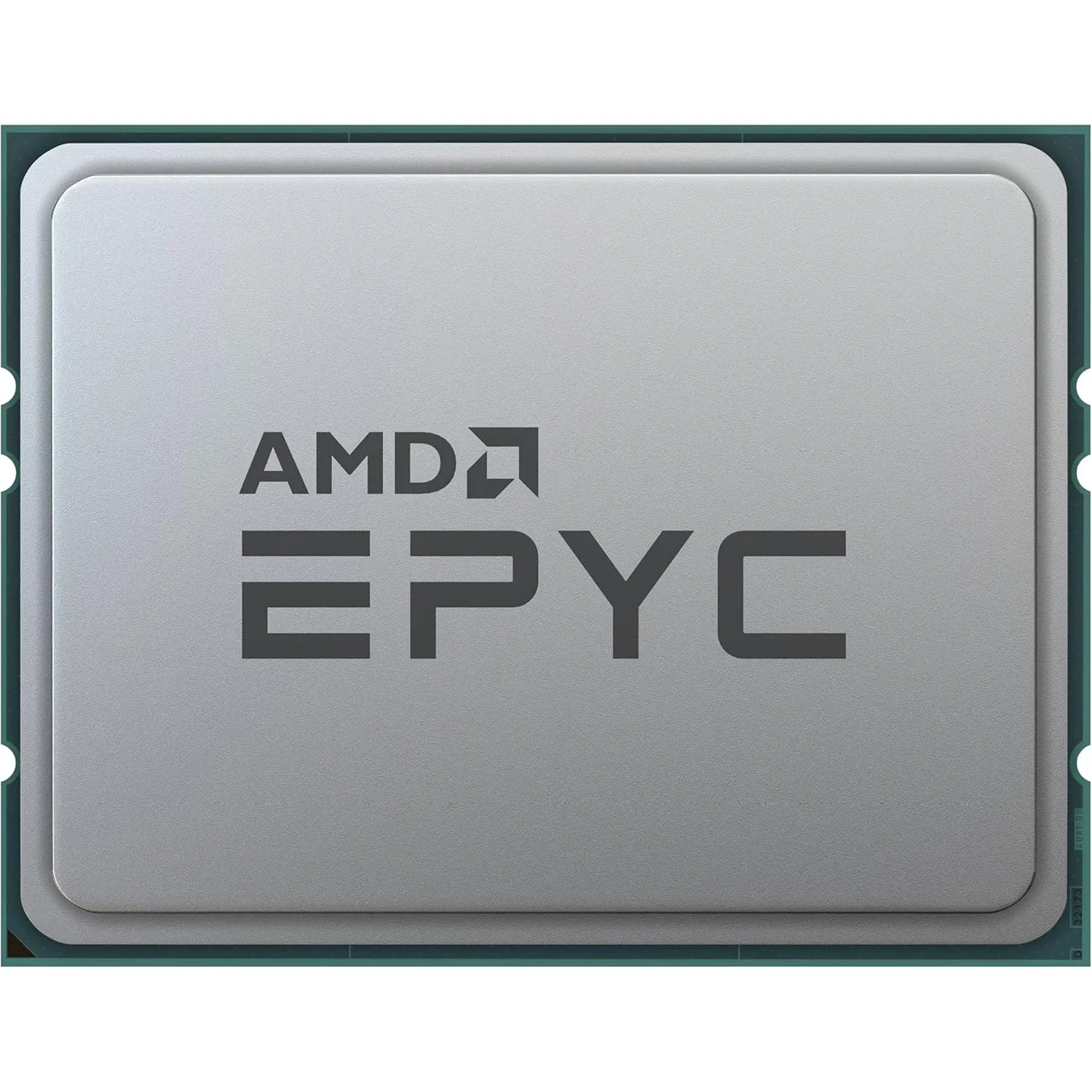
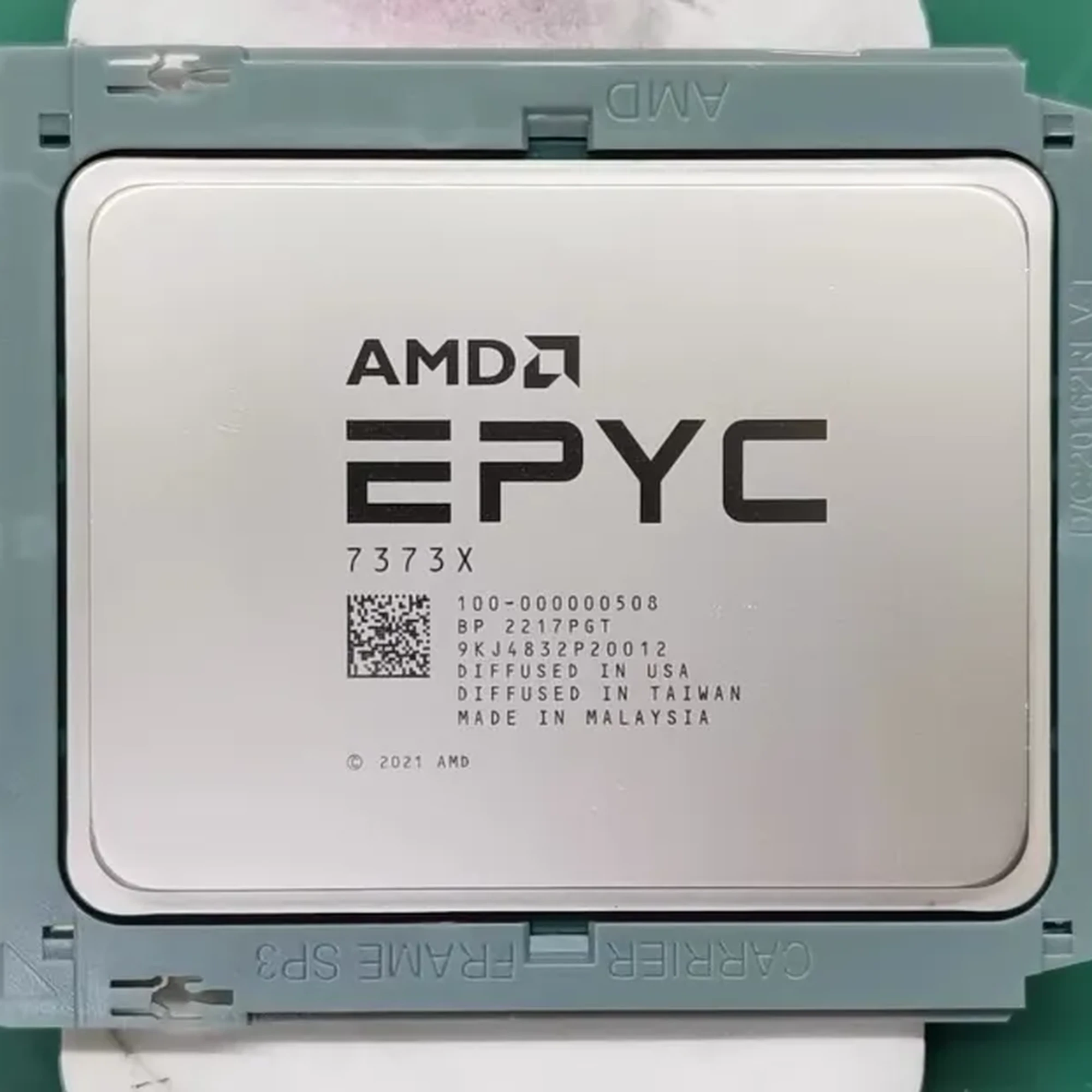
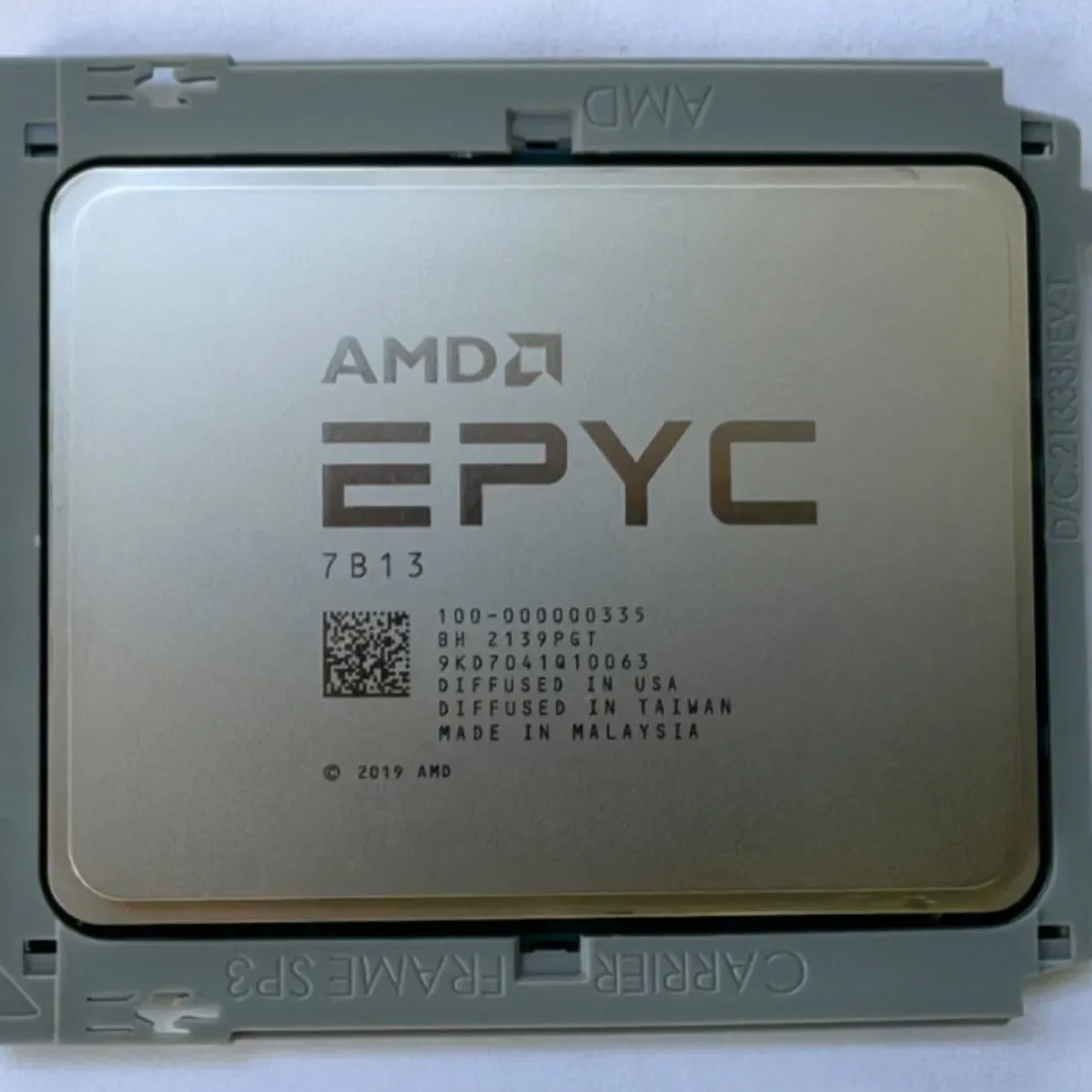
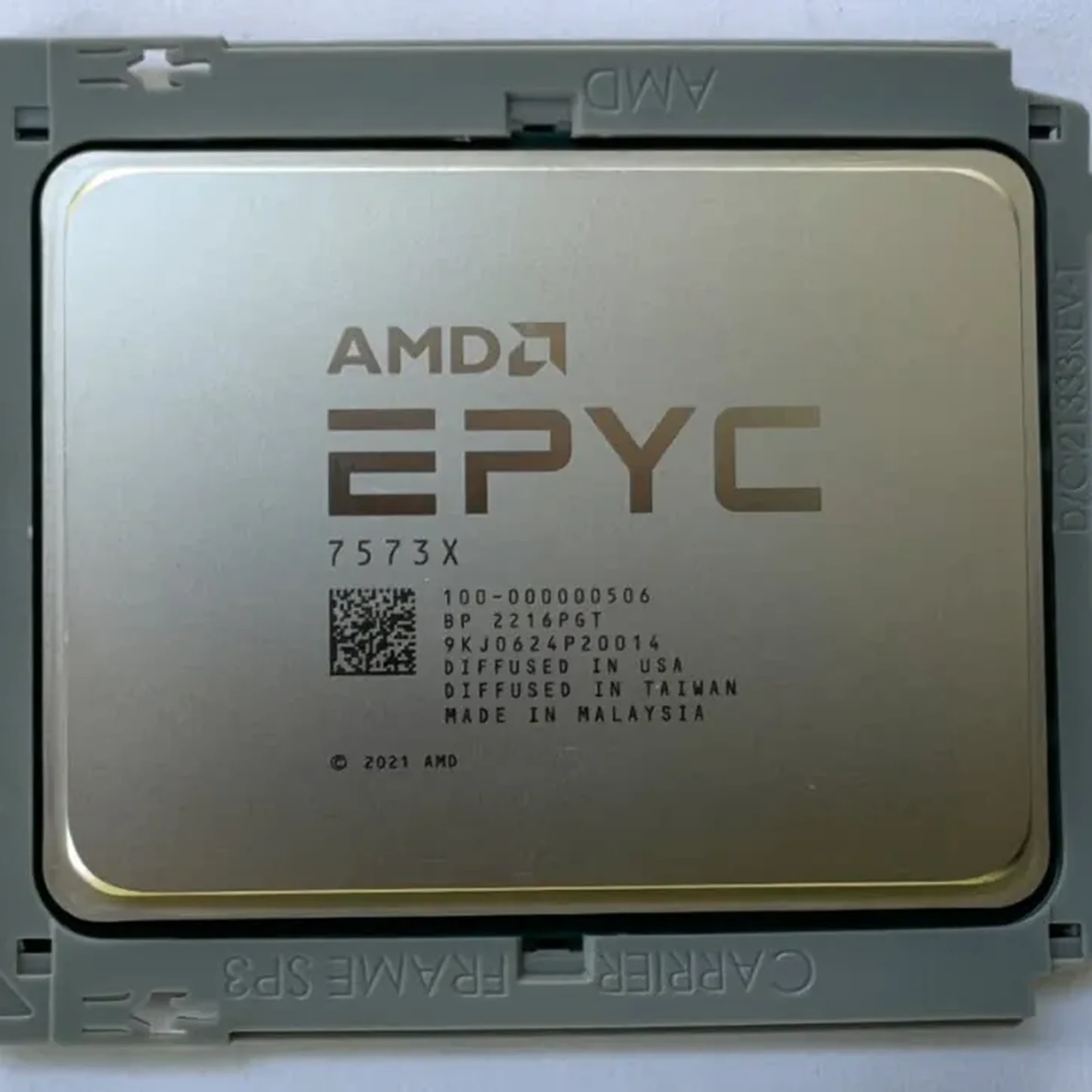
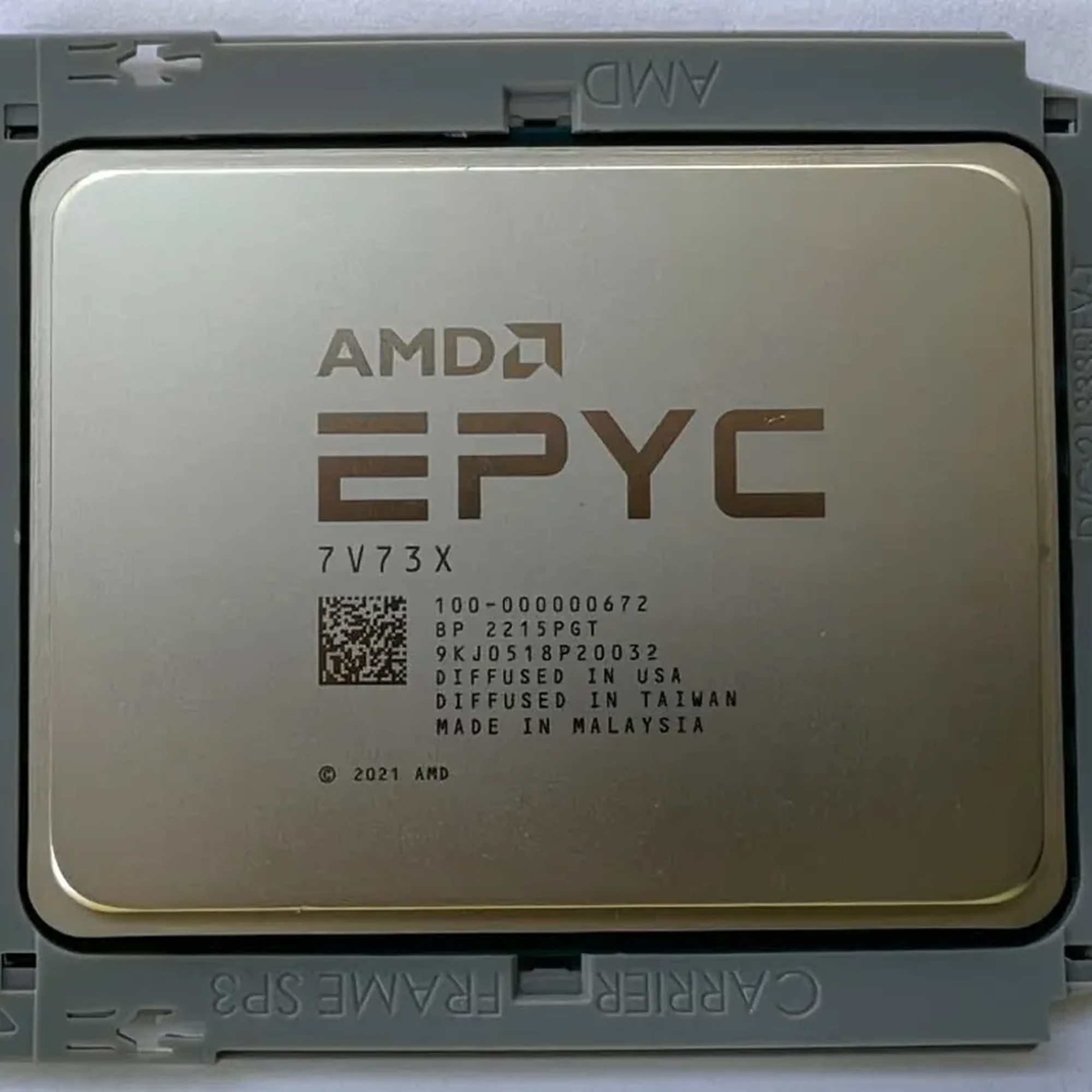
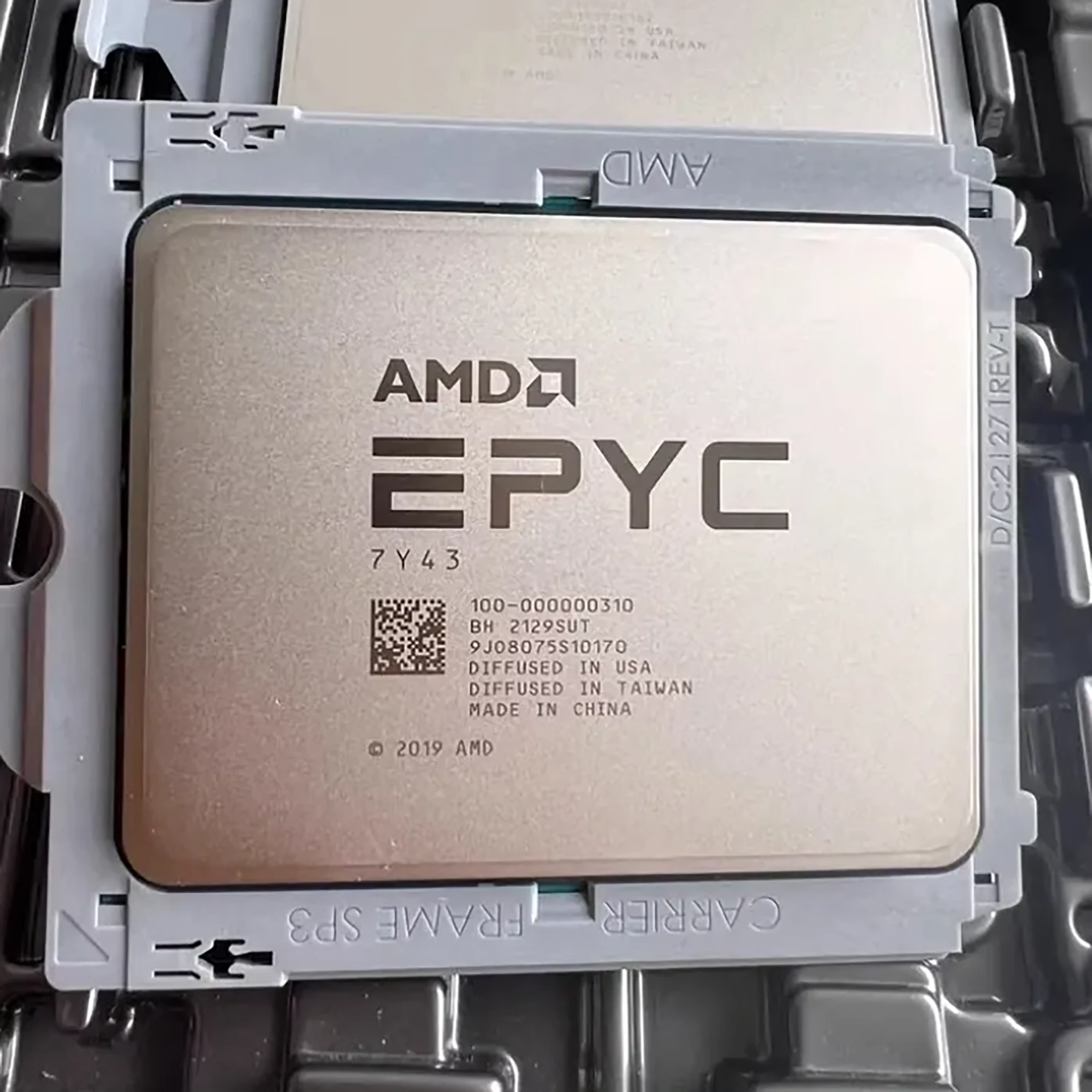
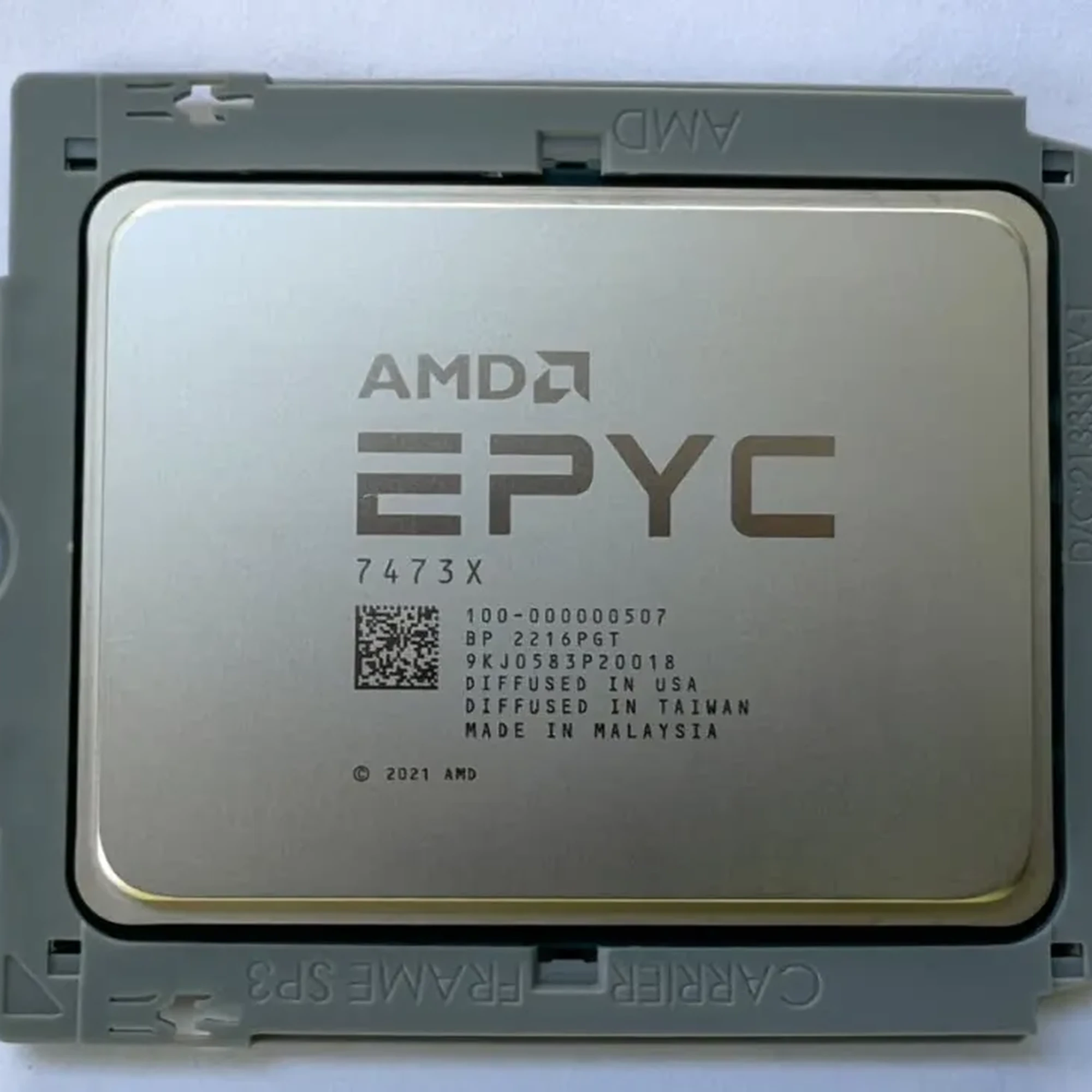
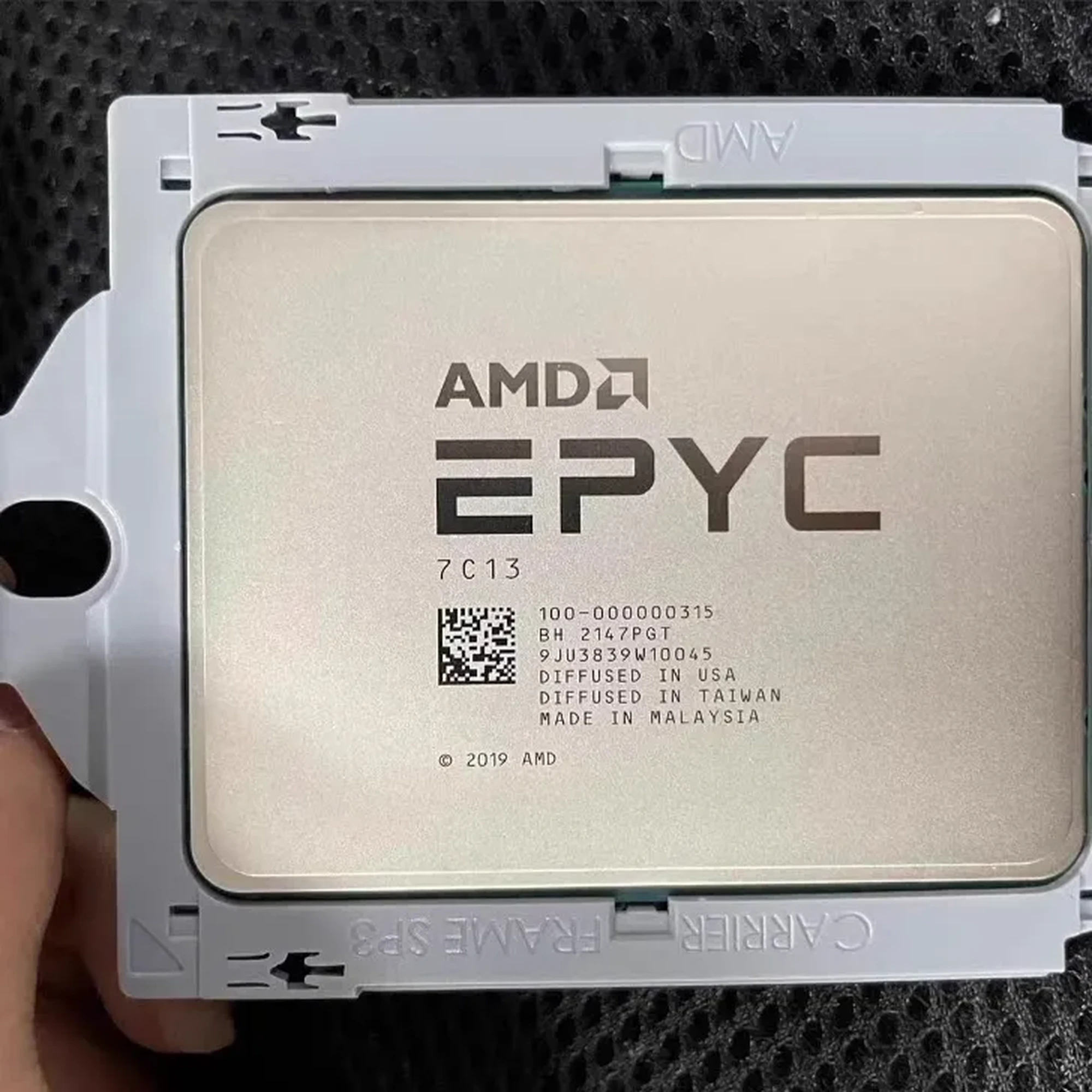
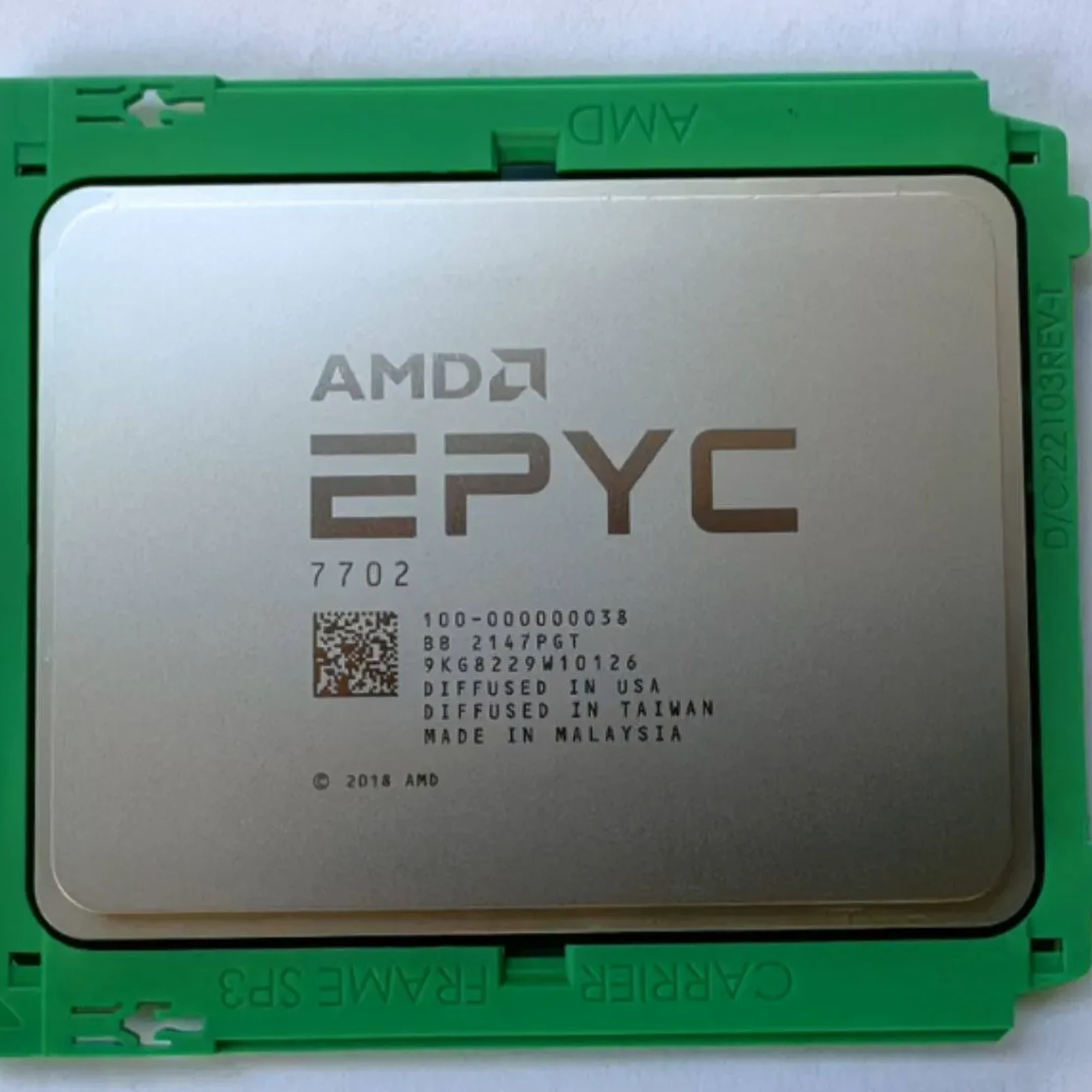

AMD EPYC 7373X 16-Core Server Processor | 7nm Milan-X, 3.8GHz Turbo, 768MB L3 Cache
| Specification Category | Details |
|---|---|
| Processor Model | AMD EPYC 7373X |
| Series | AMD EPYC 7003 (Milan-X) Series |
| Architecture | Zen 3 (Milan-X) |
| Manufacturing Process | 7nm (TSMC) |
| Release Date | March 22, 2022 |
| Core Count | 16 (Hexadeca-Core) |
| Thread Count | 32 (SMT Supported) |
| Base Clock Speed | 3.05 GHz |
| Maximum Turbo Boost Speed | 3.8 GHz |
| L1 Cache | 64KB per core (1MB total) |
| L2 Cache | 512KB per core (8MB total) |
| L3 Cache | 768MB (Shared) |
| TDP (Thermal Design Power) | 240W |
| Configurable TDP (cTDP) | 225W – 280W |
| Socket Type | AMD Socket SP3 (FCLGA-4094) |
| Max Socket Count | 1P / 2P |
| Memory Type | DDR4-3200 |
| Memory Channels | 8 |
| Memory Bandwidth | 204.8 GB/s per socket |
| ECC Memory Support | Yes |
| PCIe Version | PCIe 4.0 |
| PCIe Lanes | 128 |
| Transistor Count | 33.2 Billions |
| Die Size | 8×81 mm² (CCD); 416 mm² (I/O Die) |
| I/O Process Size | 12nm |
| Unlocked Multiplier | No |
| Supported Technologies | AMD 3D V-Cache™, AMD Infinity Guard, AMD Infinity Architecture, AMD-V Virtualization |
| Workload Affinity | CFD, EDA, FEA Solvers, Virtualization, Cloud Computing, Data Analytics |
| Product ID (Tray) | 100-000000508 |
| 1KU Pricing | USD 4185 |
In the fast-paced world of enterprise computing, data centers and businesses rely on powerful, efficient server processors to handle increasingly demanding workloads—from virtualization and cloud hosting to high-performance computing (HPC) and data analytics. The AMD EPYC 7373X emerges as a standout solution in this space, part of AMD’s acclaimed EPYC 7003 (Milan-X) series, engineered to deliver the perfect balance of performance, scalability, and reliability for modern enterprise environments. Built on cutting-edge 7nm manufacturing technology and powered by AMD’s Zen 3 (Milan-X) architecture, the EPYC 7373X is designed to redefine what’s possible for mid-range server processors, offering exceptional multi-core performance, generous cache capacity, and advanced features that cater to the most rigorous enterprise needs.
Key Overview: What Makes the AMD EPYC 7373X a Top Choice for Enterprises?
Released in March 2022, the AMD EPYC 7373X is a server-grade processor tailored for professional systems, combining 16 physical cores and 32 threads to handle parallel workloads with ease. Unlike consumer-grade CPUs, this processor is built for 24/7 operation in data center environments, with a focus on stability, security, and energy efficiency. Manufactured by TSMC using a 7nm process, it strikes a critical balance between performance and power consumption, boasting a 240W TDP (Thermal Design Power) that ensures it can deliver high performance without excessive energy costs—a key consideration for data centers looking to optimize their total cost of ownership (TCO).
At its core, the EPYC 7373X leverages AMD’s Zen 3 (Milan-X) architecture, which builds on the success of previous Zen generations by enhancing core efficiency, cache performance, and I/O capabilities. This architecture is specifically optimized for server workloads, with features like AMD 3D V-Cache™ technology, which significantly increases cache capacity to reduce latency and improve performance for memory-bound tasks. With 768MB of shared L3 cache—one of the largest in its class—the EPYC 7373X ensures that frequently accessed data is stored close to the cores, minimizing the need to access slower system memory and accelerating processing speeds for CPU-intensive workloads.
Performance Breakdown: Core, Clock, and Cache
The AMD EPYC 7373X’s performance is defined by its powerful core configuration, flexible clock speeds, and generous cache allocation—all designed to handle the most demanding enterprise workloads. Let’s break down these key components:
Core and Thread Count
With 16 physical cores and 32 threads (thanks to AMD’s Simultaneous Multithreading, or SMT, technology), the EPYC 7373X excels at parallel processing. This makes it ideal for workloads that can be split across multiple cores, such as virtualization (where multiple VMs run simultaneously), cloud computing, data analytics, and HPC tasks like CFD (Computational Fluid Dynamics), EDA (Electronic Design Automation), and FEA (Finite Element Analysis) solvers. The 16-core design strikes a balance between raw performance and energy efficiency, making it suitable for both small-to-medium data centers and large enterprise deployments.
Clock Speeds
The EPYC 7373X features a base clock speed of 3.05GHz, ensuring consistent performance for baseline workloads. For more demanding tasks, it can boost up to 3.8GHz (maximum turbo boost), delivering a significant performance boost when single-core or lightly-threaded performance is needed. This flexibility is crucial for enterprise environments, where workloads can vary from light background tasks to heavy, bursty processing— the processor adapts seamlessly to meet these changing demands without sacrificing stability.
Notably, the EPYC 7373X has a locked multiplier, meaning it cannot be overclocked. This is a deliberate design choice for server processors, as overclocking can introduce instability and increase power consumption—both of which are undesirable in 24/7 data center environments. Instead, AMD focuses on optimizing the processor’s native performance, ensuring reliable, consistent operation even under heavy loads.
Cache Capacity
One of the most standout features of the EPYC 7373X is its 768MB shared L3 cache. This massive cache size is made possible by AMD’s 3D V-Cache™ technology, which stacks cache dies vertically to increase capacity without increasing the processor’s footprint. The L3 cache acts as a high-speed buffer between the processor cores and system memory, storing frequently accessed data to reduce latency and improve throughput. For memory-bound workloads—such as database management, virtualization, and HPC—this large cache can deliver a significant performance boost, as the processor spends less time waiting for data from slower DDR4 memory.
In addition to the L3 cache, the EPYC 7373X features 64KB of L1 cache per core (1MB total) and 512KB of L2 cache per core (8MB total). This hierarchical cache design ensures that data is stored at the optimal level for quick access, further enhancing performance and efficiency.
Memory and I/O Capabilities: Scalability for Enterprise Needs
Server processors must be able to handle large amounts of memory and high-speed I/O to support modern enterprise workloads, and the AMD EPYC 7373X delivers on both fronts. Let’s explore its memory and I/O specifications:
Memory Support
The EPYC 7373X supports DDR4-3200 memory, with a maximum of 8 memory channels per socket. This high memory bandwidth (up to 204.8 GB/s per socket) ensures that the processor can quickly access large datasets, making it ideal for memory-intensive workloads like in-memory databases, virtualization, and data analytics. Additionally, the processor supports ECC (Error-Correcting Code) memory, which is critical for server environments—ECC memory detects and corrects memory errors, preventing data corruption and ensuring system stability, even during long-term operation.
The 8 memory channels also provide excellent scalability, allowing businesses to expand their memory capacity as their needs grow. This flexibility is essential for data centers that need to adapt to changing workloads and growing data volumes.
I/O Performance
The EPYC 7373X features 128 PCIe 4.0 lanes, delivering exceptional I/O bandwidth for connecting storage devices, network cards, and other peripherals. PCIe 4.0 is twice as fast as PCIe 3.0, with a maximum data transfer rate of 16 GT/s per lane—this means faster access to SSDs, GPUs, and other high-speed devices, which is critical for workloads like video editing, 3D rendering, and HPC.
The large number of PCIe lanes also provides excellent scalability, allowing businesses to connect multiple devices without sacrificing performance. This is particularly useful for virtualization environments, where multiple VMs may need access to shared storage or network resources.
Workload Optimization: Perfect for Enterprise Use Cases
The AMD EPYC 7373X is engineered to excel in a wide range of enterprise workloads, thanks to its balanced performance, large cache, and advanced features. Let’s explore some of the key use cases where this processor shines:
Virtualization and Cloud Computing
Virtualization is a cornerstone of modern data centers, allowing businesses to maximize resource utilization by running multiple virtual machines (VMs) on a single server. The EPYC 7373X’s 16 cores and 32 threads make it ideal for virtualization, as it can handle multiple VMs simultaneously without sacrificing performance. The large 768MB L3 cache ensures that each VM has quick access to frequently used data, reducing latency and improving responsiveness. Additionally, the processor’s support for AMD-V virtualization technology enhances VM performance and security, making it a top choice for cloud service providers and enterprise virtualization deployments.
High-Performance Computing (HPC)
HPC workloads—such as CFD, EDA, FEA solvers, and scientific computing—require massive parallel processing power and fast memory access. The EPYC 7373X’s 16 cores, 32 threads, and 768MB L3 cache make it well-suited for these tasks, delivering the performance needed to accelerate complex simulations and data analysis. According to benchmark data from OpenBenchmarking.org, the EPYC 7373X performs exceptionally well in HPC-related benchmarks, such as ACES DGEMM (sustained floating-point rate) and ASKAP (grid processing), making it a reliable choice for research institutions and engineering firms.
Database and Data Analytics
Databases and data analytics platforms require fast access to large datasets and the ability to process complex queries efficiently. The EPYC 7373X’s 8 memory channels and high memory bandwidth ensure that databases can quickly access and process data, while the large L3 cache reduces latency for frequently accessed data. This makes the processor ideal for enterprise databases (such as MySQL, PostgreSQL, and SQL Server) and data analytics tools (such as Apache Spark and Hadoop), helping businesses derive insights from their data faster.
Enterprise Security and Reliability
In addition to performance, the EPYC 7373X includes a range of advanced security features to protect enterprise data and systems. AMD Infinity Guard is a suite of security technologies that includes secure boot, memory encryption, and secure virtualization, helping to prevent unauthorized access to data and ensure the integrity of virtual machines. These features are critical for enterprise environments, where data security is a top priority.
The processor’s 24/7 reliability is another key advantage for data centers. Built to withstand the rigors of continuous operation, the EPYC 7373X undergoes rigorous testing to ensure stability and durability, reducing downtime and maintenance costs for businesses.
Benchmark Performance: How Does the EPYC 7373X Stack Up?
To truly understand the EPYC 7373X’s performance, it’s important to look at real-world benchmarks. According to data from TopCPU.net and OpenBenchmarking.org, the processor delivers impressive results in both single-core and multi-core tests:
- Geekbench 6 Single-Core: The EPYC 7373X scores approximately 1930, placing it on par with high-performance processors like the Intel Xeon W 5-2465X and AMD Ryzen 5 5500X3D. This means it can handle single-threaded workloads—such as web servers and light database queries—with ease.
- Geekbench 6 Multi-Core: With a score of around 15766, the EPYC 7373X outperforms many similarly priced processors, including the AMD EPYC 4464P and Intel Core Ultra 7 255H. This multi-core performance is critical for parallel workloads like virtualization and HPC.
- Geekbench 5 Multi-Core: The processor scores approximately 24913, outperforming the Intel Core i9 13900K and AMD Ryzen 9 7950X in this benchmark, highlighting its exceptional multi-core efficiency.
- OpenBenchmarking.org Tests: In HPC-related tests, the EPYC 7373X delivers strong results, including 7.980 GFlop/s in ACES DGEMM and 15060 MPIx/sec in ASKAP MPI-gridding, demonstrating its capabilities for complex scientific and engineering workloads.
These benchmarks confirm that the EPYC 7373X is a high-performance processor that can handle the most demanding enterprise workloads, while its 7nm工艺 ensures energy efficiency and lower TCO compared to older, larger-processors.
Why Choose the AMD EPYC 7373X for Your Data Center?
When it comes to choosing a server processor, businesses need to balance performance, cost, and reliability—and the AMD EPYC 7373X delivers on all three fronts. Here are the key reasons to choose this processor for your enterprise:
- Exceptional Performance: 16 cores, 32 threads, 3.8GHz turbo boost, and 768MB L3 cache deliver the power needed for enterprise workloads.
- Energy Efficiency: 7nm TSMC and 240W TDP reduce energy costs, lowering TCO for data centers.
- Scalability: 8 memory channels, 128 PCIe 4.0 lanes, and support for 2P configurations allow for easy expansion as your business grows.
- Advanced Security: AMD Infinity Guard and AMD-V virtualization technology protect your data and systems.
- Reliability: Built for 24/7 operation, with rigorous testing to ensure stability and durability.
- Value for Money: Competes with higher-priced processors while delivering comparable or better performance, making it a cost-effective choice for enterprises.
In summary, the AMD EPYC 7373X is a versatile, high-performance server processor that is perfectly suited for modern enterprise environments. Whether you’re running a small data center, a cloud service, or an HPC cluster, this processor delivers the performance, scalability, and reliability you need to stay competitive in today’s digital landscape. With its advanced features, energy efficiency, and exceptional benchmark results, the EPYC 7373X is a top choice for businesses looking to optimize their server infrastructure and reduce TCO.
Recommended Motherboards for AMD EPYC 7002/7003 SP3 Processors
| Model | Brand | CPU Configuration | Memory Slots | Max Memory | LAN | PCIe Expansion | Storage | Form Factor | BMC |
|---|---|---|---|---|---|---|---|---|---|
| MZ72-HB2 | GIGABYTE | Dual SP3 | 16×DDR4 | 2TB | 2×10G + 1×Mgmt LAN | 5×PCIe 4.0 x16/x8 | 5×SlimSAS, 1×M.2 | E-ATX | AST2600 |
| MZ32-AR0 | GIGABYTE | Single SP3 | 16×DDR4 | 2TB | 2×1G (Intel I350) | 7×PCIe 4.0/3.0 x16/x8 | 6×SlimSAS, 2×M.2 | E-ATX | AST2600 |
| MZ71-CE1 | GIGABYTE | Dual SP3 | 16×DDR4 | 2TB | 2×1G (BCM5720) + Mgmt LAN | 5×PCIe 4.0 x16/x8 | 3×SlimSAS, 4×SATA | E-ATX | AST2600 |
| ROMED8-2T/BCM | ASRock Rack | Single SP3 | 8×DDR4 | 256GB | 2×10G (Intel X550) + IPMI | 7×PCIe 4.0 x16 | 10×SATA, 2×M.2 | ATX | AST2500 |
| ROMED4ID-2T | ASRock Rack | Single SP3 | 4×DDR4 | 256GB | 2×10G (Intel X550) + IPMI | 1×PCIe 4.0 x16 | 16×SATA, 1×M.2 | Mini-ITX | AST2500 |
| ROME2D16-2T | ASRock Rack | Dual SP3 | 16×DDR4 | 4TB | 2×10G (Intel X550) + IPMI | 5×PCIe 4.0 x16 + 1×x8 | 2×SlimSAS, 2×OcuLink, 2×M.2 | EEB | AST2600 |
| ROME2D32GM-2T | ASRock Rack | Dual SP3 | 32×DDR4 | 8TB | 2×10G + IPMI | 6×PCIe 4.0 x16 | 19×SlimSAS, 1×M.2 | EEB | AST2600 |
| H12SSL-NT | Supermicro | Single SP3 | 8×DDR4 | 2TB | 2×10G (BCM57416) + IPMI | 5×PCIe 4.0 x16/x8 | 2×SlimSAS (SATA/NVMe) | ATX | AST2500 |
| H12SSL-i | Supermicro | Single SP3 | 8×DDR4 | 2TB | 2×1G (BCM5720) | 5×PCIe 4.0 x16, 2×x8 | 8×SATA, 2×M.2 | ATX | AST2500 |
| H12DSi-N6 | Supermicro | Dual SP3 | 16×DDR4 | 4TB | 2×1G + IPMI | 3×PCIe 4.0 x16, 3×x8 | 10×SATA, 1×M.2 | E-ATX | AST2600 |
AMD EPYC 7003 Series Processors Specifications
| Name | # of CPU Cores | # of Threads | Max. Boost Clock | Base Clock | L3 Cache | Default TDP |
| AMD EPYC™ 7203P | 8 | 16 | Up to 3.4 GHz | 2.8 GHz | 64 MB | 120W |
| AMD EPYC™ 7203 | 8 | 16 | Up to 3.4 GHz | 2.8 GHz | 64 MB | 120W |
| AMD EPYC™ 72F3 | 8 | 16 | Up to 4.1 GHz | 3.7 GHz | 256 MB | 180W |
| AMD EPYC™ 7303P | 16 | 32 | Up to 3.4 GHz | 2.4 GHz | 64 MB | 130W |
| AMD EPYC™ 7303 | 16 | 32 | Up to 3.4 GHz | 2.4 GHz | 64 MB | 130W |
| AMD EPYC™ 73F3 | 16 | 32 | Up to 4 GHz | 3.5 GHz | 256 MB | 240W |
| AMD EPYC™ 7373X | 16 | 32 | Up to 3.8 GHz | 3.05 GHz | 768 MB | 240W |
| AMD EPYC™ 7343 | 16 | 32 | Up to 3.9 GHz | 3.2 GHz | 128 MB | 190W |
| AMD EPYC™ 7313P | 16 | 32 | Up to 3.7 GHz | 3 GHz | 128 MB | 155W |
| AMD EPYC™ 7313 | 16 | 32 | Up to 3.7 GHz | 3 GHz | 128 MB | 155W |
| AMD EPYC™ 74F3 | 24 | 48 | Up to 4 GHz | 3.2 GHz | 256 MB | 240W |
| AMD EPYC™ 7473X | 24 | 48 | Up to 3.7 GHz | 2.8 GHz | 768 MB | 240W |
| AMD EPYC™ 7443P | 24 | 48 | Up to 4 GHz | 2.85 GHz | 128 MB | 200W |
| AMD EPYC™ 7443 | 24 | 48 | Up to 4 GHz | 2.85 GHz | 128 MB | 200W |
| AMD EPYC™ 7413 | 24 | 48 | Up to 3.6 GHz | 2.65 GHz | 128 MB | 180W |
| AMD EPYC™ 7453 | 28 | 56 | Up to 3.45 GHz | 2.75 GHz | 64 MB | 225W |
| AMD EPYC™ 75F3 | 32 | 64 | Up to 4 GHz | 2.95 GHz | 256 MB | 280W |
| AMD EPYC™ 7573X | 32 | 64 | Up to 3.6 GHz | 2.8 GHz | 768 MB | 280W |
| AMD EPYC™ 7543P | 32 | 64 | Up to 3.7 GHz | 2.8 GHz | 256 MB | 225W |
| AMD EPYC™ 7543 | 32 | 64 | Up to 3.7 GHz | 2.8 GHz | 256 MB | 225W |
| AMD EPYC™ 7513 | 32 | 64 | Up to 3.65 GHz | 2.6 GHz | 128 MB | 200W |
| AMD EPYC™ 7643P | 48 | 96 | Up to 3.6 GHz | 2.3 GHz | 256 MB | 225W |
| AMD EPYC™ 7643 | 48 | 96 | Up to 3.6 GHz | 2.3 GHz | 256 MB | 225W |
| AMD EPYC™ 7663 | 56 | 112 | Up to 3.5 GHz | 2 GHz | 256 MB | 240W |
| AMD EPYC™ 7663P | 56 | 112 | Up to 3.5 GHz | 2 GHz | 256 MB | 240W |
| AMD EPYC™ 7773X | 64 | 128 | Up to 3.5 GHz | 2.2 GHz | 768 MB | 280W |
| AMD EPYC™ 7763 | 64 | 128 | Up to 3.5 GHz | 2.45 GHz | 256 MB | 280W |
| AMD EPYC™ 7713P | 64 | 128 | Up to 3.67 GHz | 2 GHz | 256 MB | 225W |
| AMD EPYC™ 7713 | 64 | 128 | Up to 3.67 GHz | 2 GHz | 256 MB | 225W |


