
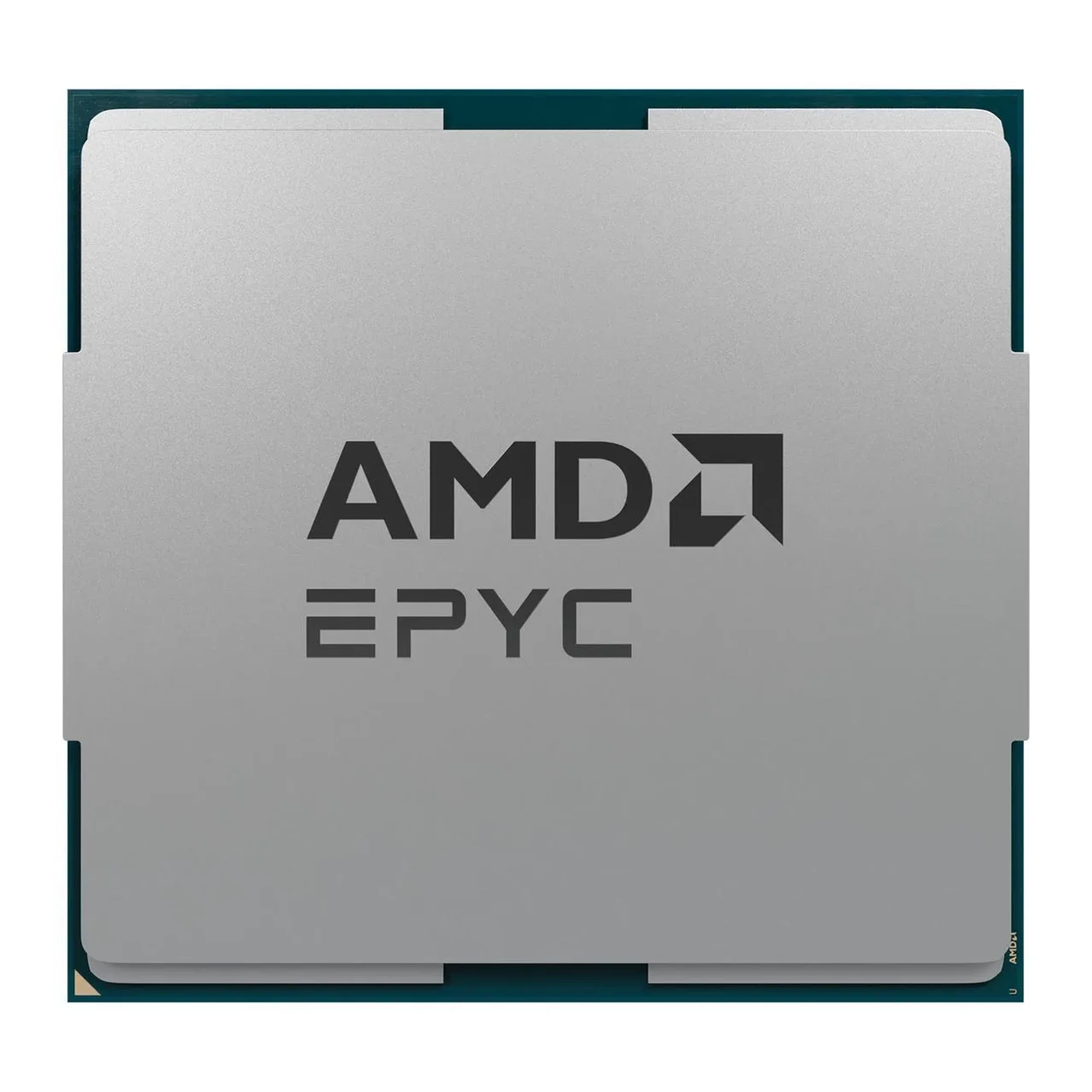
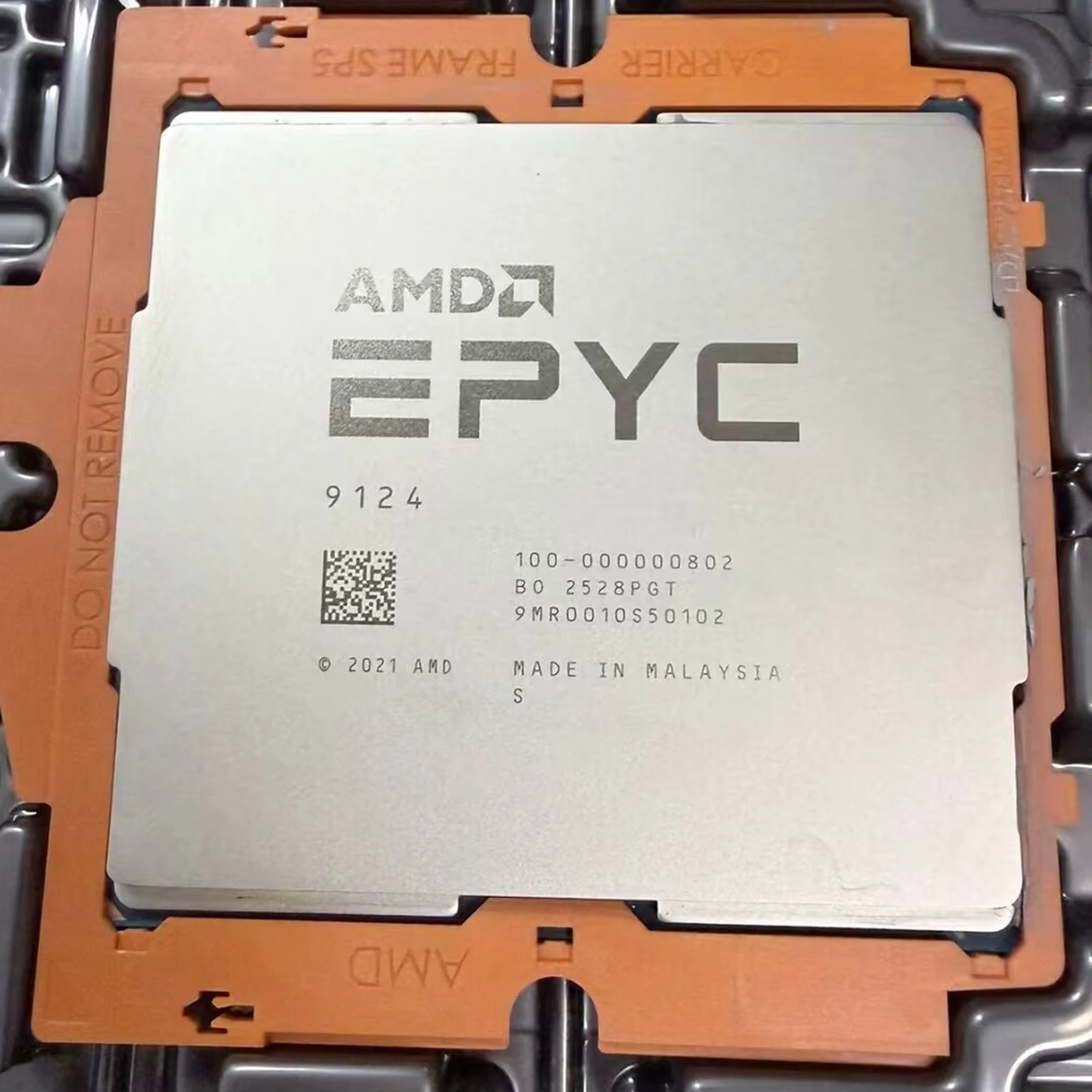
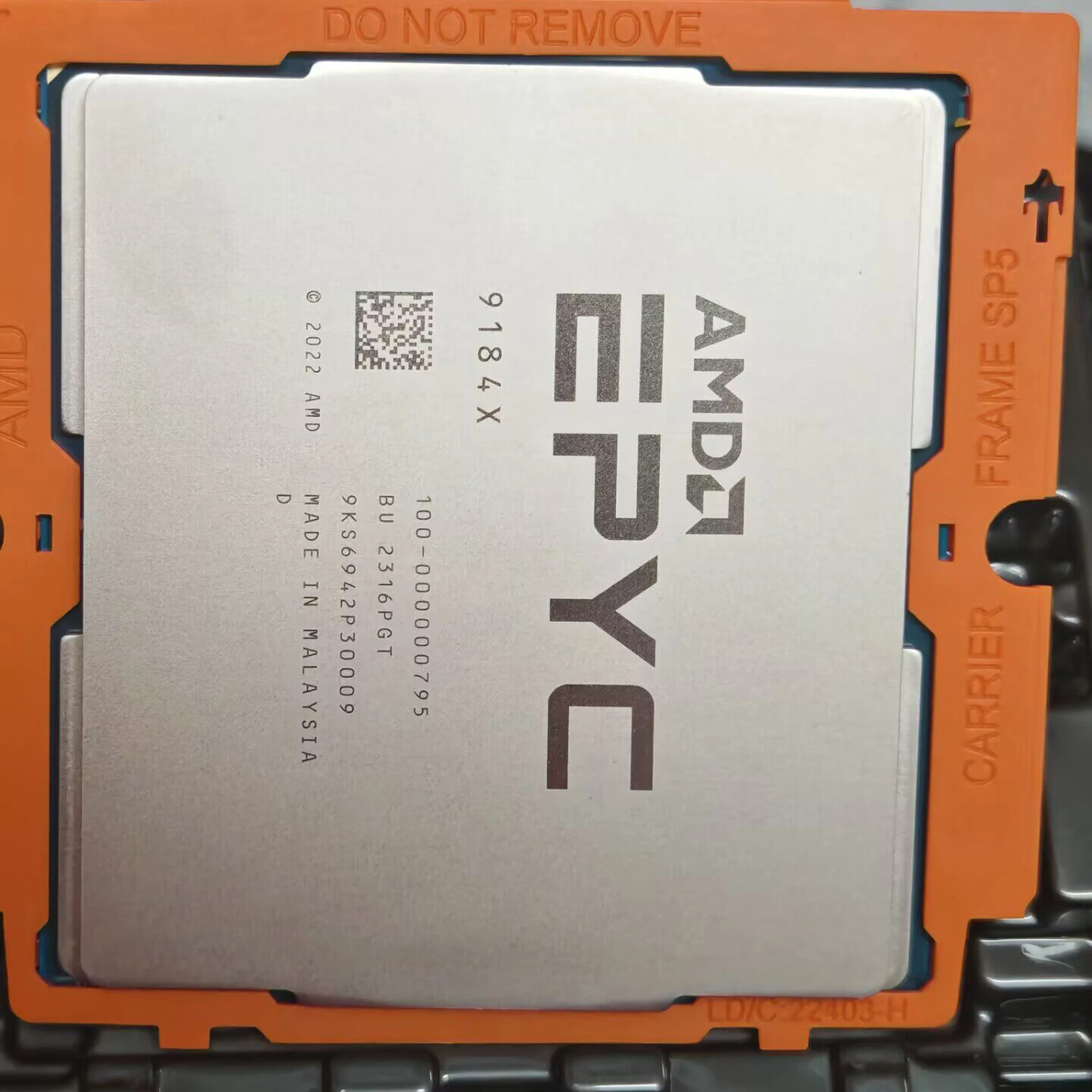
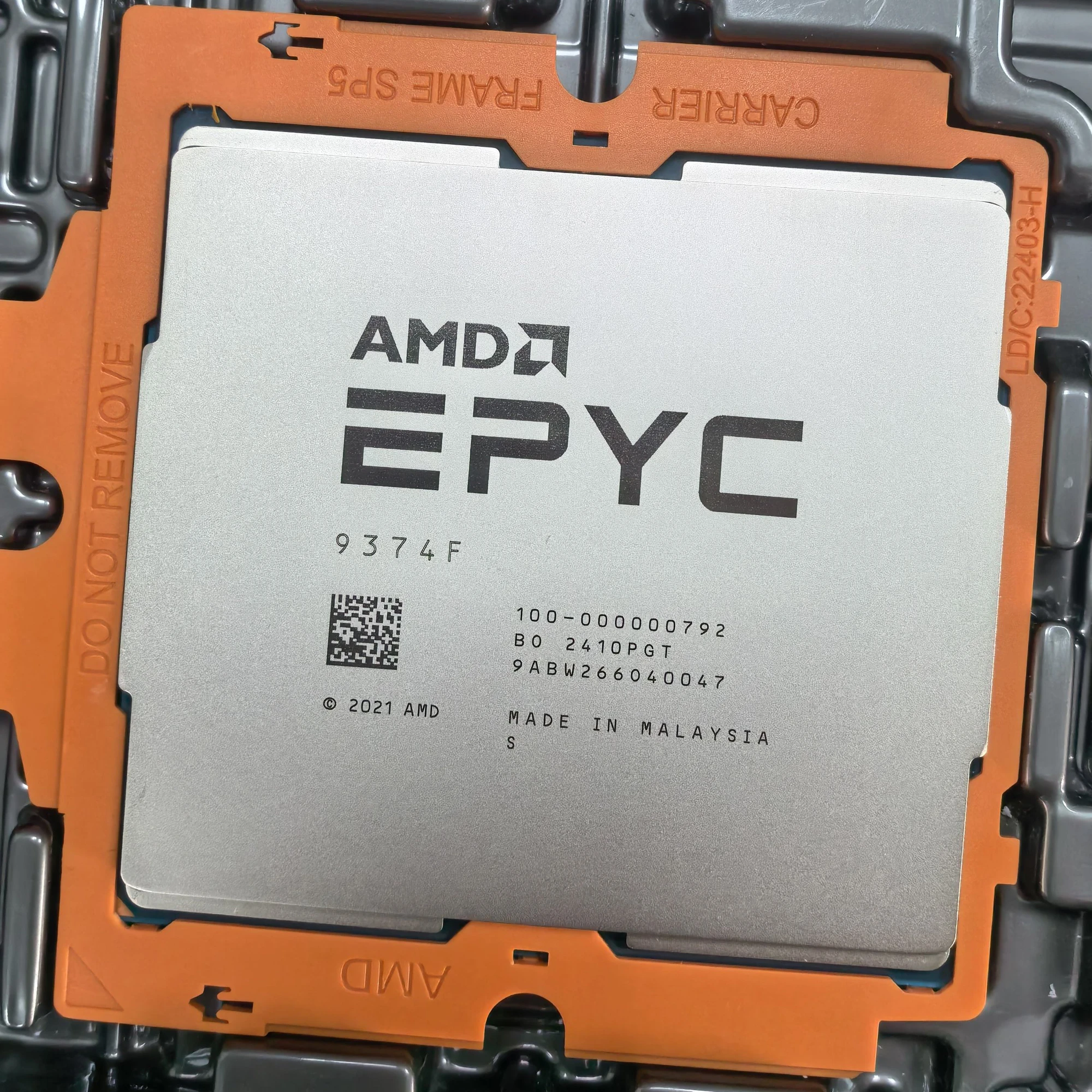
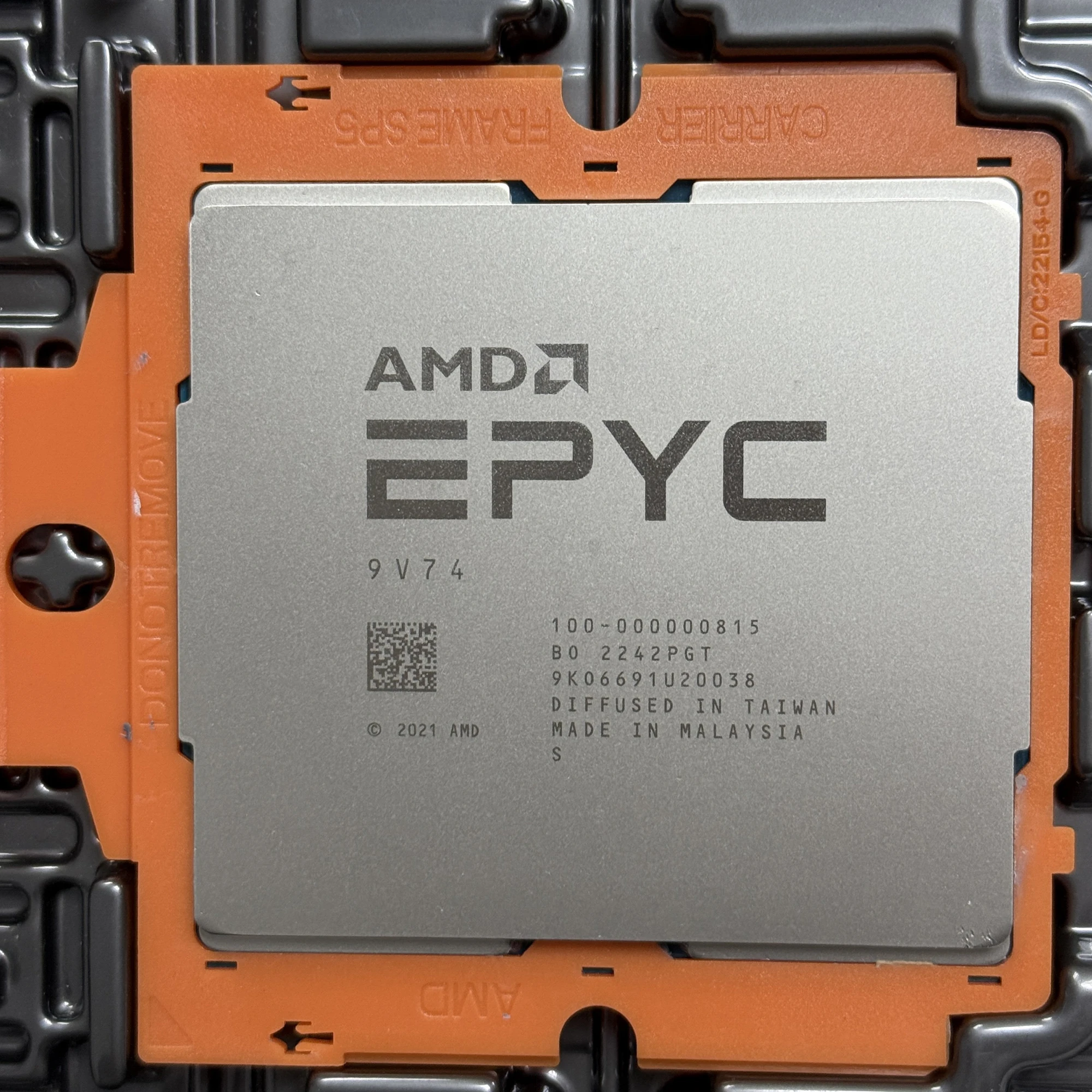
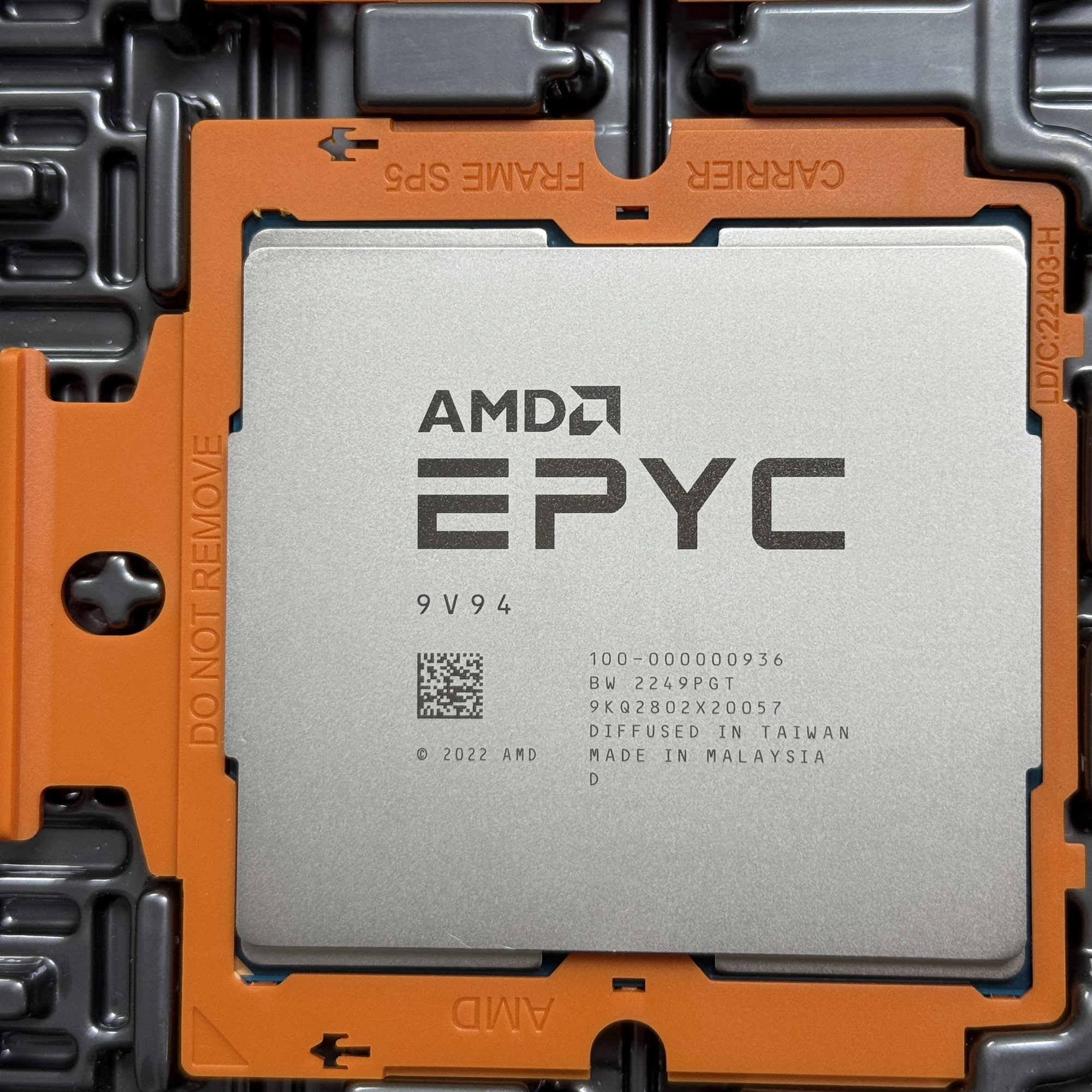
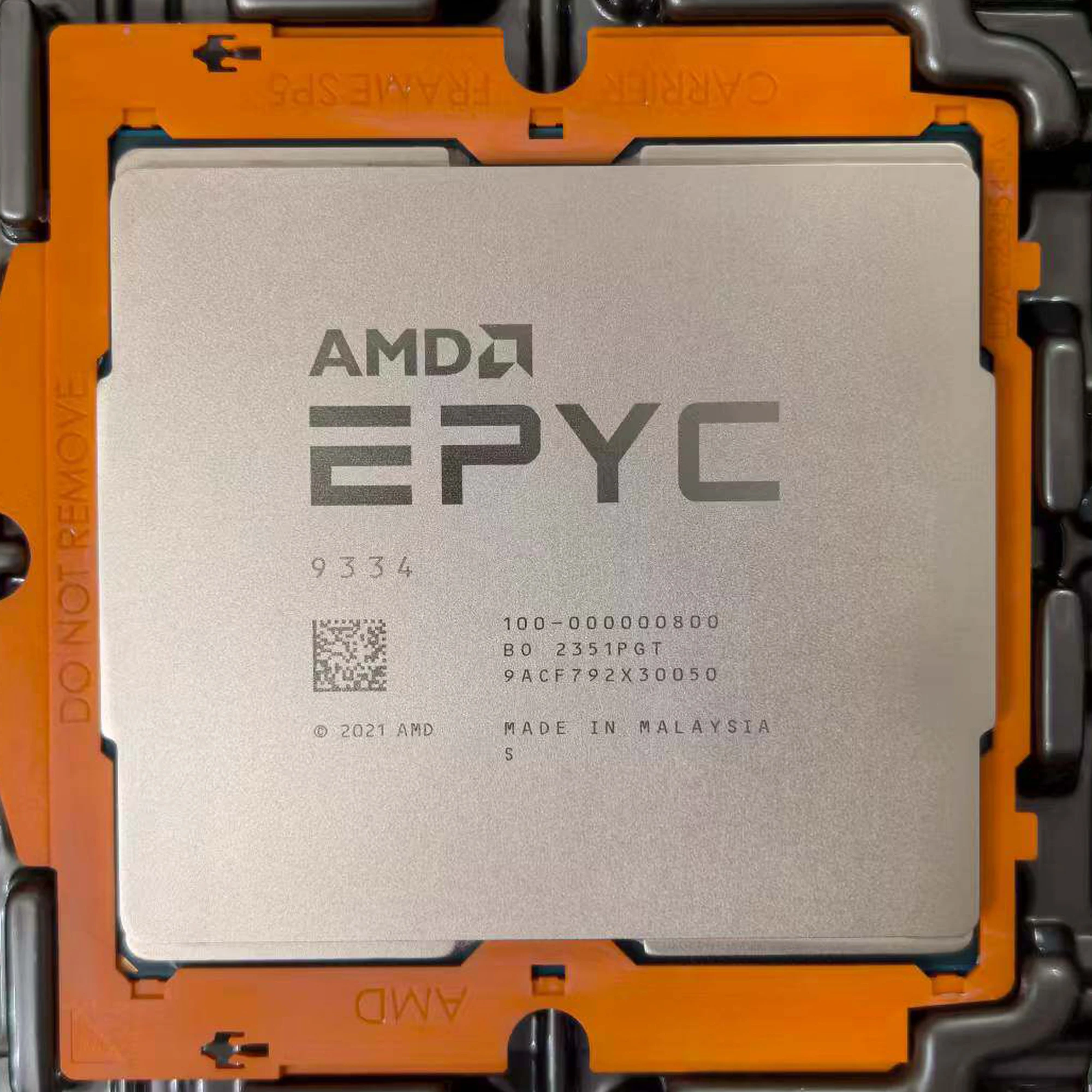
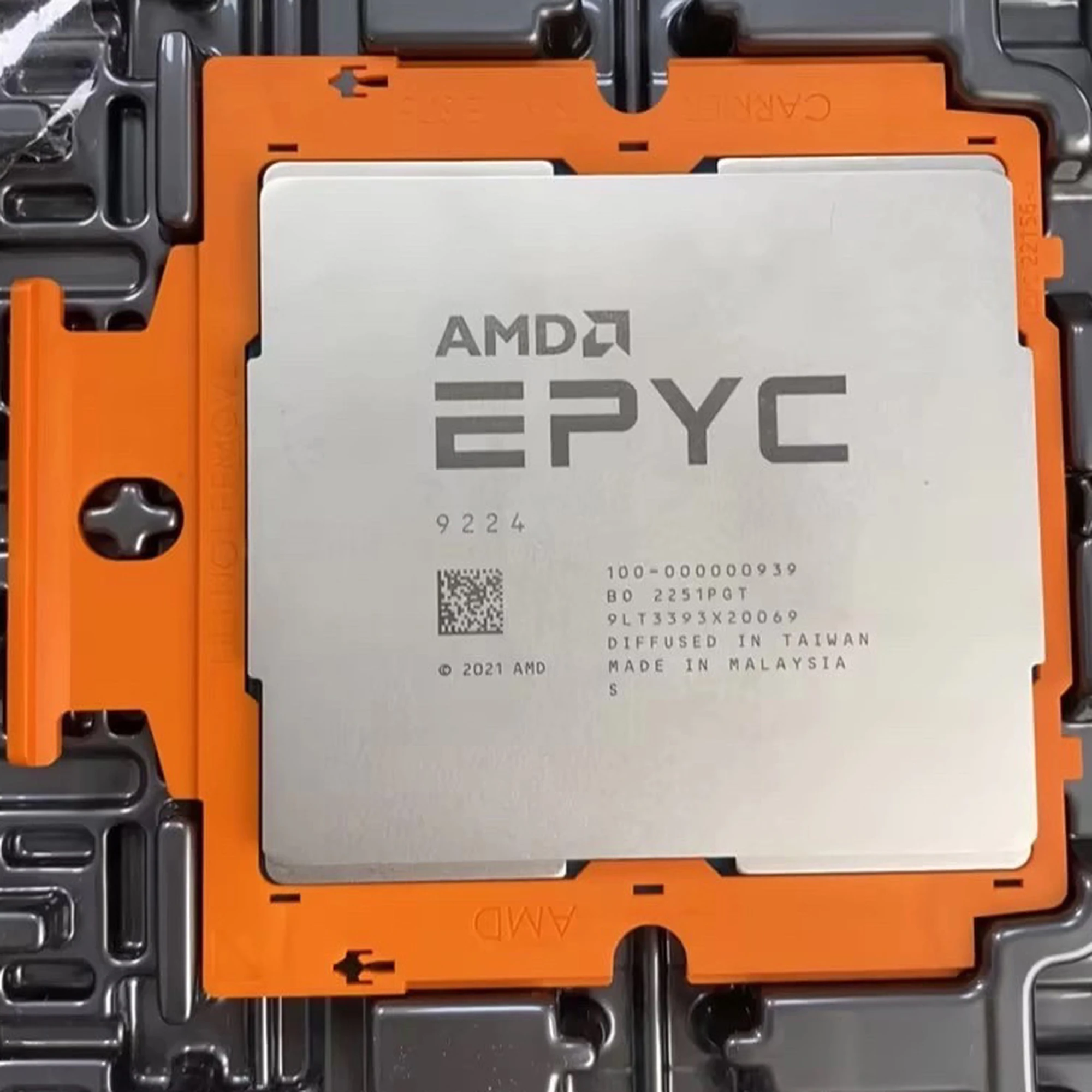

 AMD EPYC 9224 Server Processor | 24 Cores, 48 Threads, 3.7GHz Boost, DDR5, PCIe 5.0 – Enterprise-Grade Performance
| Specification | Details |
|---|---|
| Processor Model | AMD EPYC 9224 |
| Product Series | AMD EPYC 9004 (Genoa) Series |
| Architecture | Zen 4 (Genoa), 5nm Process |
| Cores | 24 Physical Cores |
| Threads | 48 Threads (SMT Supported) |
| Base Clock Speed | 2.5 GHz |
| Max Boost Clock | 3.7 GHz (Single-Core) |
| All-Core Boost Speed | 3.65 GHz |
| Cache | 24MB L2 Cache (1MB per Core), 64MB L3 Cache |
| Memory Support | DDR5, Up to 4800 MT/s, 12 Memory Channels, Up to 6TB Capacity |
| Memory Bandwidth | 460.8 GB/s (Per Socket) |
| PCIe Version | PCIe 5.0 |
| PCIe Lanes | 128 Lanes |
| TDP | 200W (Standard), Configurable (cTDP: 200-240W) |
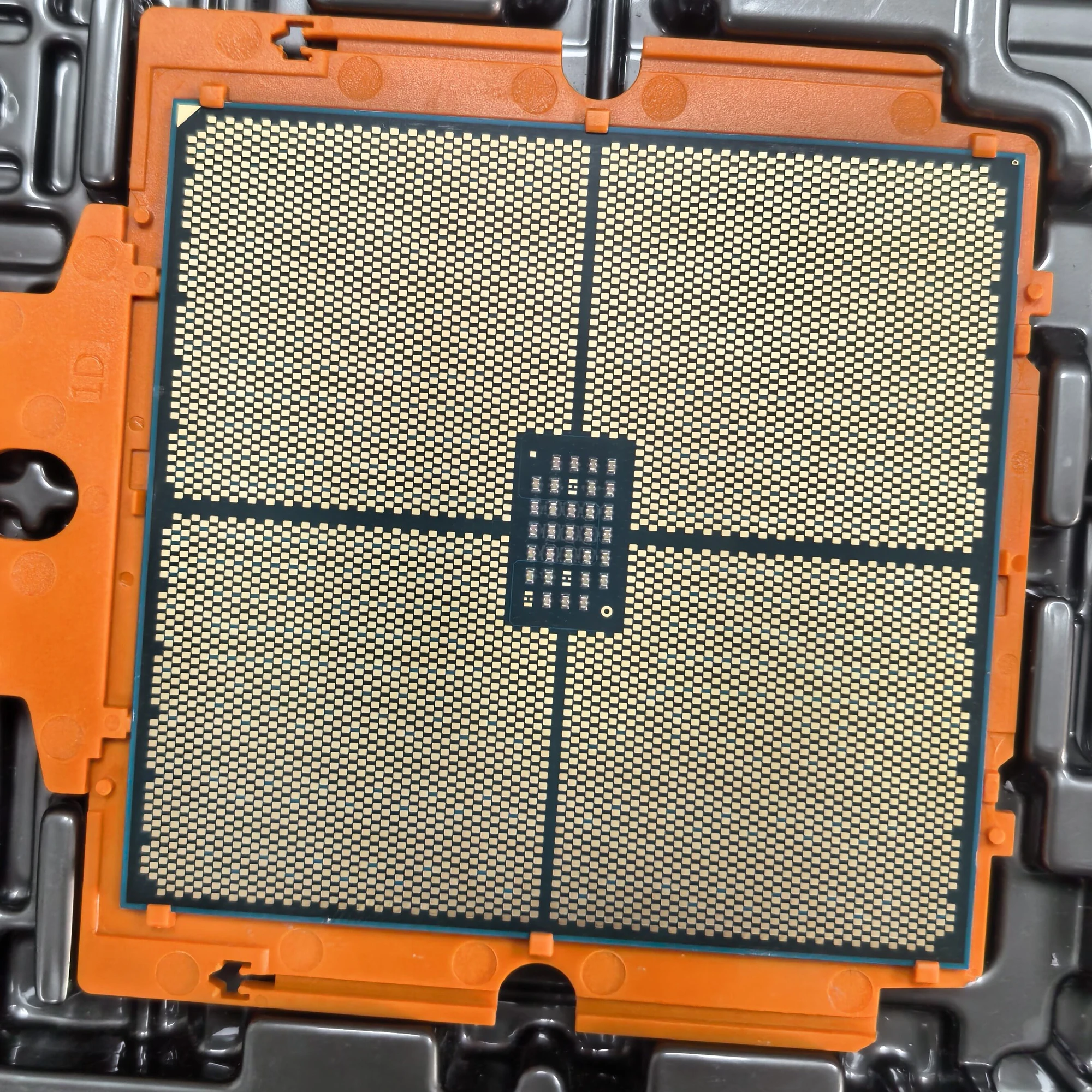
| Socket | SP5 |
| Socket Configuration | 1P (Single-Socket) / 2P (Dual-Socket) |
| Launch Date | November 10, 2022 |
| 1KU Pricing | $1825 USD |
| Security Features | AMD Infinity Guard, Secure Memory Encryption (SME), Secure Encrypted Virtualization (SEV) |
| Supported Workloads | Virtualization, Web Serving, Data Analytics, AI Inference, Networking/NFV, CRM/ERM/SCM Apps, Blockchain, Quantitative Trading |
| Product ID (Tray) | 100-000000939 |
| Geekbench 6 Score | ~1,623 (Single-Core), ~13,069 (Multi-Core) |
| Supported Operating Systems | Windows Server 2022, Linux, Windows 11 |
In the fast-paced world of enterprise data centers, choosing the right server processor is critical to unlocking efficiency, performance, and scalability—especially as businesses grapple with growing workloads, increasing data volumes, and the demand for 24/7 reliability. The AMD EPYC 9224 server processor, part of AMD’s 4th-generation EPYC 9004 (Genoa) series, stands out as a versatile, high-performance solution designed to meet the diverse needs of modern data centers, from small businesses to large enterprises. Built on AMD’s cutting-edge Zen 4 architecture and manufactured using a 5nm process, the EPYC 9224 delivers a powerful balance of multi-core performance, energy efficiency, and advanced connectivity, making it an ideal choice for a wide range of workloads, including virtualization, web serving, data analytics, AI inference, and cloud infrastructure.
Key Architecture & Core Performance: Zen 4 Power for Enterprise Workloads
At the heart of the AMD EPYC 9224 is AMD’s Zen 4 microarchitecture, a significant leap forward in CPU design that delivers improved IPC (Instructions Per Cycle), better energy efficiency, and enhanced performance compared to previous generations. Manufactured on a 5nm process, the Zen 4 architecture reduces power consumption while increasing computational density, allowing data centers to do more with less energy—a critical factor for reducing operational costs and meeting sustainability goals. The EPYC 9224 features 24 physical cores and 48 threads, thanks to AMD’s Simultaneous Multithreading (SMT) technology, which enables each core to handle two tasks simultaneously. This multi-threaded performance is particularly valuable for multi-tasking workloads, such as running multiple virtual machines (VMs), containerized applications, or parallel processing tasks like data analytics and batch processing.
The processor operates at a base clock speed of 2.5GHz, with a maximum boost clock of 3.7GHz for single-threaded performance—ideal for workloads that require quick response times, such as web serving, database queries, and real-time analytics. For multi-core workloads, the EPYC 9224 offers an all-core boost speed of 3.65GHz, ensuring consistent performance when all 24 cores are engaged. This balance of single-core and multi-core performance makes the EPYC 9224 a versatile choice, capable of handling both latency-sensitive and throughput-heavy workloads with ease.
To support its powerful core performance, the EPYC 9224 is equipped with a generous cache configuration: 24MB of L2 cache (1MB per core) and 64MB of L3 cache. The L2 cache provides fast access to frequently used data for individual cores, while the shared L3 cache reduces latency when accessing data across multiple cores, improving overall system responsiveness. This cache configuration is particularly beneficial for memory-intensive workloads, such as in-memory databases, virtualization, and AI inference, where quick data access is critical to performance.
Memory & Connectivity: DDR5 & PCIe 5.0 for Next-Generation Performance
In today’s data-driven world, memory bandwidth and I/O connectivity are just as important as core performance—and the AMD EPYC 9224 delivers on both fronts. The processor supports DDR5 memory technology, the latest standard in server memory, which offers higher bandwidth, greater capacity, and improved energy efficiency compared to DDR4. With 12 memory channels, the EPYC 9224 can support up to 6TB of DDR5 memory at speeds of up to 4800 MT/s, delivering a per-socket memory bandwidth of 460.8 GB/s. This high memory bandwidth ensures that data-intensive workloads, such as large-scale virtualization, data analytics, and AI inference, have quick access to the data they need, reducing bottlenecks and improving overall system performance.
For I/O connectivity, the EPYC 9224 features PCIe 5.0, the latest generation of PCI Express technology, which doubles the bandwidth of PCIe 4.0. With 128 PCIe 5.0 lanes, the processor supports high-speed peripherals such as NVMe SSDs, GPUs, and network adapters, enabling faster data transfer between the CPU and other components. This is particularly valuable for workloads that require high I/O throughput, such as cloud storage, virtualization, and AI/ML workloads that rely on GPU acceleration. PCIe 5.0 also provides future-proofing, ensuring that the EPYC 9224 can support next-generation hardware as it becomes available.
Power Efficiency & TDP: Balancing Performance and Energy Consumption
Energy efficiency is a top priority for data centers, as high power consumption leads to higher operational costs and increased carbon footprints. The AMD EPYC 9224 is designed with energy efficiency in mind, featuring a standard TDP (Thermal Design Power) of 200W, with a configurable TDP (cTDP) range of 200-240W. This allows data center administrators to adjust the processor’s power consumption based on their specific workload needs—balancing performance and energy efficiency. Built on the 5nm process, the EPYC 9224 delivers excellent performance per watt, ensuring that businesses can get the most out of their hardware while keeping energy costs in check.
The processor’s power efficiency is further enhanced by AMD’s Power Management Technologies, which dynamically adjust power consumption based on workload demand. When the processor is idle or running light workloads, it reduces power usage to minimize energy waste. When running heavy workloads, it allocates more power to the cores to maintain performance. This dynamic power management ensures that the EPYC 9224 is efficient in all scenarios, making it an ideal choice for data centers looking to reduce their environmental impact and operational costs.
Workload Compatibility: Versatile Performance for Diverse Enterprise Needs
The AMD EPYC 9224 is designed to handle a wide range of enterprise workloads, making it a versatile solution for data centers of all sizes. Its multi-core performance and high memory bandwidth make it ideal for virtualization, allowing businesses to run multiple VMs and containerized applications on a single server—reducing hardware costs and improving resource utilization. With support for 1P (single-socket) and 2P (dual-socket) configurations, the EPYC 9224 can scale to meet the needs of growing businesses, from small teams running a few VMs to large enterprises managing hundreds of virtualized workloads.
For web serving and networking workloads, the EPYC 9224’s single-threaded performance and high I/O connectivity ensure fast response times and reliable performance, even under heavy traffic. The processor’s support for PCIe 5.0 and high-speed memory makes it ideal for hosting dynamic websites, web applications, and content delivery networks (CDNs), where speed and reliability are critical.
Data analytics and business intelligence (BI) workloads also benefit from the EPYC 9224’s multi-core performance and high memory bandwidth. The processor can quickly process large datasets, run complex queries, and handle real-time analytics, helping businesses gain valuable insights faster. Additionally, the EPYC 9224 is well-suited for AI inference and GPU-accelerated workloads, pairing seamlessly with GPUs like NVIDIA H100, A100, L40S, and AMD MI210 to deliver accelerated compute performance for machine learning and deep learning tasks.
Other ideal use cases for the EPYC 9224 include blockchain and web3 nodes, quantitative trading, and cloud repatriation. For blockchain deployments, the processor’s high I/O throughput and reliability make it suitable for running nodes for Ethereum, Solana, and Avalanche. For quantitative trading, its low latency and fast data processing capabilities enable real-time analysis and strategy backtesting. For cloud repatriation, the EPYC 9224 allows businesses to transition data-heavy workloads from the cloud to on-premises servers, providing full control, predictable costs, and unlimited bandwidth.
Security & Reliability: Enterprise-Grade Protection for Critical Workloads
Data security and system reliability are non-negotiable for enterprise data centers, and the AMD EPYC 9224 is equipped with advanced security features to protect critical data and ensure system uptime. The processor supports AMD Infinity Guard, a comprehensive set of security features designed to protect against modern threats. This includes Secure Memory Encryption (SME), which encrypts the entire system memory to prevent unauthorized access, and Secure Encrypted Virtualization (SEV), which encrypts virtual machine memory to isolate VMs from each other and the host system.
Additionally, the EPYC 9224 supports AMD Infinity Architecture, which provides a high-speed, low-latency interconnect between cores, cache, and I/O, ensuring consistent performance and reliability. The processor also features ECC (Error-Correcting Code) memory support, which detects and corrects memory errors, reducing the risk of data corruption and system crashes—critical for 24/7 enterprise workloads.
Pricing & Availability: Value for Enterprise Investments
The AMD EPYC 9224 is available globally, with a 1KU (1000-unit) pricing of $1825 USD. This competitive pricing, combined with its powerful performance and energy efficiency, makes it a cost-effective choice for businesses looking to upgrade their data center infrastructure. The processor is compatible with SP5 socket motherboards, ensuring compatibility with a wide range of server hardware from leading manufacturers.
When compared to competitors like the Intel Xeon Gold 6418H, the EPYC 9224 offers a compelling balance of performance and value. While the Intel Xeon Gold 6418H offers slightly higher single-thread and multi-thread performance, the EPYC 9224 provides better memory bandwidth, more PCIe lanes, and competitive power efficiency—making it a better choice for memory-intensive and I/O-heavy workloads.
Conclusion: Why Choose the AMD EPYC 9224 for Your Data Center?
The AMD EPYC 9224 server processor is a powerful, versatile, and energy-efficient solution designed to meet the demands of modern enterprise data centers. With its 24 cores, 48 threads, Zen 4 architecture, DDR5 memory support, PCIe 5.0 connectivity, and advanced security features, it delivers the performance and reliability needed to handle a wide range of workloads—from virtualization and web serving to data analytics and AI inference. Its competitive pricing and energy efficiency make it a cost-effective choice for businesses of all sizes, while its support for 1P and 2P configurations ensures scalability as your needs grow.
Whether you’re looking to upgrade your existing data center infrastructure, deploy new virtualization environments, or power high-performance workloads, the AMD EPYC 9224 is a reliable and powerful choice that delivers exceptional value. With its future-proof design and enterprise-grade features, it’s built to support your business’s growth and success for years to come.
Recommended Motherboards for AMD EPYC 9005/9004 SP5 processors
| Model | CPU (Socket / TDP) | Memory | PCIe/CXL | LAN | Management | Form Factor |
|---|---|---|---|---|---|---|
| Gigabyte MZ73-LM2 | Dual SP5 / 500W | 24×DDR5 | PCIe 5.0 | 2×10GbE | IPMI | E-ATX |
| Gigabyte MZ73-LM1 | Dual SP5 / 400W | 24×DDR5 | PCIe 5.0 | 2×10GbE | IPMI | E-ATX |
| Gigabyte MZ73-LM0 | Dual SP5 / 400W | 24×DDR5 | PCIe 5.0 | 2×10GbE | IPMI | E-ATX |
| Gigabyte MZ33-AR1 | Single SP5 / 400W | 24×DDR5 | PCIe 5.0 | 1×10GbE | IPMI | E-ATX |
| Gigabyte MZ33-CP1 | Single SP5 / 500W | 12×DDR5 | PCIe 5.0 | 2×1GbE | IPMI | E-ATX |
| ASRock Rack TURIND8-2L2T | Single SP5 / 400W | 8×DDR5 | PCIe 5.0 + CXL 2.0 | 2×10GbE + 2×1GbE | IPMI | CEB |
| ASRock Rack TURIN2D16-2T | Dual SP5 / 400W | 16×DDR5 (8+8) | PCIe 5.0 + CXL 2.0 | 2×10GbE | IPMI | EEB |
| ASRock Rack TURIN2D24G-2L+/500W | Dual SP5 / 500W | 24×DDR5 (12+12) | PCIe 5.0 + CXL 2.0 | 2×1GbE | IPMI | Proprietary |
| ASUS K14PA-U12 | Single SP5 / 400W | 12×DDR5 | PCIe 5.0 | 2×25GbE (SFP28) | iKVM (ASMB11) | CEB |
4th Gen AMD EPYC Server CPUs 9004 Series Processors SKUs
| Name | # of CPU Cores | # of Threads | Max. Boost Clock | Base Clock | L3 Cache | Default TDP |
| AMD EPYC™ 9184X | 16 | 32 | Up to 4.2 GHz | 3.55 GHz | 768 MB | 320W |
| AMD EPYC™ 9174F | 16 | 32 | Up to 4.4 GHz | 4.1 GHz | 256 MB | 320W |
| AMD EPYC™ 9124 | 16 | 32 | Up to 3.7 GHz | 3 GHz | 64 MB | 200W |
| AMD EPYC™ 9184X | 16 | 32 | Up to 4.2 GHz | 3.55 GHz | 768 MB | 320W |
| AMD EPYC™ 9274F | 24 | 48 | Up to 4.3 GHz | 4.05 GHz | 256 MB | 320W |
| AMD EPYC™ 9254 | 24 | 48 | Up to 4.15 GHz | 2.9 GHz | 128 MB | 200W |
| AMD EPYC™ 9224 | 24 | 48 | Up to 3.7 GHz | 2.5 GHz | 64 MB | 200W |
| AMD EPYC™ 9384X | 32 | 64 | Up to 3.9 GHz | 3.1 GHz | 768 MB | 320W |
| AMD EPYC™ 9374F | 32 | 64 | Up to 4.3 GHz | 3.85 GHz | 256 MB | 320W |
| AMD EPYC™ 9354P | 32 | 64 | Up to 3.8 GHz | 3.25 GHz | 256 MB | 280W |
| AMD EPYC™ 9354 | 32 | 64 | Up to 3.8 GHz | 3.25 GHz | 256 MB | 280W |
| AMD EPYC™ 9334 | 32 | 64 | Up to 3.9 GHz | 2.7 GHz | 128 MB | 210W |
| AMD EPYC™ 9384X | 32 | 64 | Up to 3.9 GHz | 3.1 GHz | 768 MB | 320W |
| AMD EPYC™ 9474F | 48 | 96 | Up to 4.1 GHz | 3.6 GHz | 256 MB | 360W |
| AMD EPYC™ 9454P | 48 | 96 | Up to 3.8 GHz | 2.75 GHz | 256 MB | 290W |
| AMD EPYC™ 9454 | 48 | 96 | Up to 3.8 GHz | 2.75 GHz | 256 MB | 290W |
| AMD EPYC™ 9554P | 64 | 128 | Up to 3.75 GHz | 3.1 GHz | 256 MB | 360W |
| AMD EPYC™ 9554 | 64 | 128 | Up to 3.75 GHz | 3.1 GHz | 256 MB | 360W |
| AMD EPYC™ 9534 | 64 | 128 | Up to 3.7 GHz | 2.45 GHz | 256 MB | 280W |
| AMD EPYC™ 9634 | 84 | 168 | Up to 3.7 GHz | 2.25 GHz | 384 MB | 290W |
| AMD EPYC™ 9684X | 96 | 192 | Up to 3.7 GHz | 2.55 GHz | 1152 MB | 400W |
| AMD EPYC™ 9654P | 96 | 192 | Up to 3.7 GHz | 2.4 GHz | 384 MB | 360W |
| AMD EPYC™ 9654 | 96 | 192 | Up to 3.7 GHz | 2.4 GHz | 384 MB | 360W |
| AMD EPYC™ 9684X | 96 | 192 | Up to 3.7 GHz | 2.55 GHz | 1152 MB | 400W |
| AMD EPYC™ 9734 | 112 | 224 | Up to 3 GHz | 2.2 GHz | 256 MB | 340W |
| AMD EPYC™ 9734 | 112 | 224 | Up to 3 GHz | 2.2 GHz | 256 MB | 340W |
| AMD EPYC™ 9754S | 128 | 128 | Up to 3.1 GHz | 2.25 GHz | 256 MB | 360W |
| AMD EPYC™ 9754 | 128 | 256 | Up to 3.1 GHz | 2.25 GHz | 256 MB | 360W |
| AMD EPYC™ 9754S | 128 | 128 | Up to 3.1 GHz | 2.25 GHz | 256 MB | 360W |
| AMD EPYC™ 9754 | 128 | 256 | Up to 3.1 GHz | 2.25 GHz | 256 MB | 360W |


