
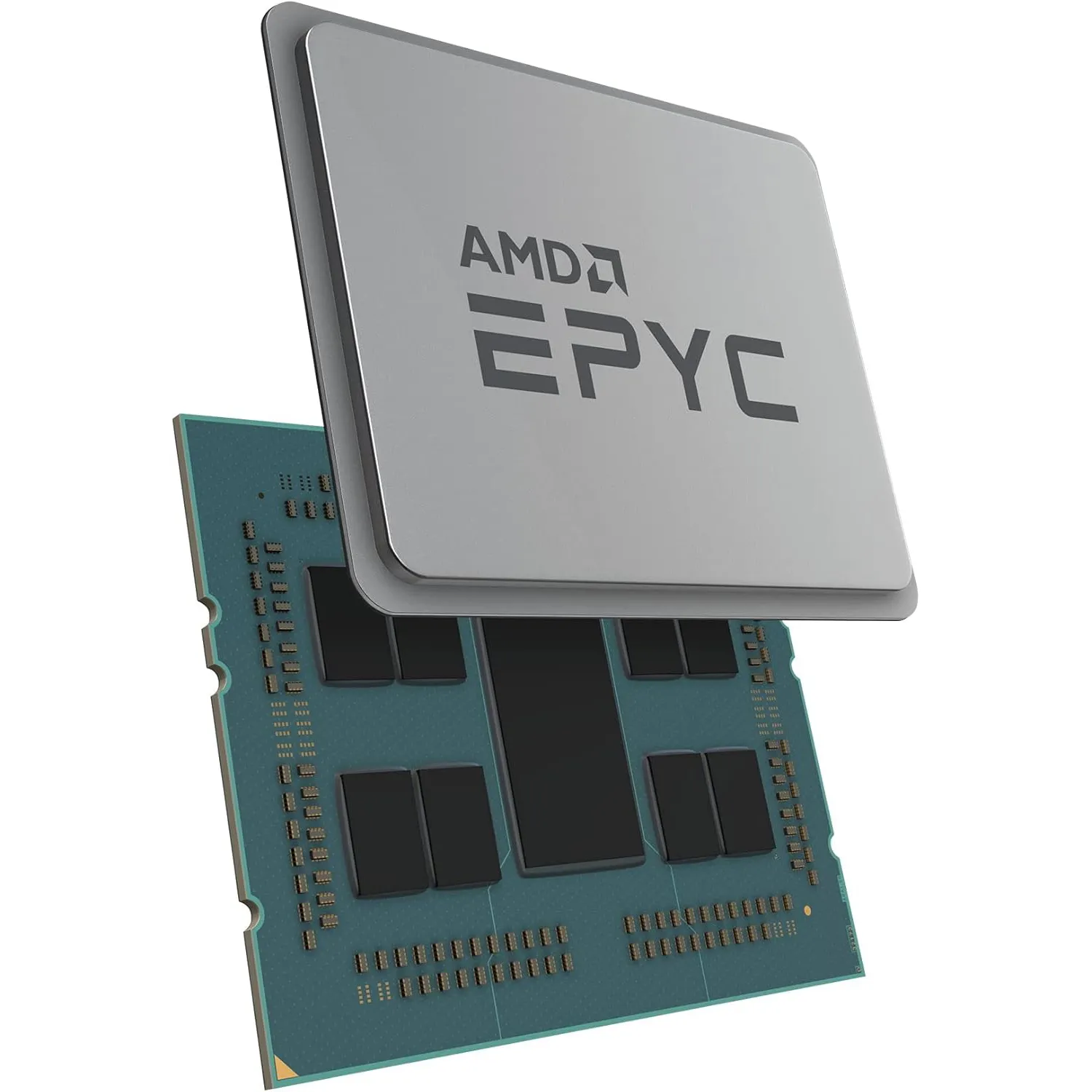
AMD EPYC 9354 4th Gen 9004 Series Server Processor – High‑Performance Enterprise CPU
Introduction to AMD EPYC 9354
The AMD EPYC 9354 is part of the powerful 4th Generation AMD EPYC™ 9004 Series of server processors, built to meet the performance, efficiency, and scalability needs of modern data centers, enterprise servers, and mission‑critical workloads. With a foundation in AMD’s advanced Zen 4 microarchitecture, the EPYC 9354 combines high core density with cutting‑edge connectivity and memory support, delivering an ideal balance of performance, throughput, and power efficiency for demanding server applications.
In an era where data centers need to support AI, virtualization, analytics, database platforms, and cloud computing, the EPYC 9354 stands out as a robust solution. It helps organizations achieve excellent time‑to‑results, improved workload handling, and future‑ready infrastructure performance.
Architecture and Performance
Zen 4 Microarchitecture
At the heart of the AMD EPYC 9354 is the Zen 4 architecture, an evolution in AMD’s CPU design that brings significant improvements in instructions per cycle (IPC), power efficiency, and raw performance compared to previous generations. Zen 4 cores are manufactured on a 5 nm node, delivering high transistor density and elevated performance metrics that support both general‑purpose and compute‑intensive tasks.
Zen 4 also introduces enhanced support for advanced instruction sets such as AVX, AVX2, and AVX‑512, which boost performance in scientific computing, data analysis, and AI‑related workloads. AMD’s implementation of Simultaneous Multithreading (SMT) further improves utilization of each core, enabling 64‑way simultaneous thread execution from 32 physical cores.
Core and Thread Configuration
With 32 physical cores and 64 threads, the EPYC 9354 is engineered for parallel processing efficiency. This configuration enables the CPU to manage a high volume of concurrent processes with responsiveness and stability, making it suitable for virtualized environments, containerized workloads, large‑scale databases, and multi‑tenant cloud services.
Clock Speeds and Turbo Boost
The EPYC 9354 operates with a base clock of 3.25 GHz and can dynamically boost up to 3.8 GHz under appropriate thermal and power conditions. This blend of high base frequency and aggressive boost behavior ensures strong performance in both single‑threaded and multi‑threaded tasks, yielding fast response times across workload types.
Memory and Bandwidth
12‑Channel DDR5 Support
A key advantage of the EPYC 9354 is its support for 12‑channel DDR5 memory, enabling exceptionally high memory bandwidth that is crucial for data‑intensive tasks. DDR5 technology significantly increases transfer rates over DDR4, improving data throughput and reducing memory bottlenecks.
The platform supports memory speeds up to 4800 MT/s, which provides ample bandwidth for analytics, large databases, in‑memory computing, and other scenarios where rapid data access is critical. This large memory channel count along with high‑speed DRAM support empowers modern servers to handle heavy workloads more efficiently.
ECC Memory Support
Error‑Correcting Code (ECC) memory support is a standard feature for EPYC processors, including the 9354. ECC memory mitigates data corruption by detecting and correcting memory errors, which is particularly important in enterprise and scientific environments where reliability and uptime are paramount.
Connectivity and Expandability
PCIe 5.0 Support
The EPYC 9354 delivers robust I/O performance with PCI Express 5.0 support across up to 128 PCIe lanes. PCIe 5.0 provides double the bandwidth of PCIe 4.0, allowing faster data transfer to high‑speed storage, GPUs, FPGA accelerators, and networking cards. This high lane count enables flexible expansion options for complex server configurations.
Such extensive PCIe connectivity is essential for demanding server deployments, especially those integrating AI accelerators, high‑speed NVMe storage arrays, and advanced networking technologies.
Thermal and Power Efficiency
TDP and cTDP Range
The EPYC 9354 is rated with a default TDP of 280 W, offering a balanced mix of performance and power consumption. AMD also provides a configurable TDP (cTDP) range of 240–300 W, giving system designers flexibility to optimize for different thermal and power scenarios within server racks.
This configurability allows data center operators to tune the processor’s power envelope for specific deployment needs, such as dense server clusters or environments with strict energy constraints.
Security and Enterprise Features
Security is a foundational aspect of EPYC processors. With AMD Infinity Guard technologies, the EPYC 9354 helps protect critical infrastructure and data through advanced security capabilities. Infinity Guard includes features like secure encrypted virtualization, memory encryption, and secure boot, which safeguard systems against an expanding landscape of threats.
Integrated security features are essential for cloud providers, financial institutions, and enterprises handling sensitive data. Built‑in security reduces reliance on additional hardware solutions while lowering overall complexity and risk.
Workload Versatility
The AMD EPYC 9354 is engineered for versatility. Its workload affinity ranges from traditional enterprise applications such as ERM, SCM, and RDBMS databases, to virtualization infrastructure, media streaming, analytics, and engineering workloads like CFD (Computational Fluid Dynamics) and FEA (Finite Element Analysis).
Whether powering high‑density virtual machines, serving mission‑critical applications, enabling large‑scale database operations, or supporting containerized application clusters, the EPYC 9354 delivers performance where it matters most.
Use Cases in Modern Data Centers
Virtualization and Cloud
With 64 threads and ample memory bandwidth, the EPYC 9354 excels in virtualized infrastructures and cloud service environments. It enables high instance density while maintaining performance for each virtual workload.
High‑Performance Compute (HPC)
The combination of high core count, fast memory, and support for advanced instruction sets makes the EPYC 9354 suitable for HPC tasks, such as scientific simulations and complex data processing.
Database and Analytics
Large memory capacity, ECC support, and high I/O throughput make the EPYC 9354 an excellent choice for relational and NoSQL databases, as well as analytics platforms that require rapid data access and processing.
Specifications Table
| Specification | Details |
|---|---|
| Product Name | AMD EPYC 9354 |
| Series | EPYC 9004 Series |
| Architecture | Zen 4 |
| Cores / Threads | 32 / 64 |
| Base Clock | 3.25 GHz |
| Max Boost Clock | 3.8 GHz |
| All Core Boost | 3.75 GHz |
| L3 Cache | 256 MB |
| TDP | 280 W (default) |
| cTDP Range | 240–300 W |
| Socket | SP5 |
| PCI Express | PCIe 5.0 x128 |
| Memory Support | 12‑channel DDR5 up to 4800 MT/s |
| ECC Memory | Yes |
| Launch Date | November 10, 2022 |
| MSRP (1k unit) | $3420 USD |
| Supported Workloads | Cloud, virtualization, databases, HPC, analytics |
4th Gen 9004 Series Model Specifications
Name | # of CPU Cores | # of Threads | Max. Boost Clock | Base Clock | L3 Cache | Default TDP |
|---|---|---|---|---|---|---|
| AMD EPYC™ 9754S | 128 | 128 | Up to 3.1 GHz | 2.25 GHz | 256 MB | 360W |
| AMD EPYC™ 9754 | 128 | 256 | Up to 3.1 GHz | 2.25 GHz | 256 MB | 360W |
| AMD EPYC™ 9734 | 112 | 224 | Up to 3 GHz | 2.2 GHz | 256 MB | 340W |
| AMD EPYC™ 9684X | 96 | 192 | Up to 3.7 GHz | 2.55 GHz | 1152 MB | 400W |
| AMD EPYC™ 9654P | 96 | 192 | Up to 3.7 GHz | 2.4 GHz | 384 MB | 360W |
| AMD EPYC™ 9654 | 96 | 192 | Up to 3.7 GHz | 2.4 GHz | 384 MB | 360W |
| AMD EPYC™ 9634 | 84 | 168 | Up to 3.7 GHz | 2.25 GHz | 384 MB | 290W |
| AMD EPYC™ 9554P | 64 | 128 | Up to 3.75 GHz | 3.1 GHz | 256 MB | 360W |
| AMD EPYC™ 9554 | 64 | 128 | Up to 3.75 GHz | 3.1 GHz | 256 MB | 360W |
| AMD EPYC™ 9534 | 64 | 128 | Up to 3.7 GHz | 2.45 GHz | 256 MB | 280W |
| AMD EPYC™ 9474F | 48 | 96 | Up to 4.1 GHz | 3.6 GHz | 256 MB | 360W |
| AMD EPYC™ 9454P | 48 | 96 | Up to 3.8 GHz | 2.75 GHz | 256 MB | 290W |
| AMD EPYC™ 9454 | 48 | 96 | Up to 3.8 GHz | 2.75 GHz | 256 MB | 290W |
| AMD EPYC™ 9384X | 32 | 64 | Up to 3.9 GHz | 3.1 GHz | 768 MB | 320W |
| AMD EPYC™ 9374F | 32 | 64 | Up to 4.3 GHz | 3.85 GHz | 256 MB | 320W |
| AMD EPYC™ 9354P | 32 | 64 | Up to 3.8 GHz | 3.25 GHz | 256 MB | 280W |
| AMD EPYC™ 9354 | 32 | 64 | Up to 3.8 GHz | 3.25 GHz | 256 MB | 280W |
| AMD EPYC™ 9334 | 32 | 64 | Up to 3.9 GHz | 2.7 GHz | 128 MB | 210W |
| AMD EPYC™ 9274F | 24 | 48 | Up to 4.3 GHz | 4.05 GHz | 256 MB | 320W |
| AMD EPYC™ 9254 | 24 | 48 | Up to 4.15 GHz | 2.9 GHz | 128 MB | 200W |
| AMD EPYC™ 9224 | 24 | 48 | Up to 3.7 GHz | 2.5 GHz | 64 MB | 200W |
| AMD EPYC™ 9184X | 16 | 32 | Up to 4.2 GHz | 3.55 GHz | 768 MB | 320W |
| AMD EPYC™ 9174F | 16 | 32 | Up to 4.4 GHz | 4.1 GHz | 256 MB | 320W |
| AMD EPYC™ 9124 | 16 | 32 | Up to 3.7 GHz | 3 GHz | 64 MB | 200W |