
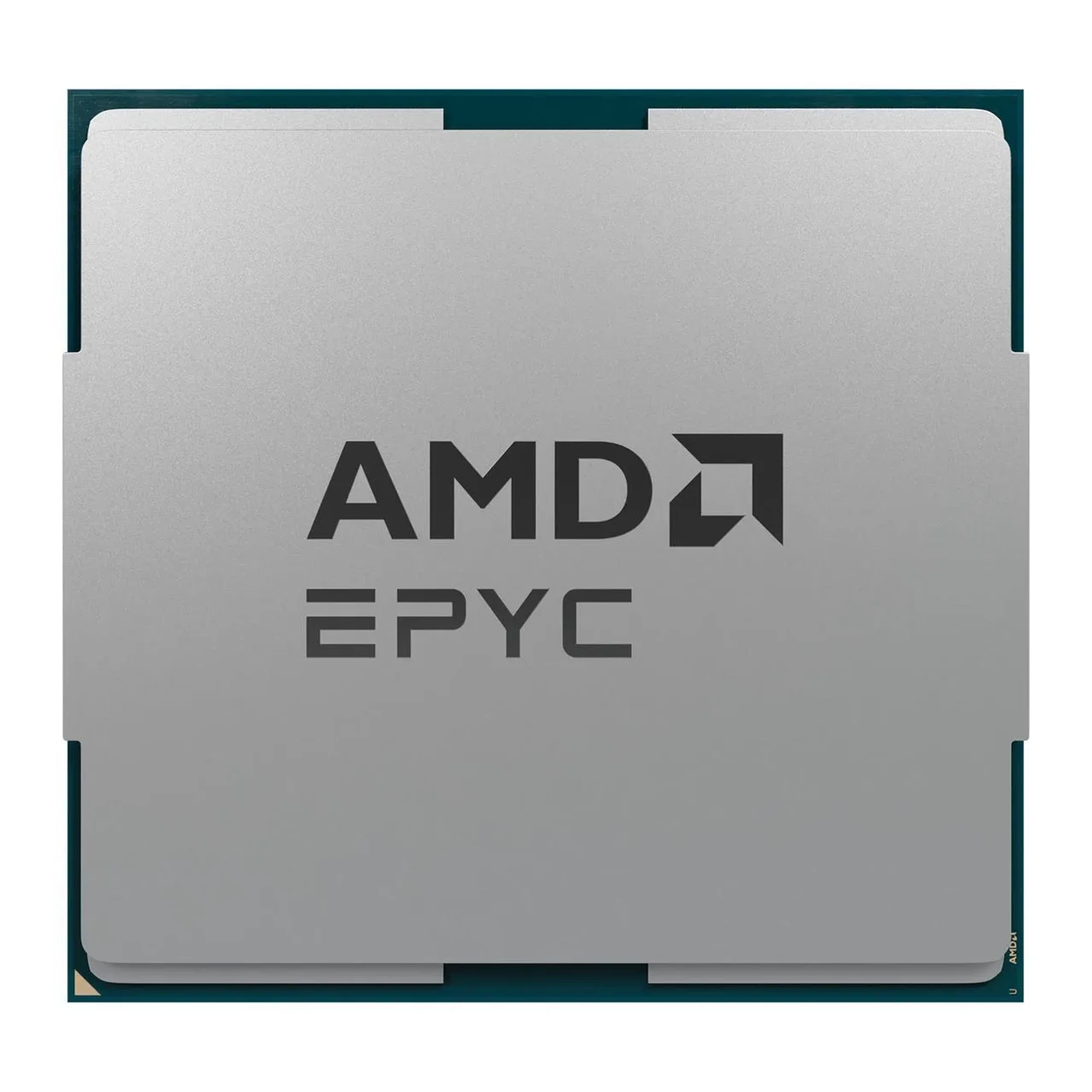
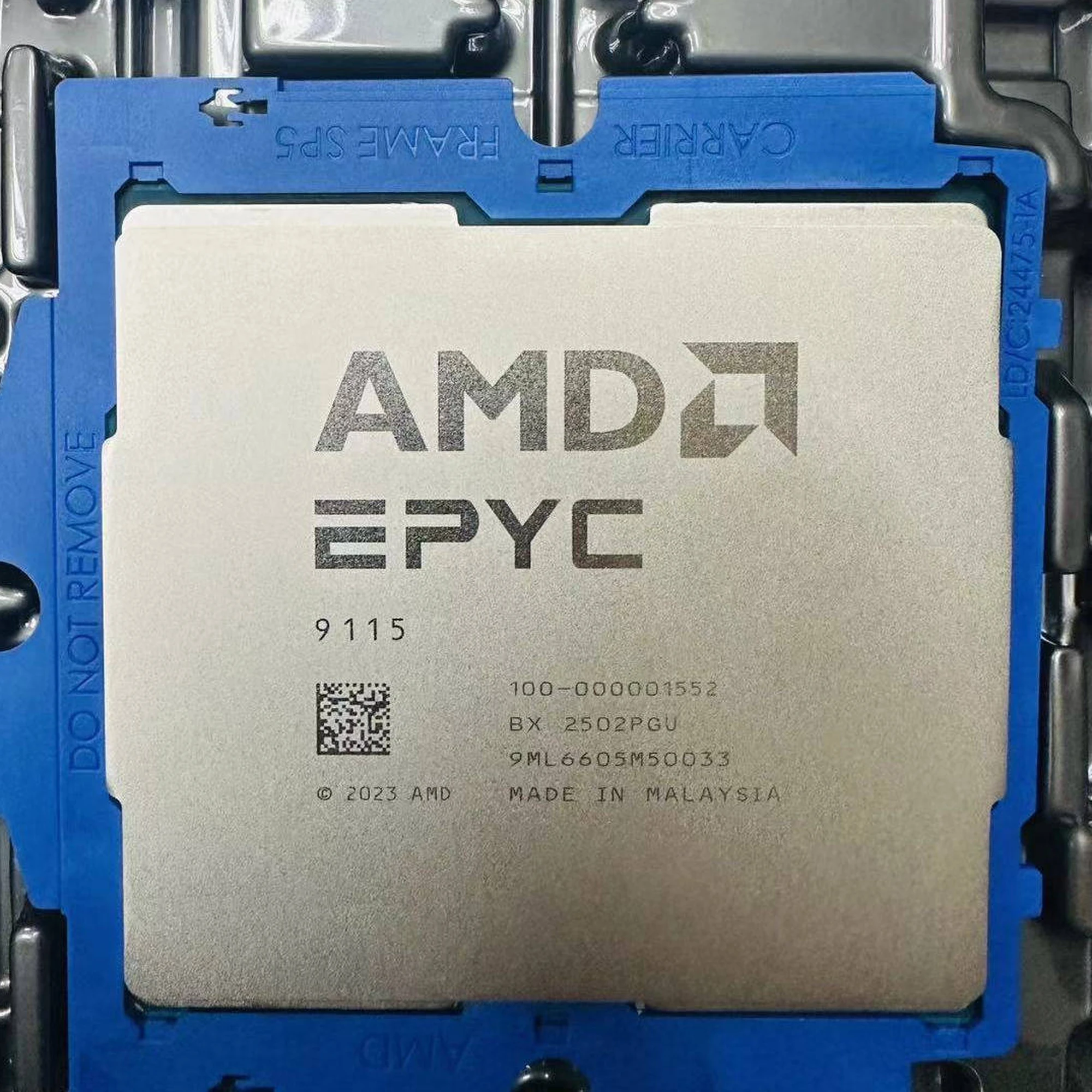
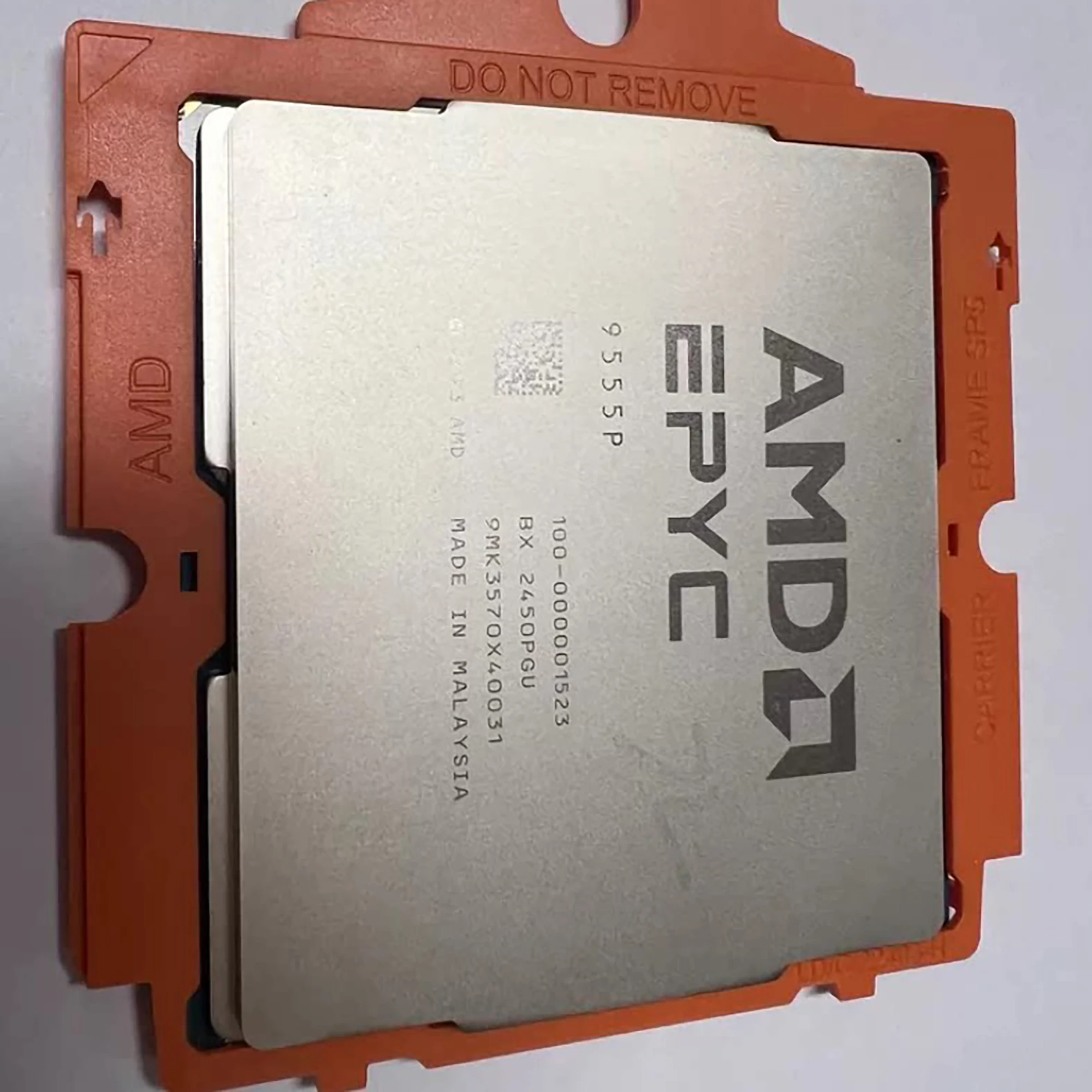
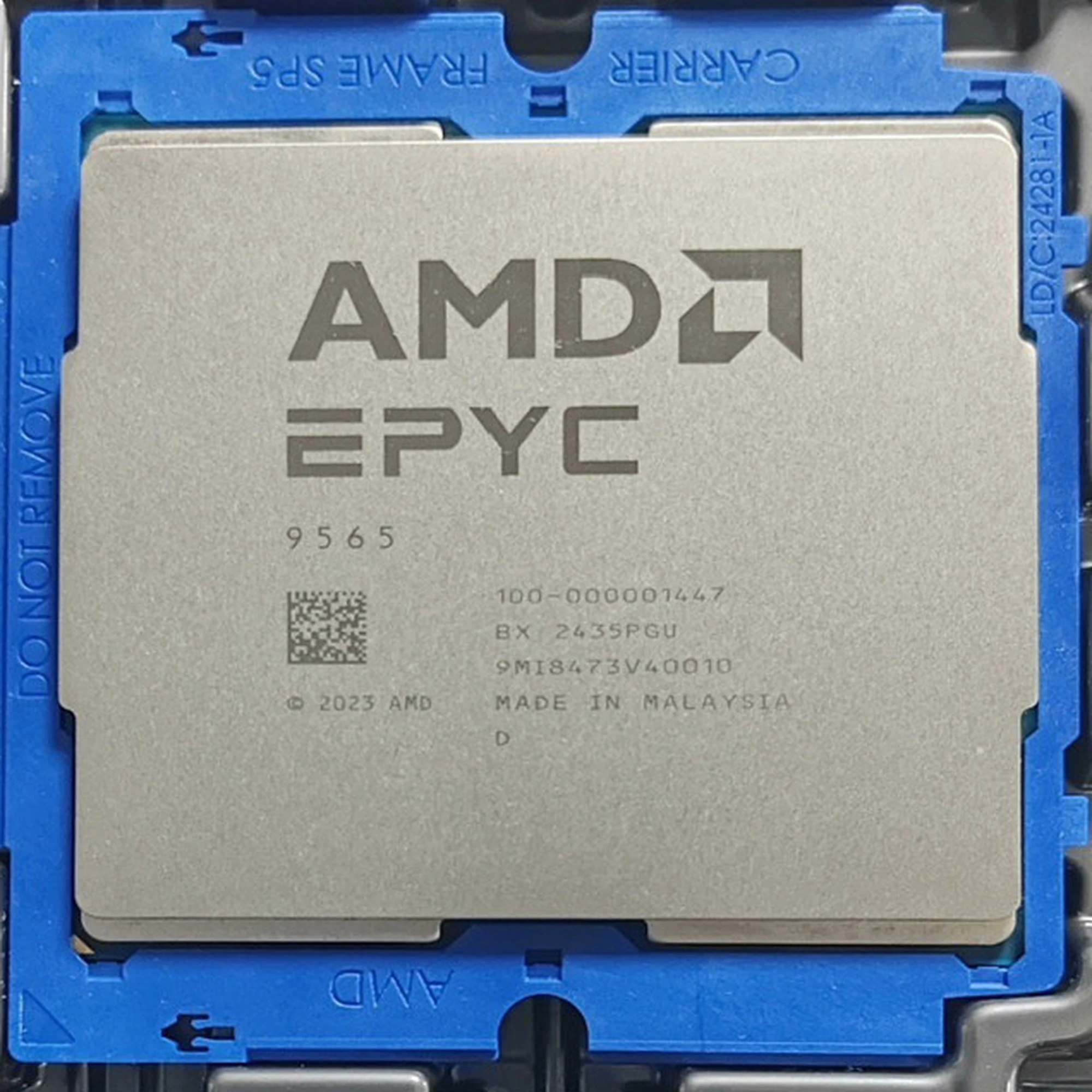
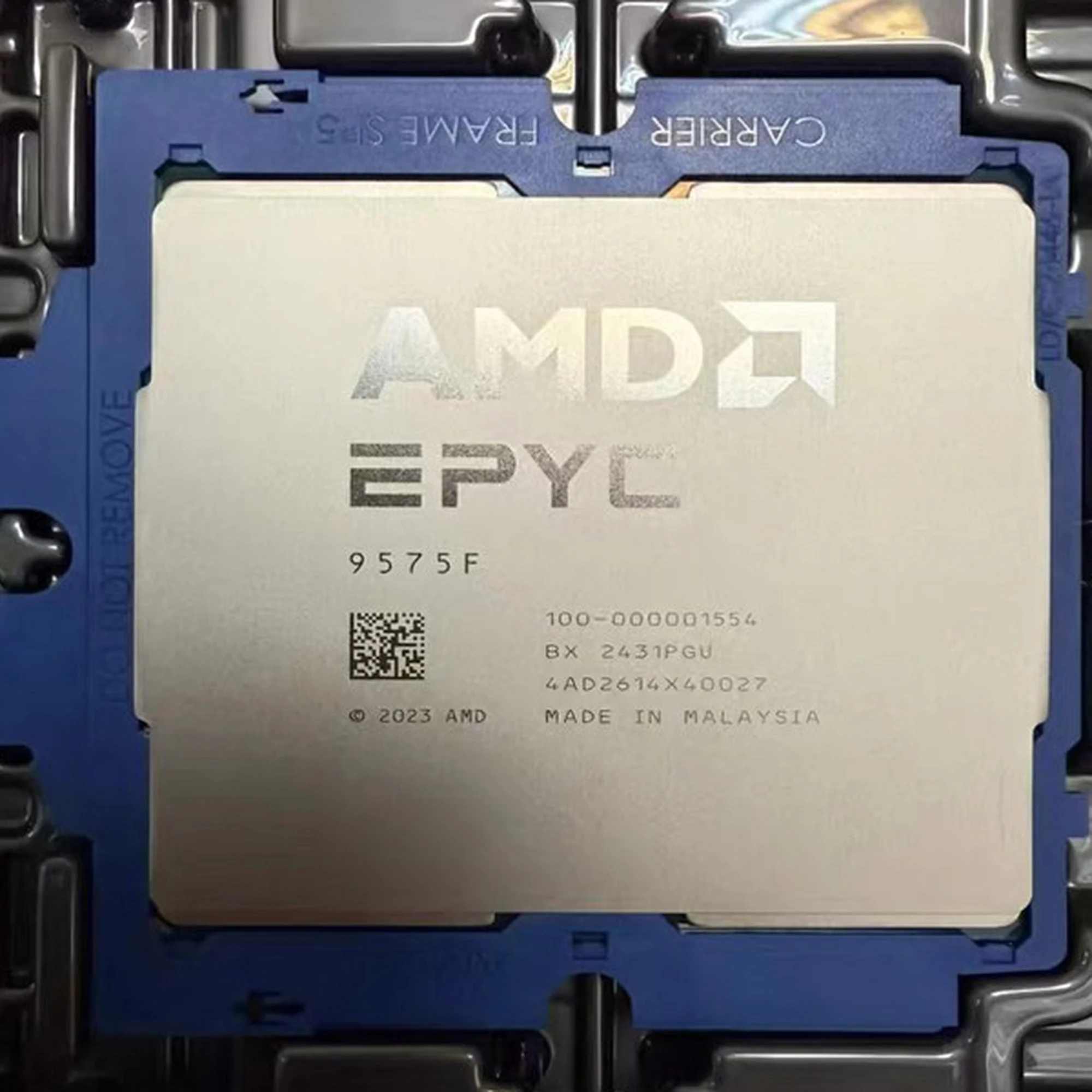
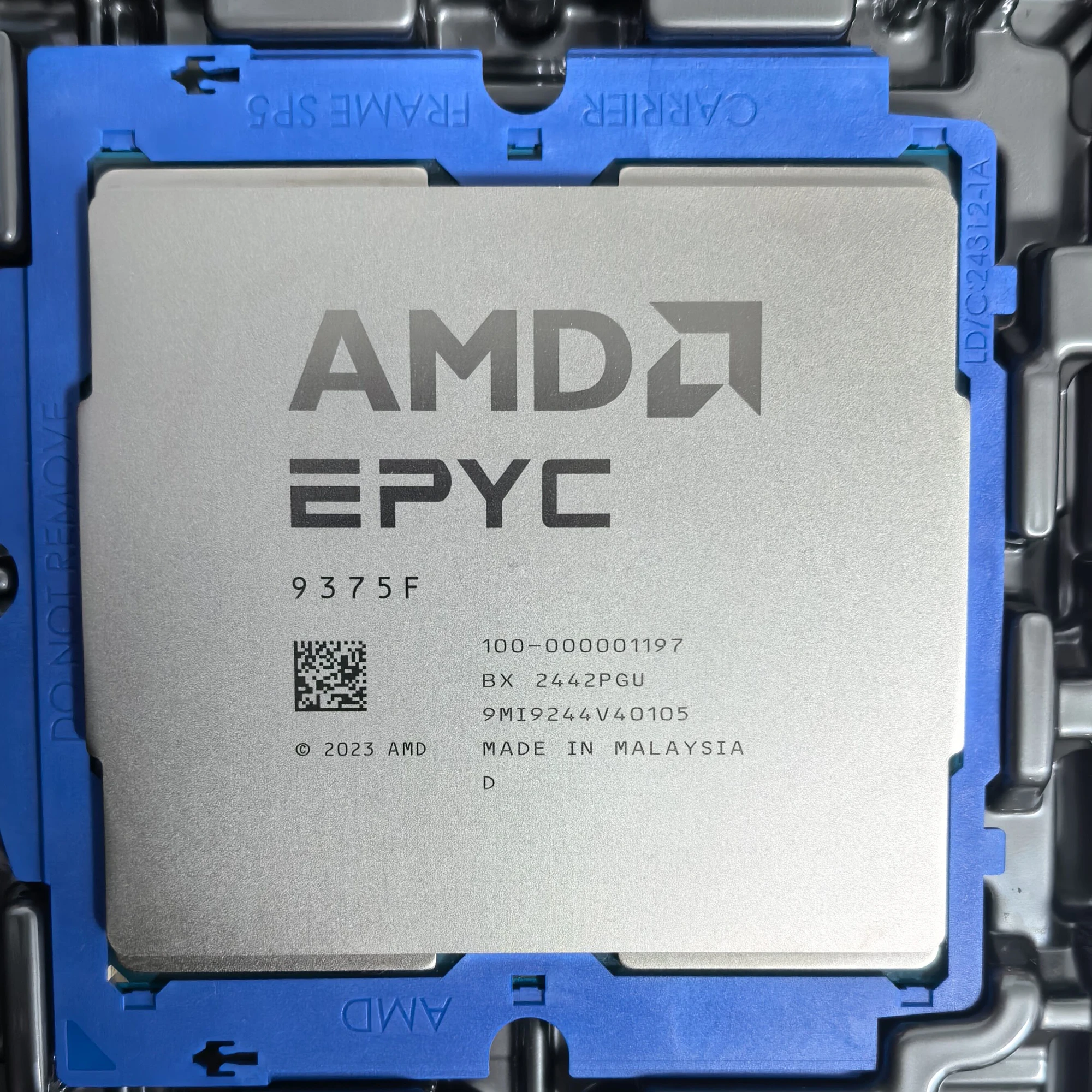
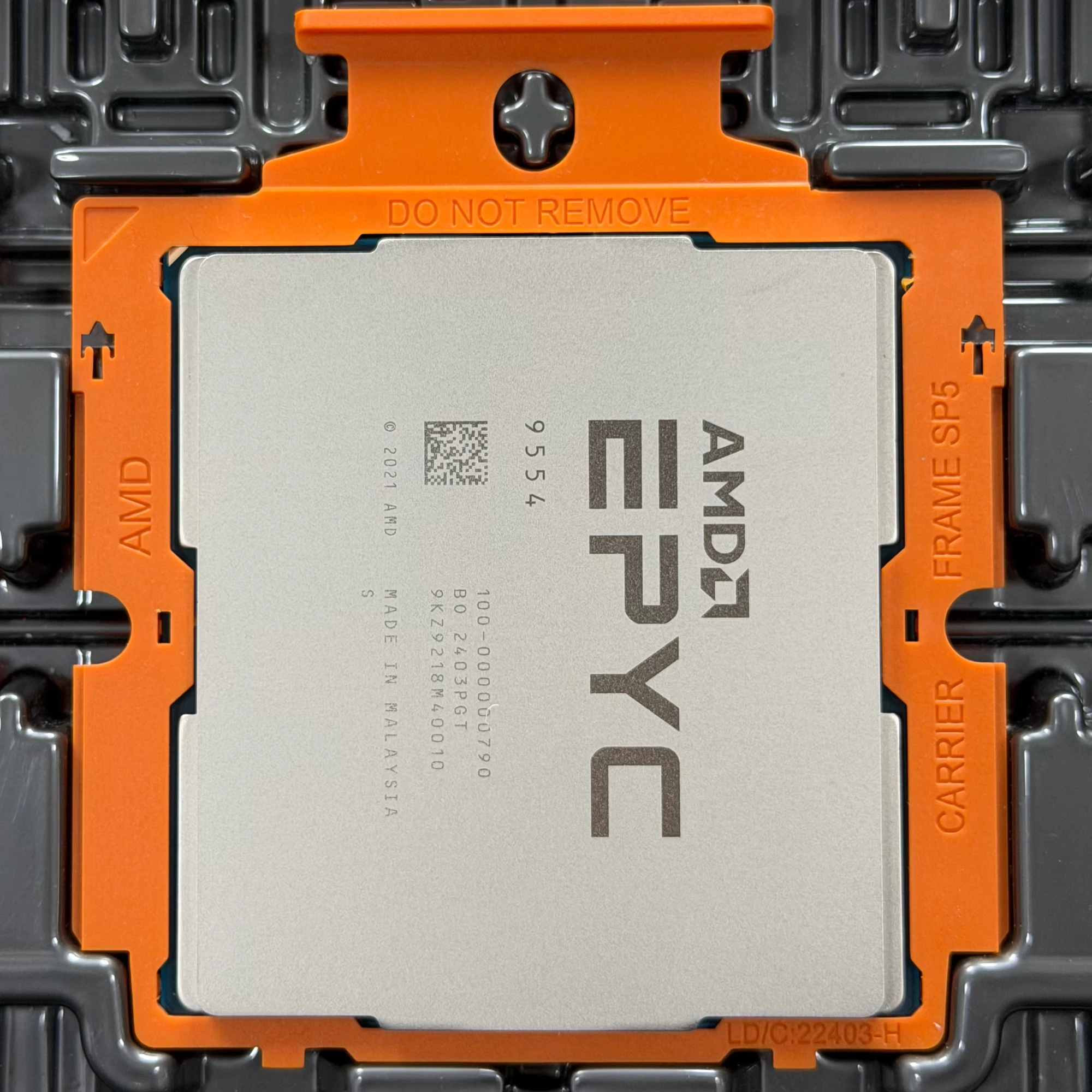
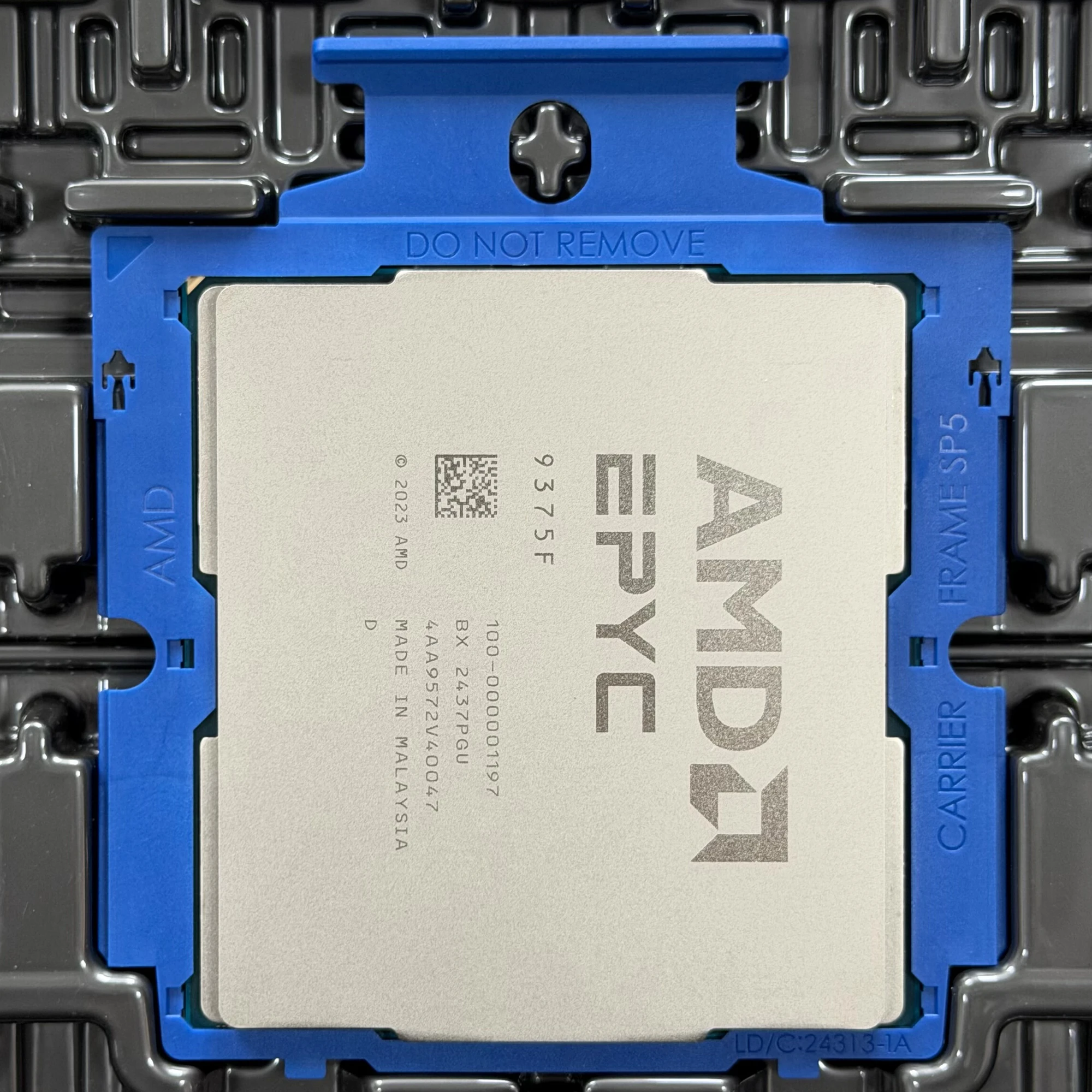
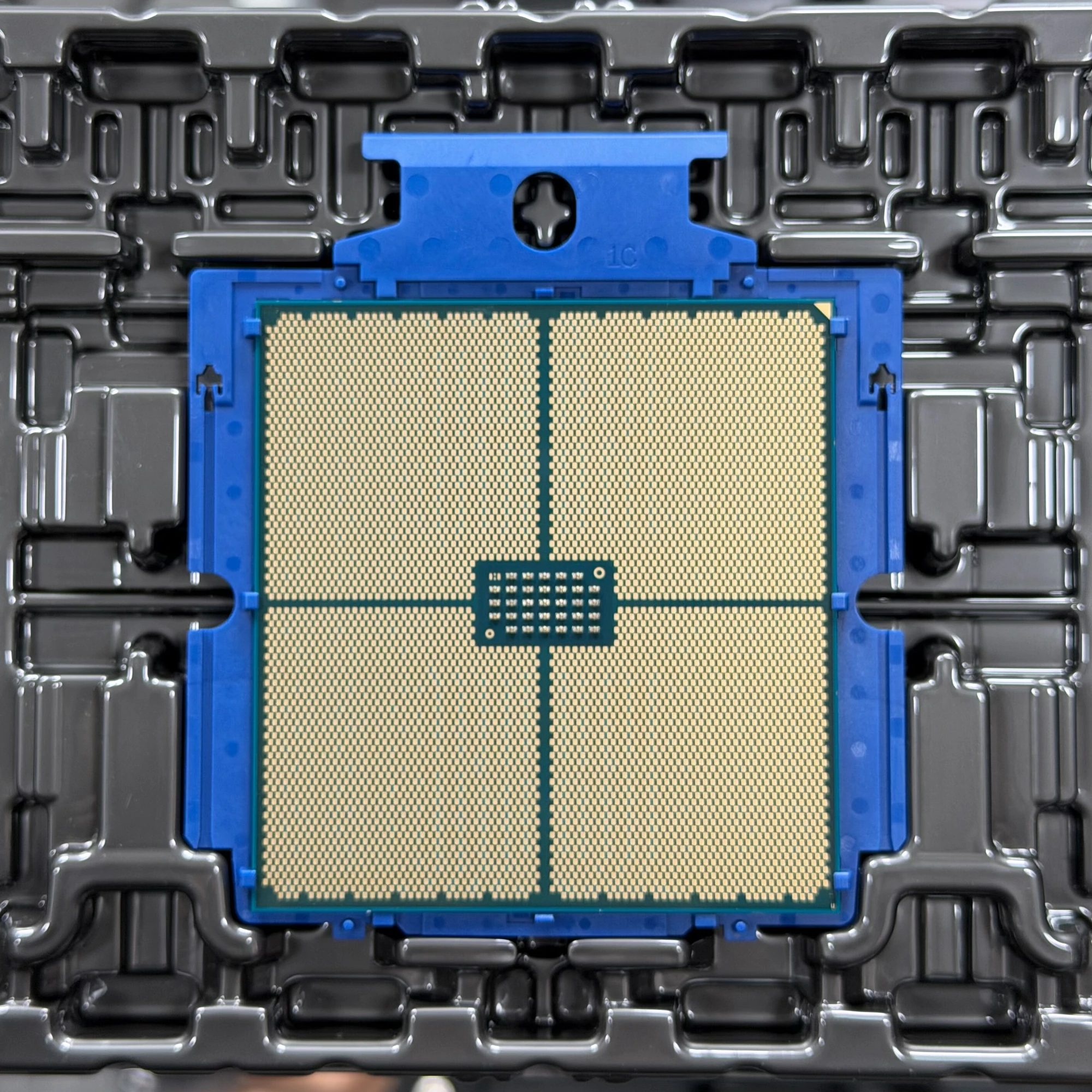
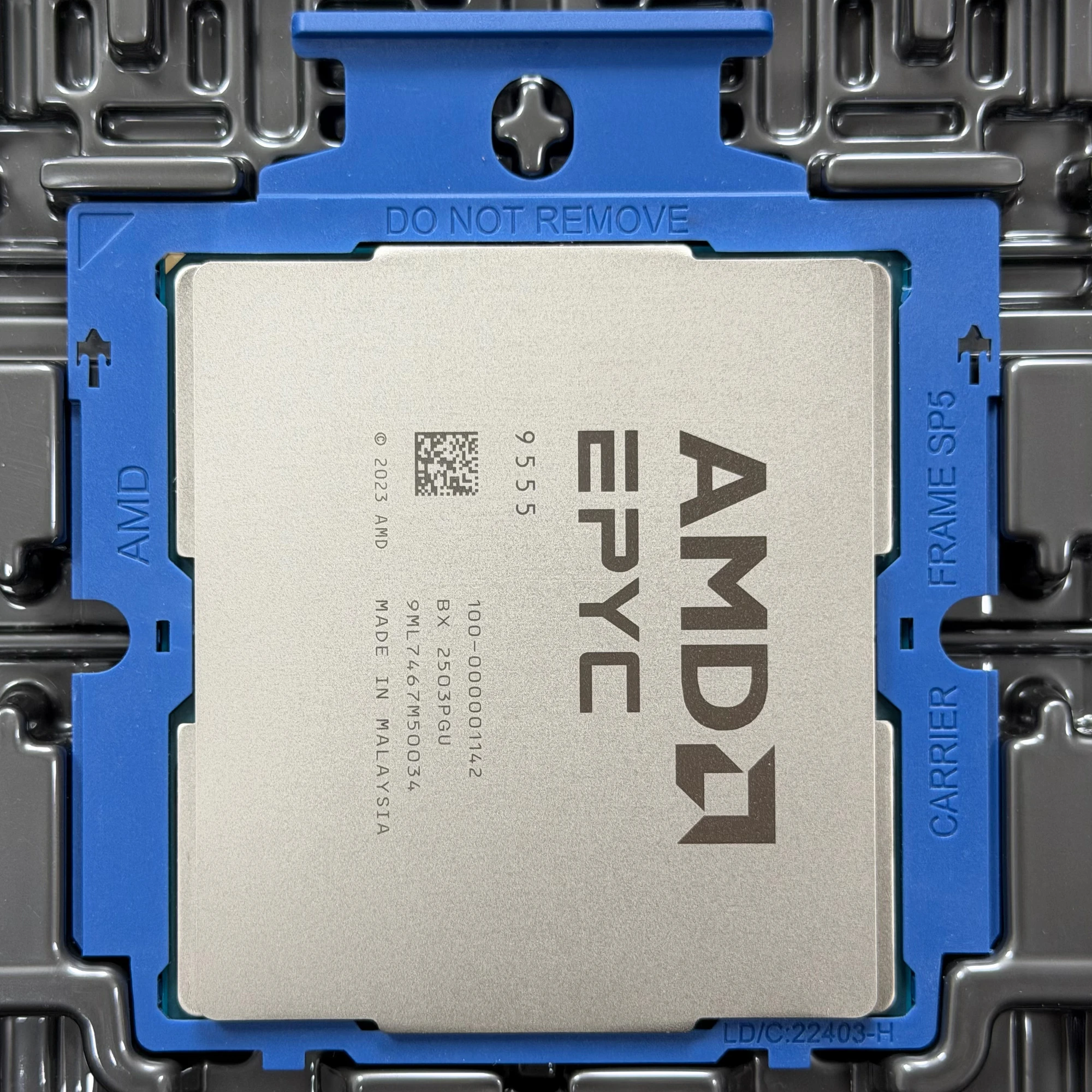
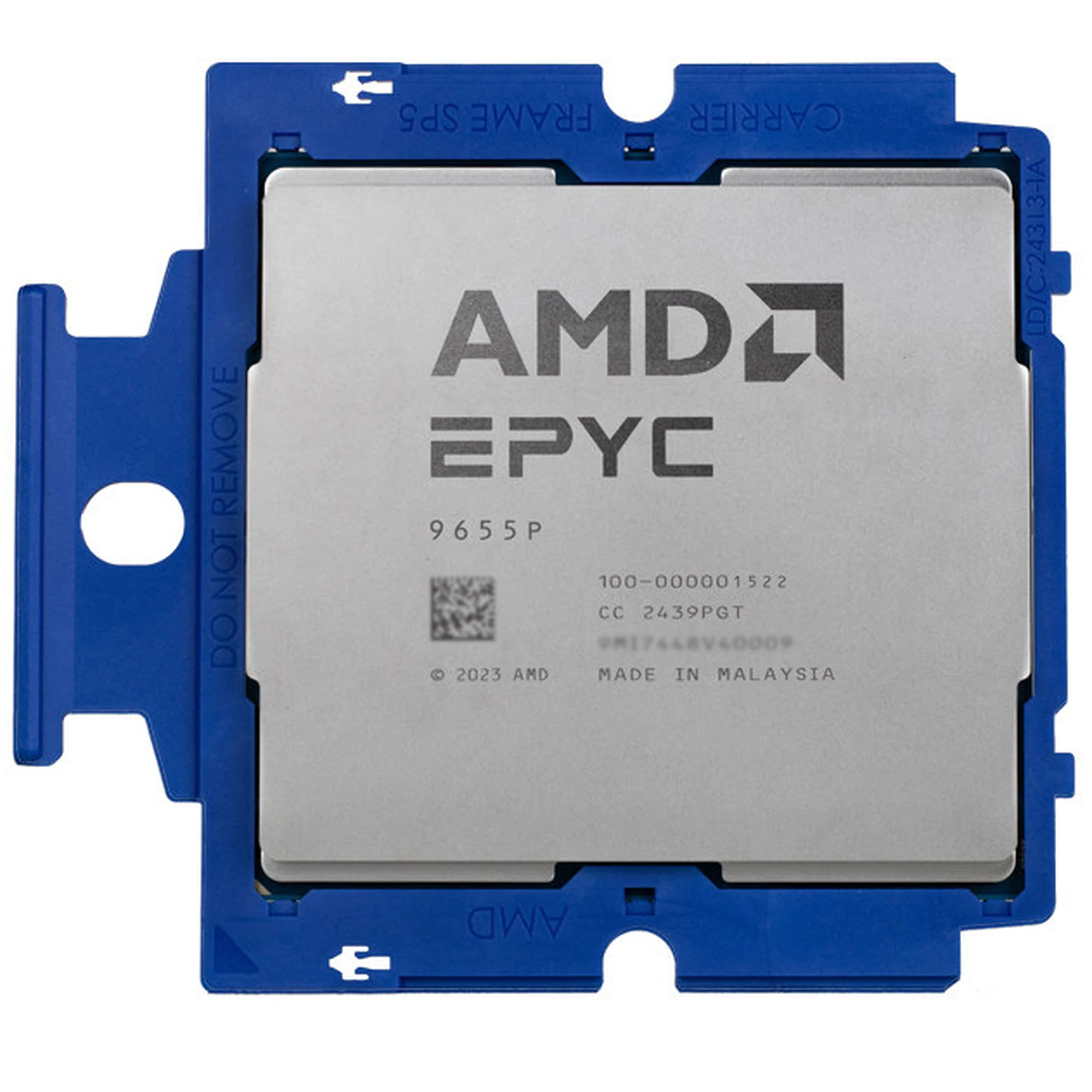
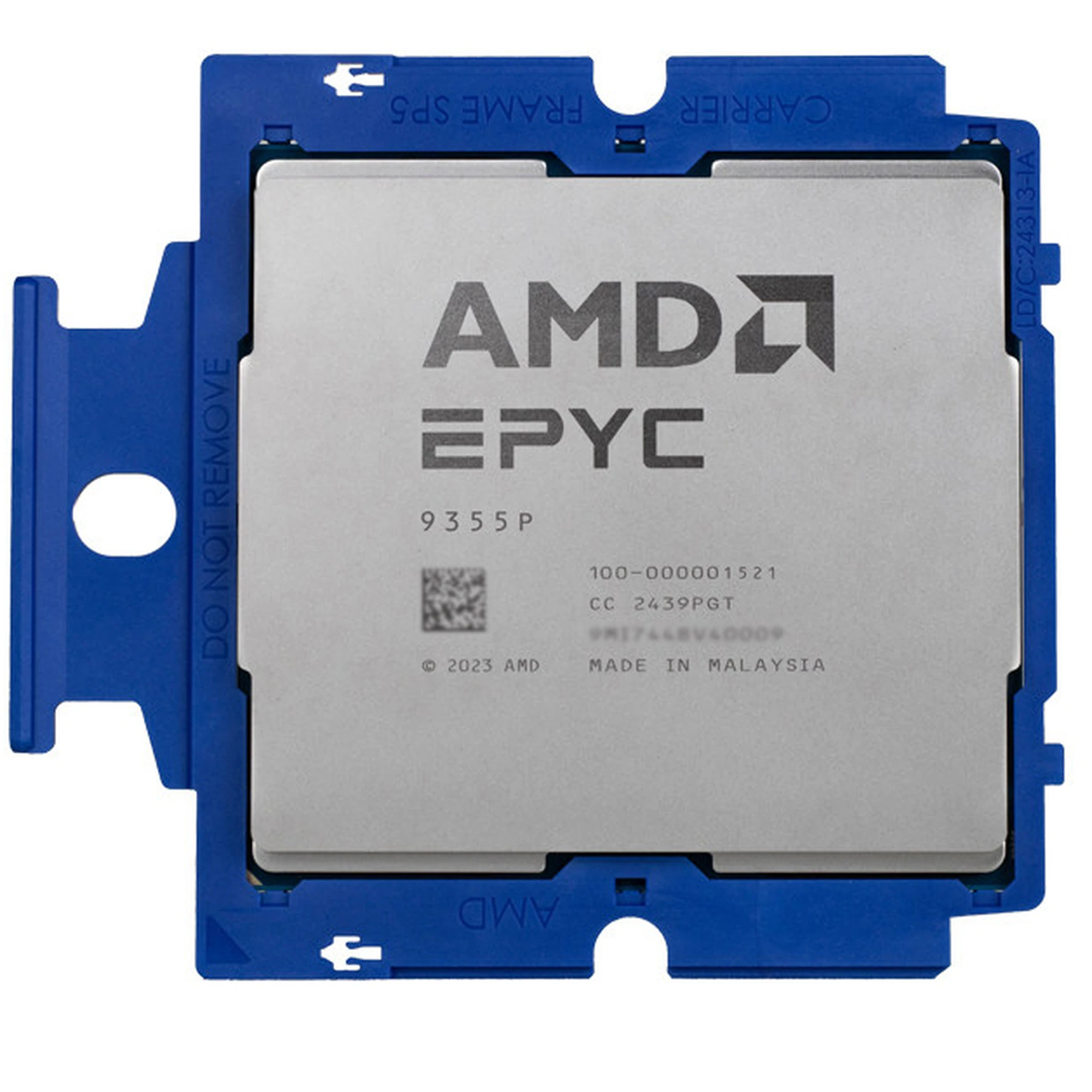
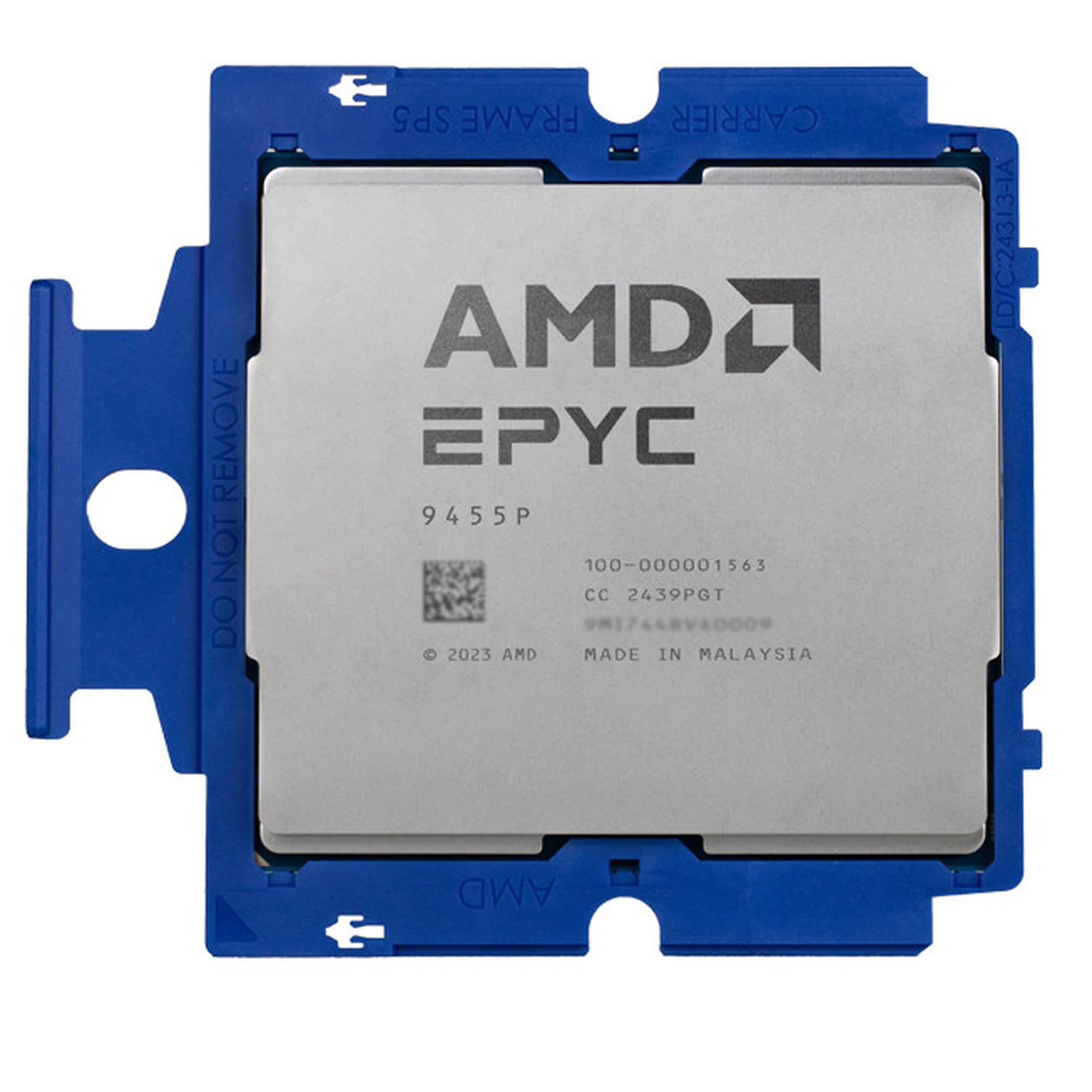
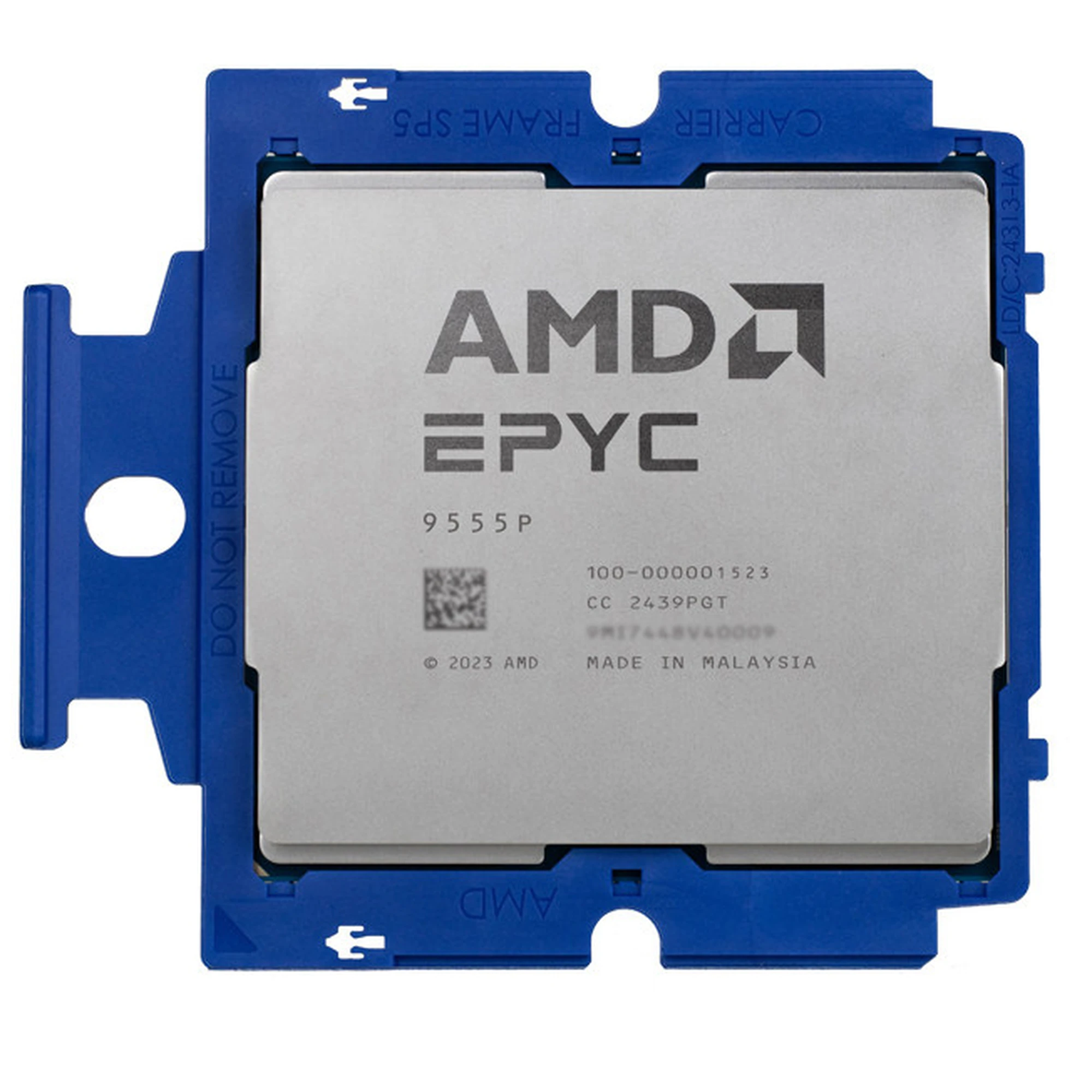

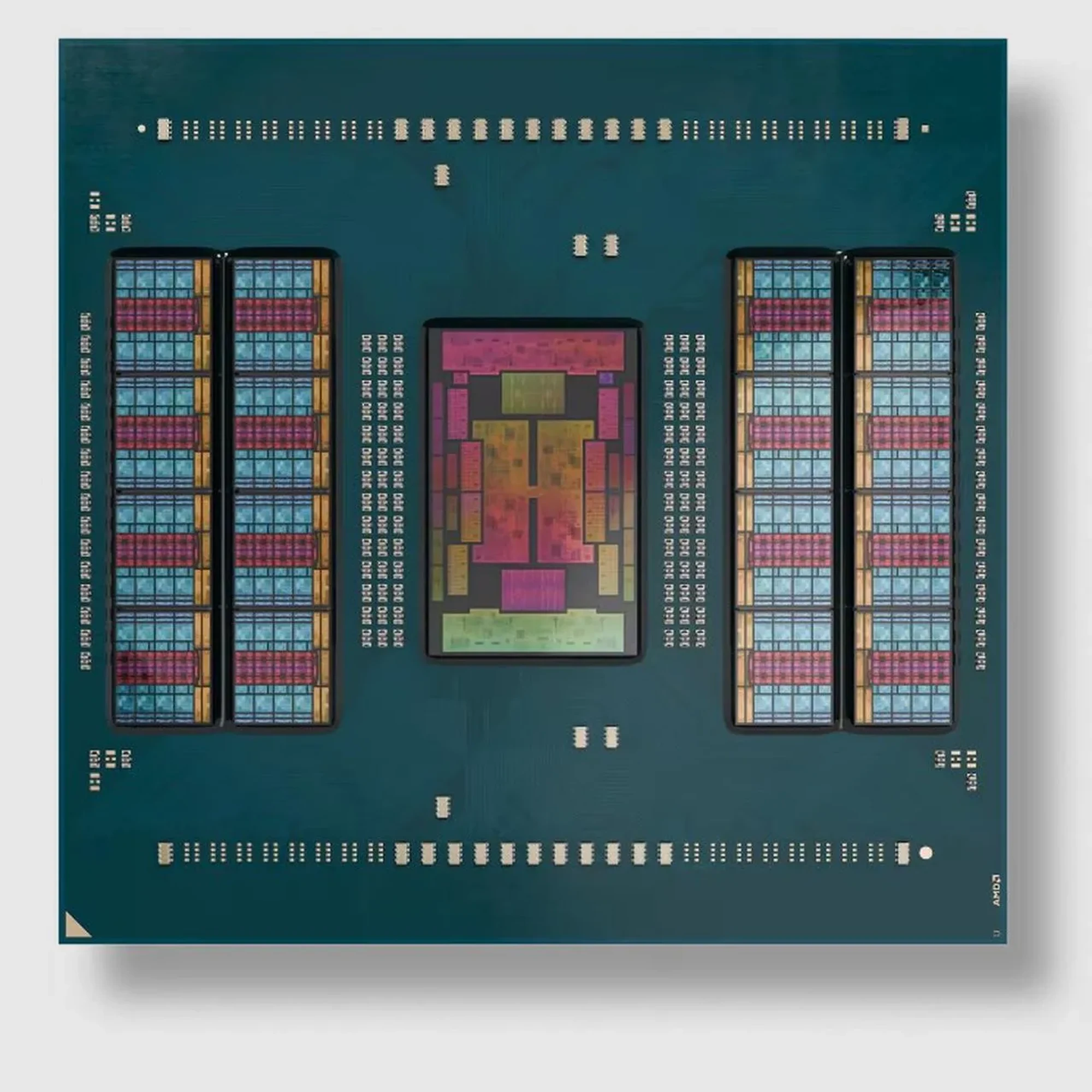
AMD EPYC™ 9555P 64-Core Server Processor | 4.4GHz Boost, 256MB Cache
| Specification | Details |
|---|---|
| Processor Model | AMD EPYC™ 9555P |
| Product Family | EPYC 9005 Series (Turin) |
| Architecture | Zen 5c |
| Manufacturing Process | TSMC 4nm |
| Cores / Threads | 64 Cores / 128 Threads |
| Base Clock | 3.2 GHz |
| Max Boost Clock | Up to 4.4 GHz |
| All Core Boost | 4.2 GHz |
| L2 Cache | 64MB (1MB per core) |
| L3 Cache | 256MB |
| Socket | SP5 |
| Platform Support | Single Socket (1P) |
| Default TDP | 360W |
| Configurable TDP | 320-400W |
| PCI Express Version | PCIe 5.0 x128 |
| Memory Type | DDR5 |
| Memory Channels | 12 |
| Memory Speed | Up to 6400 MT/s |
| Memory Bandwidth | 614 GB/s |
| Max Memory Capacity | 6TB |
| ECC Memory Support | Yes |
| Release Date | October 10, 2024 |
| Part Number | 100-000001523 |
| Key Features | AMD Infinity Guard, 4th Gen Infinity Architecture, SMT, AES-NI, AVX-512, SHA |
| Workload Optimization | Application Development, ERP/SCM/CRM, Database Management, VDI, VM Density |
AMD EPYC™ 9555P: The Ultimate 64-Core Server Processor for Modern Data Centers
In the rapidly evolving landscape of enterprise computing, data centers demand processors that deliver exceptional performance, energy efficiency, and scalability to handle increasingly complex workloads. The AMD EPYC™ 9555P server processor stands at the forefront of this technological revolution, representing the pinnacle of AMD’s Zen 5c architecture designed specifically for high-density, business-critical environments. Released in October 2024 as part of the EPYC 9005 series, this 64-core, 128-thread powerhouse redefines what’s possible in single-socket server computing, combining unprecedented core counts with industry-leading memory bandwidth and I/O capabilities.
Unprecedented Processing Power: 64 Cores & 128 Threads
At the heart of the AMD EPYC™ 9555P lies its most impressive feature: 64 physical cores capable of handling 128 simultaneous threads through AMD’s Simultaneous Multithreading (SMT) technology. Built on TSMC’s advanced 4nm process technology, these Zen 5c cores are optimized for maximum performance-per-watt, making them ideal for modern data centers striving to balance computing power with energy efficiency.
The processor features a 3.2GHz base clock speed, providing consistent performance across all cores during sustained workloads. When demand spikes, the intelligent boost technology dynamically accelerates individual cores up to an impressive 4.4GHz maximum frequency, while maintaining a 4.2GHz all-core boost speed for heavily parallelized tasks. This combination of high core counts and impressive clock speeds ensures the EPYC 9555P excels in both multi-threaded enterprise applications and single-threaded critical services.
With 256MB of unified L3 cache (organized as 8x32MB clusters) and an additional 64MB of L2 cache (1MB per core), the processor minimizes memory latency and maximizes data throughput for even the most demanding applications. This massive cache hierarchy ensures frequently accessed data remains close to the cores, dramatically improving performance for database operations, virtual machines, and in-memory computing workloads.
Advanced Architecture & Security Features
The AMD EPYC™ 9555P utilizes the innovative Turin architecture with Zen 5c cores, representing AMD’s fourth-generation EPYC design. This architecture introduces several key enhancements over previous generations, including improved instructions per cycle (IPC), better power management, and enhanced security features.
Security is paramount in enterprise environments, and the EPYC 9555P incorporates AMD Infinity Guard, a comprehensive suite of security features that provides robust protection throughout the processor’s lifecycle. This includes hardware-level security features such as:
- Secure Encrypted Virtualization (SEV) for encrypting individual virtual machines
- Secure Memory Encryption (SME) for full system memory encryption
- Secure Boot to prevent unauthorized firmware and software execution
- Hardware root of trust for secure system initialization
- Protection against side-channel attacks
These advanced security features enable businesses to confidently deploy sensitive workloads in multi-tenant environments, private clouds, and hybrid infrastructures without compromising data integrity or security.
Industry-Leading Memory & I/O Capabilities
The AMD EPYC™ 9555P sets new standards for memory and I/O performance in single-socket servers, featuring:
Memory Subsystem
- 12 DDR5 memory channels supporting speeds up to 6400 MT/s
- Maximum memory capacity of 6TB per socket with ECC support
- Impressive 614 GB/s of memory bandwidth
- Full support for ECC (Error-Correcting Code) memory for maximum system reliability
- Advanced memory RAS (Reliability, Availability, Serviceability) features
This exceptional memory configuration ensures the processor can handle memory-intensive workloads such as large in-memory databases, virtual desktop infrastructures (VDI), and data analytics applications without bottlenecks.
PCI Express & Connectivity
- 128 PCIe 5.0 lanes providing unprecedented I/O bandwidth
- Support for next-generation NVMe 5.0 storage, HDR InfiniBand, and 400Gbps Ethernet
- Flexible configuration options for multi-port high-speed networking and storage
- Compatibility with legacy PCIe 4.0 and 3.0 devices
- Enhanced I/O virtualization capabilities
The massive PCIe 5.0 bandwidth enables direct connection to multiple high-speed GPUs, NVMe storage arrays, and network adapters without the need for external switches, reducing system complexity and improving overall performance.
Optimized for Modern Workloads
The AMD EPYC™ 9555P is specifically engineered to excel in today’s most demanding data center workloads, with optimized performance for:
Virtualization & Cloud Computing
With 64 cores and 128 threads, the EPYC 9555P delivers exceptional virtual machine (VM) density, allowing service providers to host more VMs per server while maintaining consistent performance. Advanced virtualization features including AMD-V, Extended Page Tables (EPT), and I/O virtualization optimizations ensure efficient VM operation and live migration capabilities.
Database & Enterprise Applications
The processor’s massive cache and high memory bandwidth make it ideal for enterprise resource planning (ERP), supply chain management (SCM), customer relationship management (CRM), and database workloads. Both traditional relational databases (RDBMS) and modern NoSQL databases benefit from the processor’s ability to handle large datasets and concurrent user connections efficiently.
AI & Machine Learning
As artificial intelligence and machine learning become increasingly integral to business operations, the EPYC 9555P provides excellent performance for AI inference workloads. The processor’s high core count, large memory bandwidth, and extensive PCIe 5.0 connectivity support efficient deployment of AI models and seamless integration with dedicated AI accelerators when needed.
Application Development & Testing
Development and testing environments benefit from the processor’s ability to run multiple simultaneous build processes, test environments, and containerized applications with minimal performance degradation. Software development teams can significantly reduce build times and improve overall productivity.
Virtual Desktop Infrastructure (VDI)
The EPYC 9555P supports a high density of virtual desktops per server, making it cost-effective for deploying virtual desktop environments. Users experience responsive performance even during peak usage periods, while IT teams benefit from reduced infrastructure costs and simplified management.
Energy Efficiency & TCO Advantages
Despite its impressive performance capabilities, the AMD EPYC™ 9555P maintains excellent energy efficiency with a 360W default TDP and configurable TDP options ranging from 320W to 400W. This balance of performance and power efficiency delivers exceptional performance-per-watt, reducing data center cooling costs and overall power consumption.
The processor’s single-socket design further enhances cost savings by:
- Eliminating expensive dual-socket motherboards
- Reducing power supply requirements
- Lowering cooling demands
- Simplifying system architecture
- Reducing overall hardware costs
For businesses, this translates to a significantly lower total cost of ownership (TCO) while maintaining or improving performance compared to traditional dual-socket server solutions.
Compatibility & Platform Information
The AMD EPYC™ 9555P utilizes the SP5 socket and is designed exclusively for single-socket (1P) server platforms. This focus on single-socket optimization allows for simpler, more cost-effective server designs while still delivering performance that rivals or exceeds many dual-socket configurations.
The processor is compatible with server platforms featuring:
- SP5 socket motherboards with appropriate power delivery
- DDR5 memory modules (ECC RDIMMs, LRDIMMs)
- PCIe 5.0 storage and networking devices
- Server chassis with appropriate cooling solutions
Major server manufacturers including Dell, HPE, and Lenovo offer certified platforms supporting the EPYC 9555P, ensuring businesses can choose from a wide range of validated hardware options.
Conclusion: The Future of Single-Socket Server Computing
The AMD EPYC™ 9555P server processor represents a significant leap forward in data center computing, delivering exceptional performance, advanced security, and outstanding value for modern enterprises. With 64 cores, 128 threads, 256MB cache, 12-channel DDR5-6400 memory, and 128 PCIe 5.0 lanes, it provides the perfect balance of computing power, memory bandwidth, and I/O capabilities required by today’s most demanding workloads.
Whether you’re building private clouds, deploying virtual desktop infrastructures, running enterprise databases, or implementing AI solutions, the EPYC 9555P offers the performance, efficiency, and security needed to drive your business forward. As part of AMD’s industry-leading EPYC portfolio, it continues the tradition of redefining expectations for server processors and provides a future-proof foundation for your data center infrastructure investments.
Invest in the AMD EPYC™ 9555P today and experience the next generation of single-socket server performance that will power your enterprise’s digital transformation for years to come.
Recommended Motherboards for AMD EPYC 9005/9004 SP5 processors
| Model | CPU (Socket / TDP) | Memory | PCIe/CXL | LAN | Management | Form Factor |
|---|---|---|---|---|---|---|
| Gigabyte MZ73-LM2 | Dual SP5 / 500W | 24×DDR5 | PCIe 5.0 | 2×10GbE | IPMI | E-ATX |
| Gigabyte MZ73-LM1 | Dual SP5 / 400W | 24×DDR5 | PCIe 5.0 | 2×10GbE | IPMI | E-ATX |
| Gigabyte MZ73-LM0 | Dual SP5 / 400W | 24×DDR5 | PCIe 5.0 | 2×10GbE | IPMI | E-ATX |
| Gigabyte MZ33-AR1 | Single SP5 / 400W | 24×DDR5 | PCIe 5.0 | 1×10GbE | IPMI | E-ATX |
| Gigabyte MZ33-CP1 | Single SP5 / 500W | 12×DDR5 | PCIe 5.0 | 2×1GbE | IPMI | E-ATX |
| ASRock Rack TURIND8-2L2T | Single SP5 / 400W | 8×DDR5 | PCIe 5.0 + CXL 2.0 | 2×10GbE + 2×1GbE | IPMI | CEB |
| ASRock Rack TURIN2D16-2T | Dual SP5 / 400W | 16×DDR5 (8+8) | PCIe 5.0 + CXL 2.0 | 2×10GbE | IPMI | EEB |
| ASRock Rack TURIN2D24G-2L+/500W | Dual SP5 / 500W | 24×DDR5 (12+12) | PCIe 5.0 + CXL 2.0 | 2×1GbE | IPMI | Proprietary |
| ASUS K14PA-U12 | Single SP5 / 400W | 12×DDR5 | PCIe 5.0 | 2×25GbE (SFP28) | iKVM (ASMB11) | CEB |
5th Gen AMD EPYC Server CPUs Model Specifications
| Name | # of CPU Cores | # of Threads | Max. Boost Clock | Base Clock | L3 Cache | Default TDP |
| AMD EPYC™ 9965 | 192 | 384 | Up to 3.7 GHz | 2.25 GHz | 384 MB | 500W |
| AMD EPYC™ 9845 | 160 | 320 | Up to 3.7 GHz | 2.1 GHz | 320 MB | 390W |
| AMD EPYC™ 9825 | 144 | 288 | Up to 3.7 GHz | 2.2 GHz | 384 MB | 390W |
| AMD EPYC™ 9755 | 128 | 256 | Up to 4.1 GHz | 2.7 GHz | 512 MB | 500W |
| AMD EPYC™ 9745 | 128 | 256 | Up to 3.7 GHz | 2.4 GHz | 256 MB | 400W |
| AMD EPYC™ 9655P | 96 | 192 | Up to 4.5 GHz | 2.6 GHz | 384 MB | 400W |
| AMD EPYC™ 9655 | 96 | 192 | Up to 4.5 GHz | 2.6 GHz | 384 MB | 400W |
| AMD EPYC™ 9645 | 96 | 192 | Up to 3.7 GHz | 2.3 GHz | 256 MB | 320W |
| AMD EPYC™ 9575F | 64 | 128 | Up to 5 GHz | 3.3 GHz | 256 MB | 400W |
| AMD EPYC™ 9565 | 72 | 144 | Up to 4.3 GHz | 3.15 GHz | 384 MB | 400W |
| AMD EPYC™ 9555P | 64 | 128 | Up to 4.4 GHz | 3.2 GHz | 256 MB | 360W |
| AMD EPYC™ 9555 | 64 | 128 | Up to 4.4 GHz | 3.2 GHz | 256 MB | 360W |
| AMD EPYC™ 9535 | 64 | 128 | Up to 4.3 GHz | 2.4 GHz | 256 MB | 300W |
| AMD EPYC™ 9475F | 48 | 96 | Up to 4.8 GHz | 3.65 GHz | 256 MB | 400W |
| AMD EPYC™ 9455P | 48 | 96 | Up to 4.4 GHz | 3.15 GHz | 256 MB | 300W |
| AMD EPYC™ 9455 | 48 | 96 | Up to 4.4 GHz | 3.15 GHz | 256 MB | 300W |
| AMD EPYC™ 9375F | 32 | 64 | Up to 4.8 GHz | 3.8 GHz | 256 MB | 320W |
| AMD EPYC™ 9365 | 36 | 72 | Up to 4.3 GHz | 3.4 GHz | 192 MB | 300W |
| AMD EPYC™ 9355P | 32 | 64 | Up to 4.4 GHz | 3.55 GHz | 256 MB | 280W |
| AMD EPYC™ 9355 | 32 | 64 | Up to 4.4 GHz | 3.55 GHz | 256 MB | 280W |
| AMD EPYC™ 9335 | 32 | 64 | Up to 4.4 GHz | 3 GHz | 128 MB | 210W |
| AMD EPYC™ 9275F | 24 | 48 | Up to 4.8 GHz | 4.1 GHz | 256 MB | 320W |
| AMD EPYC™ 9255 | 24 | 48 | Up to 4.3 GHz | 3.2 GHz | 128 MB | 200W |
| AMD EPYC™ 9175F | 16 | 32 | Up to 5 GHz | 4.2 GHz | 512 MB | 320W |
| AMD EPYC™ 9135 | 16 | 32 | Up to 4.3 GHz | 3.65 GHz | 64 MB | 200W |
| AMD EPYC™ 9115 | 16 | 32 | Up to 4.1 GHz | 2.6 GHz | 64 MB | 125W |
| AMD EPYC™ 9015 | 8 | 16 | Up to 4.1 GHz | 3.6 GHz | 64 MB | 125W |


